

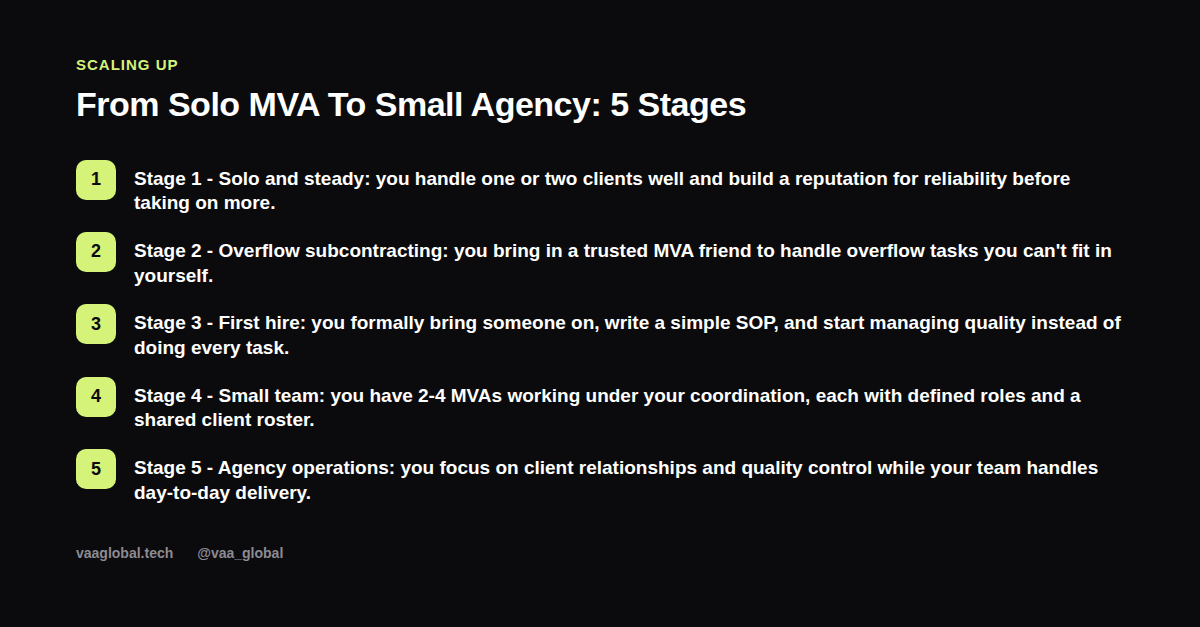
Medical virtual assistant building an agency is a natural next step once you've got more client demand than you can personally handle, and it's a path more experienced MVAs quietly take without ever calling themselves an agency owner at first. It usually starts small: a referral you can't take on, a friend who needs overflow work, and suddenly you're managing more than just your own hours.
Why MVAs End Up Building An Agency At All
Once you've built a reputation as a reliable medical virtual assistant, referrals start coming in faster than your own hours can absorb. Instead of turning down good clients, many MVAs quietly scale by bringing in trusted colleagues. Over time, that informal overflow arrangement starts looking like a small agency, even if nobody planned it that way from the start.
Signs You're Ready To Scale From Solo
You're probably ready when you're consistently turning down work, when your schedule has no slack left for new clients, and when you've already got processes that work well enough to hand off. If you're still learning the basics of the role itself, it's worth mastering your daily tasks and your own career path before thinking about managing others.
Standard Operating Procedures: The Thing That Makes Delegation Possible
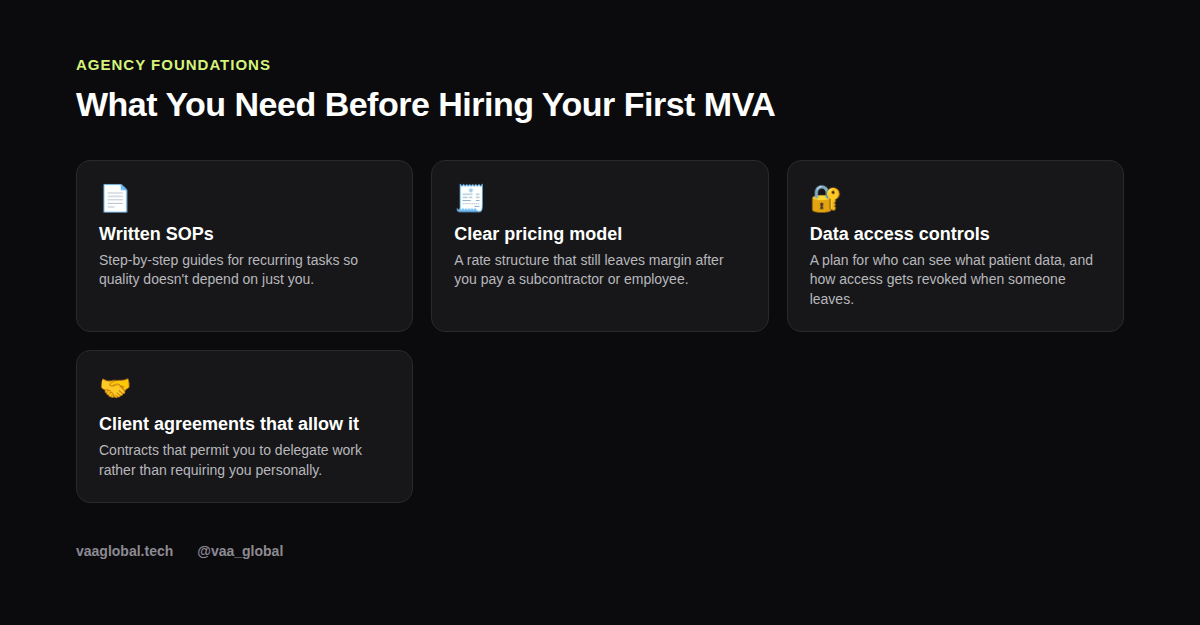
You can't hand off work you haven't documented. Standard operating procedures, even simple step-by-step checklists for recurring tasks like insurance verification or appointment scheduling, are what let someone else do the work to your standard without you checking every detail. Start documenting your own workflow now, even if you're not hiring anyone yet; you'll thank yourself later.
Hiring Subcontractors Vs. Employees
Most MVAs start by hiring subcontractors rather than employees, since it's simpler administratively and lets you scale up or down based on client demand. Be clear in writing about rates, confidentiality expectations, and who's responsible for what, the same way you would in your own contract essentials. Patient data access needs the same discipline with a subcontractor as it does with you.
Pricing So There's Still A Margin
A common mistake is pricing services the same way you did solo, then losing most of the margin to a subcontractor's pay. Build your pricing with a buffer that covers quality control, client communication, and your own time managing the relationship, not just the hourly task work itself. This is different territory than straightforward rate-setting, which our rate negotiation article covers from the individual contractor side.
Managing A Remote Team Without Losing Quality
Managing a remote team means regular check-ins, a shared way to track task status, and a feedback loop when something isn't done to standard. Weekly check-ins work well for small teams. As you grow past a handful of people, a lightweight project management tool becomes worth the cost, even if it felt unnecessary when it was just you.
Client Contracts Need To Allow Delegation
Before you bring in help, check your existing client agreements. Some contracts specify that you personally perform the work, which means delegating without updating the agreement could breach trust or the contract itself. Have this conversation with clients directly rather than assuming it's fine.
Common Pitfalls When Scaling Too Fast
The biggest risk is growing your client list faster than your systems can support. Quality slips, clients notice, and the reputation you built solo starts eroding. Grow one hire at a time, confirm quality holds steady, and only then take on the next client or the next hire.
How Do I Scale From Solo MVA To An Agency?
The honest answer is one step at a time. First, document your processes. Then, find one client willing to let a trusted colleague help under your supervision. Next, confirm that colleague follows your SOPs closely before you add a second client. Only after that cycle repeats smoothly a few times does it make sense to think bigger. So, how do I scale from solo MVA to an agency without losing quality? Slow down the hiring pace and speed up the documentation instead.
When Should I Hire My First Virtual Assistant?
When should I hire my first virtual assistant for overflow work? Usually, the right moment is when you're turning away paid opportunities regularly, not just occasionally. If it's a one-off busy week, push through it yourself. If it's a pattern lasting a month or more, that's a real signal. Also, make sure you have at least one documented process ready before that first hire starts.
How To Manage Multiple MVAs Under One Business
Wondering how to manage multiple MVAs under one business without constant firefighting? Set a weekly check-in, use one shared tracker for task status, and review quality on a sample of completed work rather than everything. As your team grows, this rhythm matters more than any specific software tool you choose.
Where This Fits In Your Broader Career
Scaling a virtual assistant business into something bigger than yourself is one of several paths available after you've built solid experience, alongside options like becoming a trainer or mentor for newer MVAs. If you're earlier in your journey, the Medical Virtual Assistant Training course is a good starting point, a 6-module, beginner-level program with no medical background required and job assistance built in. For general advice on building a team as you freelance, the U.S. Small Business Administration has useful background on hiring contractors; see their hiring guide for general principles that apply even outside the US.
The Bottom Line
Medical virtual assistant building an agency doesn't require a grand plan from day one. It usually starts with one overflow hire, a documented process, and a willingness to manage rather than just do. Scale deliberately, protect patient data at every step, and the agency model can turn a solo income into something far more sustainable.



