
Medical virtual assistant difficult patient calls are inevitable in this line of work, because sick, worried, or frustrated people sometimes take their stress out on whoever answers the phone, and that's often going to be you. Learning a few reliable de-escalation techniques won't make every call pleasant, but it will make most of them manageable, and it will protect both the patient relationship and your own composure.

Why Patients Get Upset in the First Place
Most anger on a healthcare call isn't really about you. It's about pain, fear, a long wait, a billing surprise, or feeling unheard by the system generally. Recognizing that the anger is directed at a situation, not at you personally, makes it much easier to stay calm and respond helpfully instead of defensively.
How Do You Handle an Angry Patient on the Phone?
The first and most important move is to let them finish talking without interrupting, even when it's tempting to jump in and correct something right away. Interrupting an upset person almost always escalates things further. Once they've said what they need to say, acknowledge the feeling directly before moving to a solution: "I can hear how frustrating this has been for you" lands very differently than jumping straight to "Let me look into that."
A Sample De-Escalation Script (For Training Purposes Only)
Here's a simplified, fictional example of how a call might go: Patient: "I've called three times about this billing issue and nobody has fixed it!" You: "I'm really sorry you've had to call multiple times about this, that's frustrating and it shouldn't have happened. Let me pull up your account right now and see exactly where things stand." Notice the structure: acknowledge first, apologize for the experience (not necessarily admitting fault for the underlying issue), then move immediately into a concrete action. This combination does more to calm a caller than any amount of logical explanation offered too early.
What Do You Say to Calm Down an Upset Patient?
Beyond the opening acknowledgment, a few phrases consistently help: "That makes sense, given what you've been dealing with." "I want to make sure I get this right for you, can you walk me through it one more time?" "Here's what I can do right now, and here's what I'll need to follow up on." Avoid phrases that sound dismissive even if unintentional, like "calm down," "that's not really our policy," or "there's nothing I can do," since each tends to increase frustration rather than reduce it.
When Should a Medical VA Escalate a Call?
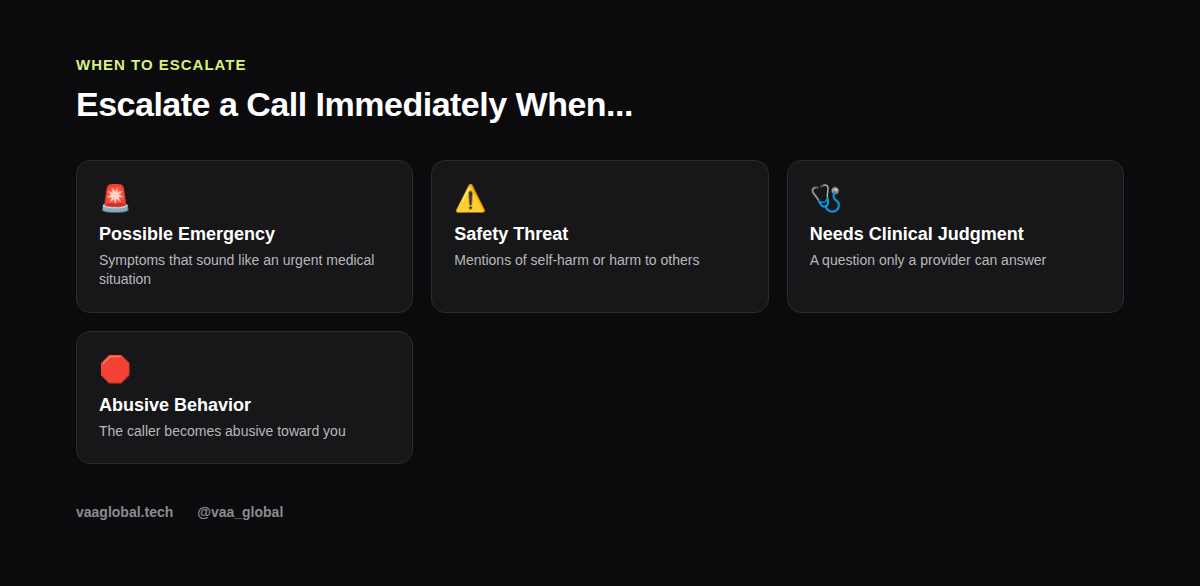
Escalate immediately if a patient describes a situation that sounds like a medical emergency, if they threaten self-harm or harm to others, if the issue requires clinical judgment you're not authorized to give, or if the call has become abusive toward you personally. It's also appropriate to escalate simply when you've genuinely tried your best and the patient is still not satisfied; that's not a failure on your part, it's recognizing the limits of your role. The Agency for Healthcare Research and Quality (AHRQ) publishes communication guidance for healthcare staff that backs up this same escalate-without-guilt approach. Most practices have a clear escalation path (a supervisor, office manager, or on-call provider), and knowing that path before you need it is far better than scrambling for it mid-call.
Protecting Your Own Composure
Difficult calls add up emotionally over a shift, even when you handle each one well. Taking a short breath before dialing back into the queue, briefly stepping away between particularly hard calls when your workflow allows it, and reminding yourself that the anger wasn't really about you all help prevent burnout. This is a real, ongoing part of the job, not a sign you're doing something wrong if a tough call affects your mood briefly afterward.
How This Connects to Other Medical VA Skills
Difficult call handling overlaps closely with broader phone etiquette on patient calls, and the same calm, acknowledging tone applies directly to delivering lab results communication or managing a frustrated response during no-show follow-up. VA Global's Medical Virtual Assistant Training course covers healthcare administration and communication skills across its six beginner-friendly modules, giving new VAs practice scenarios before they face real patients.
The Bottom Line
Medical virtual assistant difficult patient calls get easier with a consistent structure: let them talk, acknowledge the feeling, offer a concrete next step, and escalate without guilt when the situation calls for it. That structure protects the patient relationship and protects you.
Active Listening Makes Everything Else Easier
Active listening is the skill underneath all of this. It means not planning your response while the patient is still talking, reflecting back what you heard before responding ("So the issue is the billing statement showed twice, is that right?"), and watching your own tone of voice, since a flat or rushed tone can undercut even the right words. A calm tone of voice, paired with genuinely listening instead of just waiting for your turn to speak, does more to de-escalate a call than any scripted phrase on its own. When a patient feels heard, the volume of the conversation almost always drops on its own within the first minute or two.
Logging the Complaint Correctly
Every difficult call tied to a genuine patient complaint should be logged, not just resolved and forgotten. Note the date, the issue, what was said, and the resolution or escalation path taken. This protects the practice if the same patient calls again, helps a supervisor see patterns across multiple complaints, and gives you a clear record if the escalation path needs to be followed up on later by someone else on the team.



