If you've started reading job postings for GRC analyst, compliance officer, or security roles, you've probably seen ISO 27001 mentioned so often it starts to feel like a secret password. This ISO 27001 explained for beginners guide breaks the standard down into plain language so you understand what it actually is, how it works, and why so many companies chase it.
What ISO 27001 Actually Covers
ISO 27001 is published and maintained by the International Organization for Standardization (ISO), and it sits at the center of the ISO 27000 family of information security standards. Instead of handing companies a rigid checklist, it asks them to build an information security management system — essentially a repeatable set of policies, processes, and controls tailored to their own risks. That's an important distinction for anyone new to this field: ISO 27001 is a management-system standard, not a one-time technical fix.
The ISMS: The Core Idea Behind the Standard
The heart of ISO 27001 is the ISMS, or information security management system. Think of it as the operating system for how a company manages information security — who owns which risk, how incidents get handled, how access is granted and revoked, and how all of that gets reviewed and improved over time. A small logistics company and a global bank can both run an ISMS; the controls just look different based on their risk profile.
Why Risk Sits at the Center
ISO 27001 is explicitly risk-based. Organizations are expected to identify their information assets, assess the risks to those assets, and then decide how to treat each risk — accept it, reduce it, transfer it, or avoid it. This is why people studying GRC spend so much time on risk assessment basics early on; the same muscle you build assessing risk for ISO 27001 carries over into nearly every other framework you'll encounter.
The Plan-Do-Check-Act Cycle
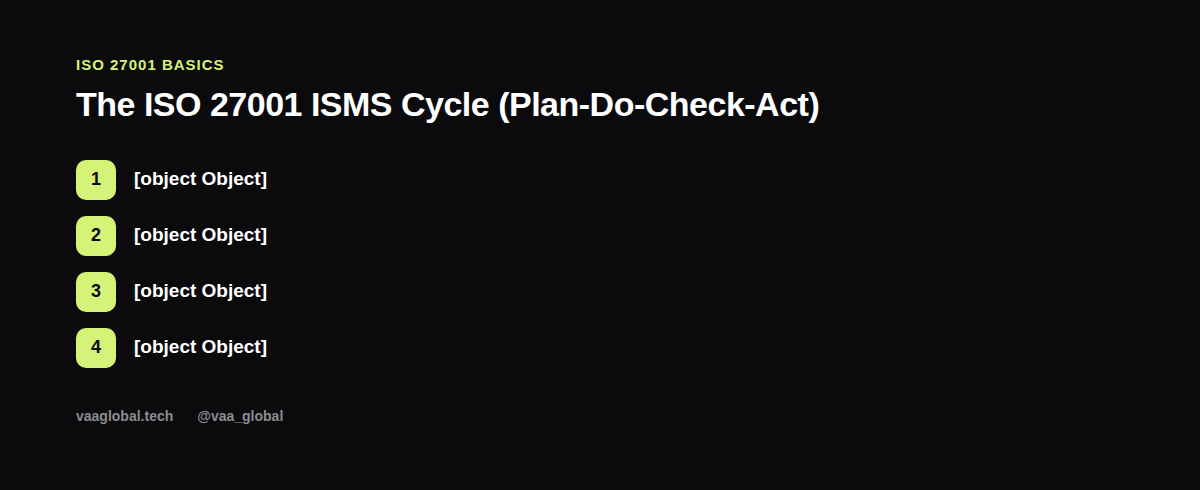
ISO 27001 is built around continuous improvement, often visualized as a Plan-Do-Check-Act cycle (shown in the graphic above). You plan your ISMS and risk treatment, you do the implementation work, you check how it's performing through monitoring and internal audits, and you act on what you learn to improve it. Then the cycle repeats. This is very different from a one-and-done security project — it's meant to run indefinitely.
How Certification Works
A company isn't ISO 27001 certified just because it read the standard and implemented some controls. Certification requires an independent, accredited external auditor to review the ISMS and confirm it meets the standard's requirements, usually through a staged audit process followed by periodic surveillance audits. If you're unsure about the exact steps or timelines involved, the authoritative source is always ISO itself rather than a secondhand summary.
ISO 27001 vs. SOC 2: A Common Point of Confusion
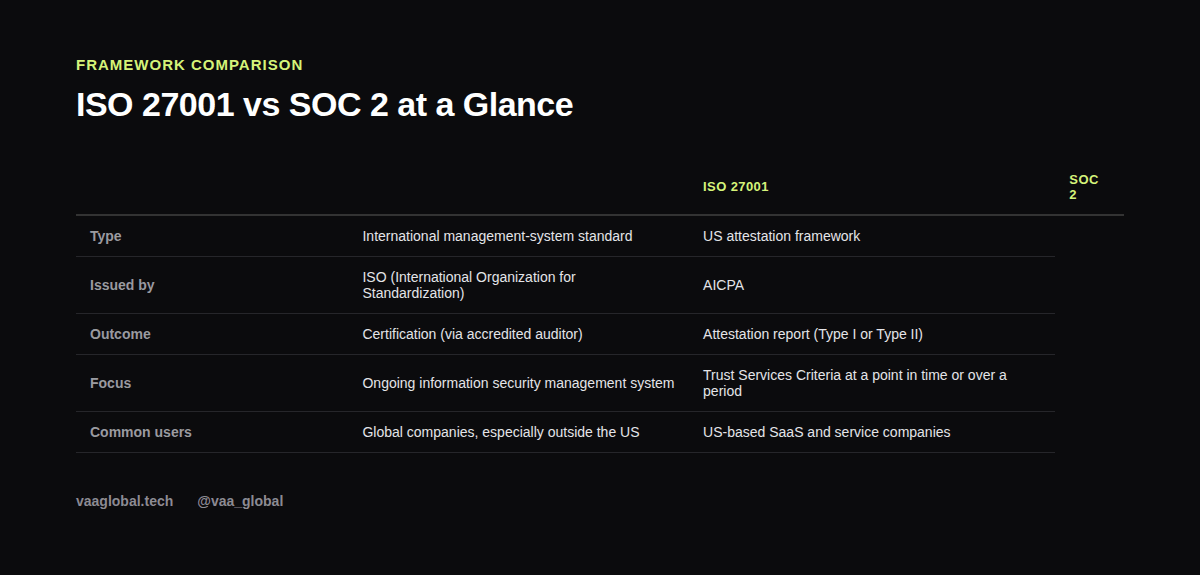
Beginners often lump ISO 27001 and SOC 2 together because both relate to information security, but they're structured quite differently — one is an international certification standard, the other is a US-centered attestation report. The table below gives a quick side-by-side comparison.
A Simple Example: Treating One Risk
Say a company identifies that employee laptops could be lost or stolen with sensitive client data on them. Under an ISO 27001-aligned ISMS, that risk would be logged, rated, and treated — for example, by mandating full-disk encryption and remote-wipe capability as controls, then reviewing whether those controls are actually working during the next internal audit. That loop — identify, treat, review — is the pattern you'll see repeated across almost every GRC framework.
Why This Matters for Your Career
You don't need to be a security engineer to work with ISO 27001. GRC analysts, compliance coordinators, and internal auditors all work with the standard regularly — translating audit findings into plain language, tracking remediation tasks, and keeping documentation current. If you're building toward this kind of role, it helps to also understand the technical side of information security; VAA Global's Cybersecurity course covers foundational skills like vulnerability management and incident response that overlap with what ISO 27001-aligned teams actually do day to day. For entry points into the field more broadly, see our guide on how to start a career in cybersecurity from scratch and entry-level cybersecurity jobs that don't require a degree.
Common Mistakes Beginners Make
The most common misunderstanding is treating ISO 27001 as a one-time technical project rather than an ongoing management system. Another is assuming it only applies to tech companies — in reality, organizations across healthcare, finance, logistics, and manufacturing pursue it. A third mistake is memorizing specific clause numbers from secondhand blog posts rather than going to iso.org directly, since paraphrased summaries (including this one) should never replace the actual standard when precision matters.
Quick Questions Beginners Ask
If you're wondering what is ISO 27001 in simple terms, think of it as a rulebook for building a trustworthy information security management system, not a list of specific technologies to buy. People also ask how does ISO 27001 certification work — in short, through an accredited external auditor reviewing your ISMS against the standard's requirements. Another common question is why do companies need ISO 27001: often it's because customers, partners, or regulators require proof of a credible security program before they'll sign a contract. And if you're asking is ISO 27001 hard to get, the honest answer is that it takes sustained effort and documentation discipline rather than any single difficult exam — the Statement of Applicability alone, which records which controls an organization applies and why, takes real care to get right. Every organization also needs an infosec compliance framework that fits its size, which is part of why ISO 27001 scopes so flexibly.
The Bottom Line
Once you strip away the jargon, ISO 27001 explained for beginners really comes down to one idea: build a structured, risk-based security management system, pursue ISO 27001 certification when it's genuinely needed, and keep improving it through the PDCA cycle. That's a skill set that transfers across industries and pairs well with broader compliance knowledge, from cybersecurity certifications for beginners to interview prep for your first GRC-adjacent role.