If your company is about to go through its first review, learning how to prepare for a SOC 2 audit properly can save you months of scrambling and a lot of late nights chasing down evidence. SOC 2 (System and Organization Controls 2) is a widely recognized audit framework, developed by the American Institute of Certified Public Accountants (AICPA), that evaluates how well a service organization protects customer data. It's become close to a baseline requirement for B2B SaaS companies trying to win enterprise customers.
What SOC 2 Actually Covers
SOC 2 compliance is built around five Trust Services Criteria: Security, Availability, Processing Integrity, Confidentiality, and Privacy. Security is mandatory for every SOC 2 report — the others are optional, chosen based on what's relevant to your business. A company that processes a lot of sensitive customer data might add Confidentiality and Privacy, while a company whose main promise is uptime might add Availability. Picking the right scope up front avoids wasted effort collecting evidence for criteria that don't actually apply to you.
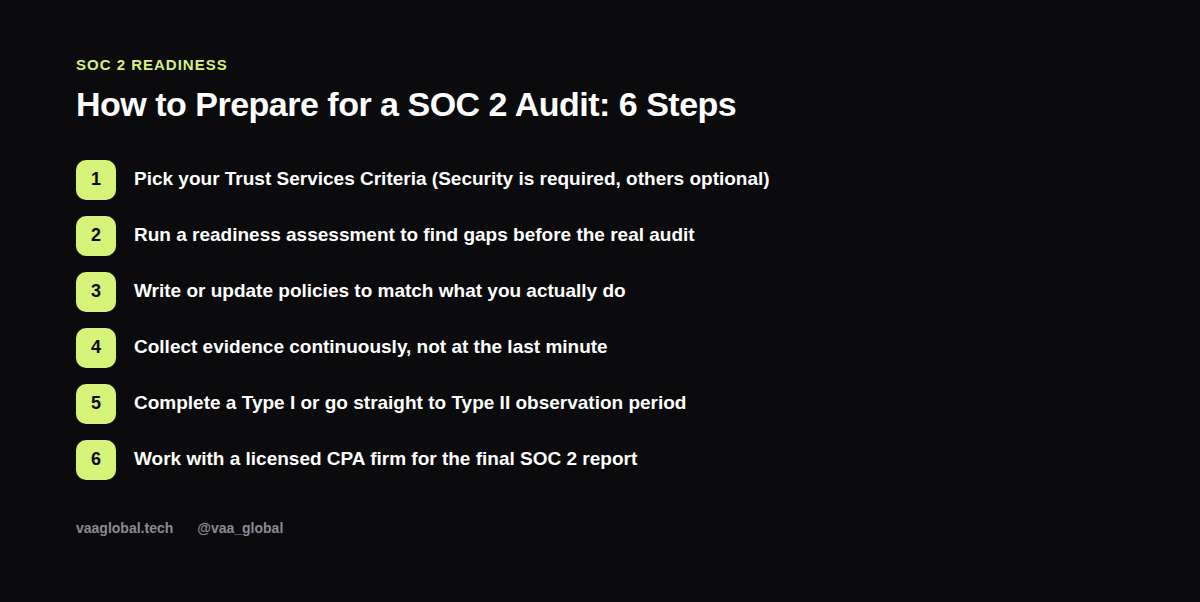
Step 1: Choose Your Trust Services Criteria
Before anything else, decide which criteria you're being audited against. This isn't just a compliance decision — it shapes which controls you need to build evidence for. Talk to your sales and customer success teams first; often your biggest prospective customers have already told you, directly or indirectly, which criteria matter to them.
Step 2: Run a Readiness Assessment
A SOC 2 readiness assessment is essentially a practice run. Someone — internal staff, a consultant, or GRC software — walks through each control requirement and checks whether you'd actually pass if the real auditor showed up today. This step exists specifically to surface gaps while there's still time to fix them, rather than finding out about a missing control during the formal audit, which can mean a qualified (less favorable) opinion in your final report.
Step 3: Write or Update Your Policies
Auditors check your policies against your actual practice, so both sides need to match. If your access control policy says reviews happen quarterly but no one's actually been doing them, that's a gap you need to fix before the audit — not during it. This is closely related to policy management basics: a policy document that nobody follows is worse than useless in an audit context, because it creates a documented promise you're not keeping.
Step 4: Collect Evidence Continuously
The single biggest mistake first-time companies make is treating evidence collection as a last-minute scramble. For a Type II report especially, auditors want to see evidence spread across the entire observation period, not just screenshots taken the week before the audit starts — strong SOC 2 evidence collection habits make this painless. Set up a routine — monthly access reviews, logged change approvals, documented incident response drills — so evidence accumulates naturally as part of how the team already works.
Step 5: Decide Between Type I and Type II
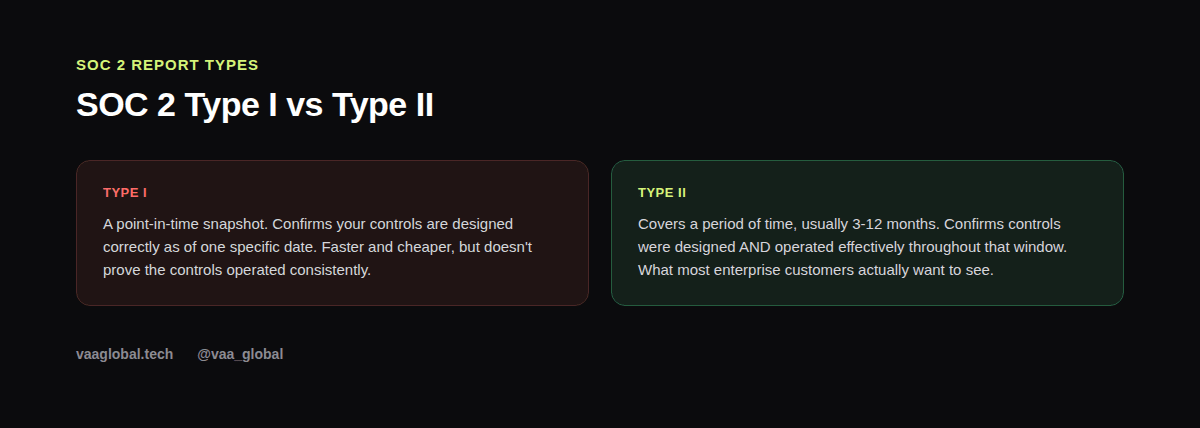
A Type I report is a snapshot: it confirms your controls are designed properly as of one date. A Type II report covers an observation period, typically three to twelve months, and confirms the controls actually operated effectively throughout that window — not just that they looked good on paper one day. Many companies start with a Type I to get a report in hand quickly, then move to Type II once they've built a track record. Most enterprise buyers, though, eventually want to see a Type II.
Step 6: Work With a Licensed CPA Firm
Only a licensed CPA firm can actually issue a SOC 2 report — this isn't optional or something an internal team can self-certify. Choose a firm with real experience in your industry if possible, since they'll recognize common control patterns faster and ask sharper questions during fieldwork.
A Worked Example: Sample Evidence Checklist
People asking how long does a SOC 2 audit take usually also want to know what is a SOC 2 readiness assessment and how much does a SOC 2 audit cost — those questions come up together constantly, and the answer depends heavily on scope, company size, and whether this is your first audit or a repeat one. Many first-timers also wonder do I need SOC 2 Type I or Type II before they even start gathering evidence, which is why that decision belongs early in the process, not at the end.
For the Security criterion alone, a first-time company typically needs to gather evidence like:
- An access control policy, plus logs showing quarterly access reviews actually happened
- Onboarding and offboarding records showing access was granted and revoked on schedule
- Change management records showing code or infrastructure changes went through approval
- Incident response plan, plus evidence of at least one tabletop exercise or real incident walkthrough
- Vendor risk assessments for any third party touching customer data
Building this list early, and assigning an owner to each item, turns SOC 2 prep from an overwhelming project into a manageable checklist.
How SOC 2 Connects to a GRC Career
SOC 2 audit prep work is a common entry point into compliance monitoring and GRC analyst roles, especially at SaaS companies. If you're coming from an IT or security background and want supporting technical skills, VAA Global's Cybersecurity course covers vulnerability management and incident response fundamentals that overlap meaningfully with SOC 2 Security criteria work, though it's not a dedicated compliance or GRC program — see what's covered in what you learn in VAA Global's cybersecurity course. If you're weighing a few different remote career paths, top remote jobs for Nigerians in 2026 is a useful starting point. For the authoritative source on the SOC 2 framework itself, see the AICPA.
Common Pitfalls First-Timers Hit
Beyond late evidence collection, first-time SOC 2 companies commonly underestimate how long policy-writing takes, forget to loop in vendors for their own attestations, and assume automation tools alone will handle everything. GRC software can speed up evidence collection and tracking, but it doesn't replace the judgment calls, like deciding whether a control gap is a real risk or an acceptable one. If you're building toward this kind of role, it's worth browsing common cybersecurity tools beginners should learn and cybersecurity certifications for beginners in Nigeria, since many SOC 2-adjacent roles expect familiarity with both.
The Bottom Line
Learning how to prepare for a SOC 2 audit really comes down to starting early: pick your scope, run a readiness check, fix policy-practice mismatches, build evidence collection into daily operations, and bring in a licensed CPA firm when you're genuinely ready. Rushed SOC 2 prep almost always shows up as stress during fieldwork and weaker findings in the final report — steady, early preparation is what gets companies a clean result.