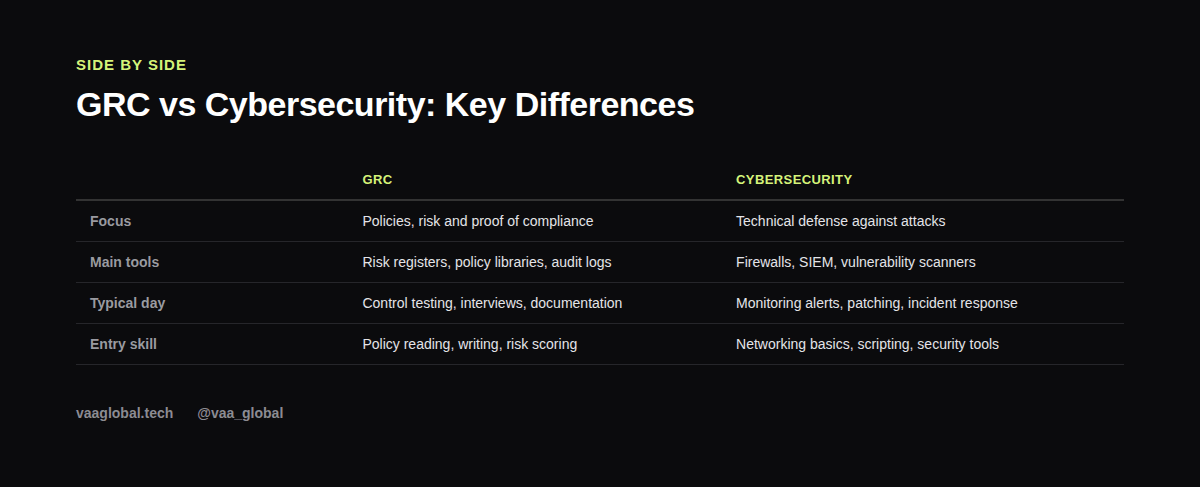
When people compare GRC vs cybersecurity for the first time, they often assume the two are basically the same thing because both fields talk about risk and security. In reality, GRC and cybersecurity ask different core questions: cybersecurity asks whether a system is technically protected from attack, while GRC asks whether the organization can prove it is following the rules it has committed to.
Different Core Questions, Different Daily Work
A cybersecurity analyst spends the day asking: is this system patched, is this alert a real threat, and how do we stop an active attack right now. A GRC analyst spends the day asking: can we prove this control works, does this process actually match the written policy, and what happens if a regulator or auditor asks for evidence next month. Because of this, cybersecurity work often feels more urgent and reactive, while GRC work is usually more structured and scheduled around audit cycles.
Compliance vs Security: Not the Same Goal
The compliance vs security distinction trips up a lot of beginners. Being compliant does not automatically mean a system is secure; a company can pass a compliance audit while still having real technical vulnerabilities that simply were not covered by the checklist being tested. Conversely, a technically well-secured system can still fail compliance if the paperwork trail proving it was configured correctly does not exist. This is exactly why both functions need to exist and talk to each other regularly.
Where GRC and Cybersecurity Overlap
The GRC and cybersecurity overlap is real and growing, especially around risk management vs security conversations. Vulnerability management, which is a core cybersecurity skill, directly feeds into a GRC risk register: a known unpatched vulnerability is a risk that needs an owner and a remediation deadline. Incident response, another cybersecurity discipline, generates evidence that GRC teams later use to prove the company responded appropriately to a breach, which regulators frequently require. Because of this overlap, many professionals move between the two fields over a career rather than staying in one lane forever.

Is GRC Part of Cybersecurity?
Strictly speaking, is GRC part of cybersecurity, or the other way around? Neither, really. GRC is a broader discipline that covers financial regulation, data privacy law, operational risk and more, of which cybersecurity risk is only one piece. At the same time, modern cybersecurity teams often run their own internal GRC-style processes just for security controls specifically. So the honest answer is that they are sibling disciplines that constantly borrow from each other rather than one being a subset of the other.
Which Field Pays More and Which Grows Faster
On the question of which field pays more, compensation varies significantly by market, company size and experience level, so it is worth treating any specific number you see online skeptically and instead researching current listings in your target market. What is more useful to know is that both fields have grown steadily as regulation and cyber threats have both increased, and neither is a passing trend. The Institute of Internal Auditors and ISACA both publish ongoing research and career resources on how demand in these adjacent fields is trending, which is worth a direct read if you want current data rather than secondhand claims. If you are also curious how security controls connect to risk assessment work specifically, it is worth reading our breakdown of a governance, risk and compliance framework explained from scratch.
Do GRC Analysts Need to Know Cybersecurity?
Do GRC analysts need to know cybersecurity in depth? Not at an engineering level, but a working understanding helps enormously. A GRC analyst who understands basic concepts like patch management, access control and network segmentation can ask sharper questions during a control review and avoid being talked past by a technical stakeholder. If this side of the field interests you, VAA Global's Cybersecurity course covers networking, vulnerability management and incident response over ten weeks, which gives exactly this kind of foundation, even though it is not a GRC-specific program itself.
Can You Switch From Cybersecurity to GRC, or Back?
Yes, and it happens often. Someone who has spent a few years doing hands-on cybersecurity work frequently moves into GRC once they want less on-call pressure and more structured, policy-driven work. The reverse also happens, where a GRC professional who becomes curious about the technical side pursues additional training to move toward a security engineering or analyst role. If you are deciding between the two right now, it can help to first read about starting a cybersecurity career from scratch and compare it honestly against what GRC day-to-day work involves, covered in our GRC analyst job description guide.
Should I Choose GRC or Cybersecurity? A Simple Self-Check
If you are still asking yourself should I choose GRC or cybersecurity, try this: picture a Monday morning where a new security alert and a new policy review both land in your inbox. If your instinct is to dig into the technical alert first, cybersecurity likely suits your temperament better. If your instinct is to read the policy carefully and figure out what evidence proves compliance, GRC is probably the better fit. Neither answer is wrong, and plenty of people happily build a long career on security controls and security control testing within a GRC function without ever writing a line of security code.
The Bottom Line
GRC vs cybersecurity is not really a competition between a better and worse field; it is a choice between two closely related disciplines that approach the same underlying problem, organizational risk, from different angles. If you like policy, documentation and proof-based thinking, GRC fits better. If you like hands-on technical defense and rapid response, cybersecurity fits better. Either way, understanding the other field will make you stronger in your own.