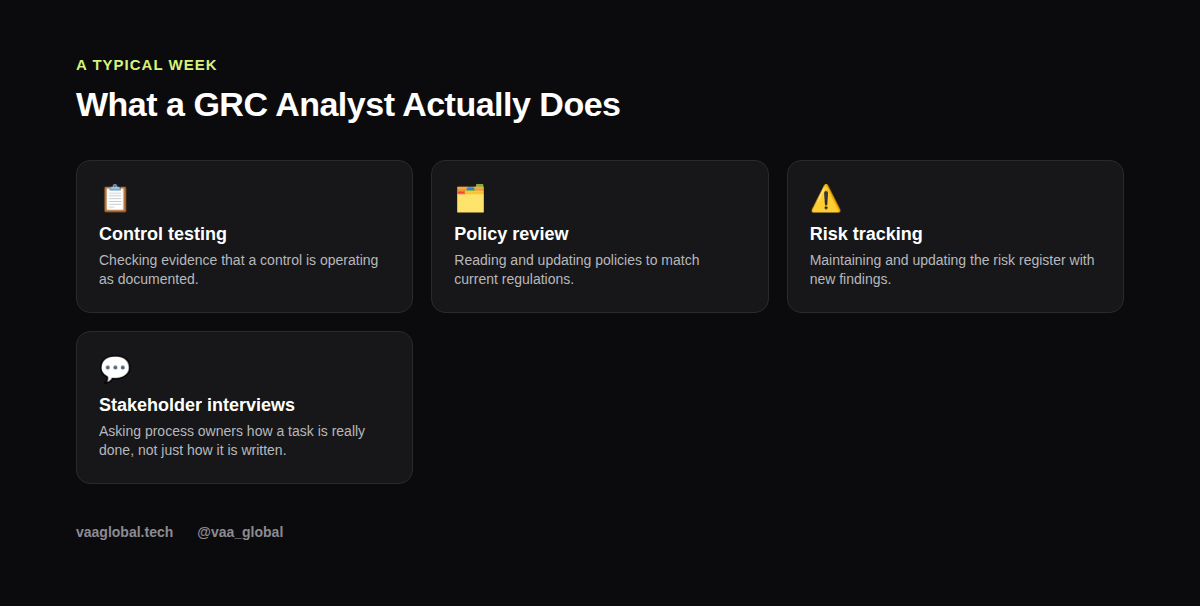
A GRC analyst job description on a careers page usually reads like a vague list of buzzwords, so it helps to know what the role actually involves before you apply or accept an offer. In practice, a GRC analyst spends most of the week testing whether controls are working, updating a risk register, and talking to people who actually run the processes being reviewed.
The Core Loop: Test, Document, Report
Most GRC analyst daily tasks follow a repeating loop. First, pick a control that is supposed to be in place, such as “only approved staff can access customer financial records.” Second, gather evidence that the control is actually working, which might mean pulling an access log or interviewing the system administrator. Third, document whether the evidence supports the claim, and if it does not, write up the gap clearly enough that someone outside the GRC team can understand and fix it. This loop, repeated across dozens of controls, is the backbone of the job.
Control Testing in Plain Terms
Control testing sounds technical, but it is closer to detective work than engineering. For example, if a policy says all new vendors go through a security review before being approved, a control test might involve picking five vendors onboarded in the last quarter and checking whether each one has a completed review on file. If two out of five are missing documentation, that is a finding, and the analyst has to write it up with enough detail that it can be tracked to resolution.
Risk and Compliance Analyst Duties Beyond Testing
Risk and compliance analyst duties also include maintaining the risk register, which is a living document listing identified risks, their likelihood, their potential impact, and the person responsible for managing each one. Analysts often update this register after audits, after security incidents, or when a new regulation changes what counts as acceptable practice. This is less glamorous than it sounds; it is mostly accurate record-keeping done consistently over time.
The Skills That Actually Get Used
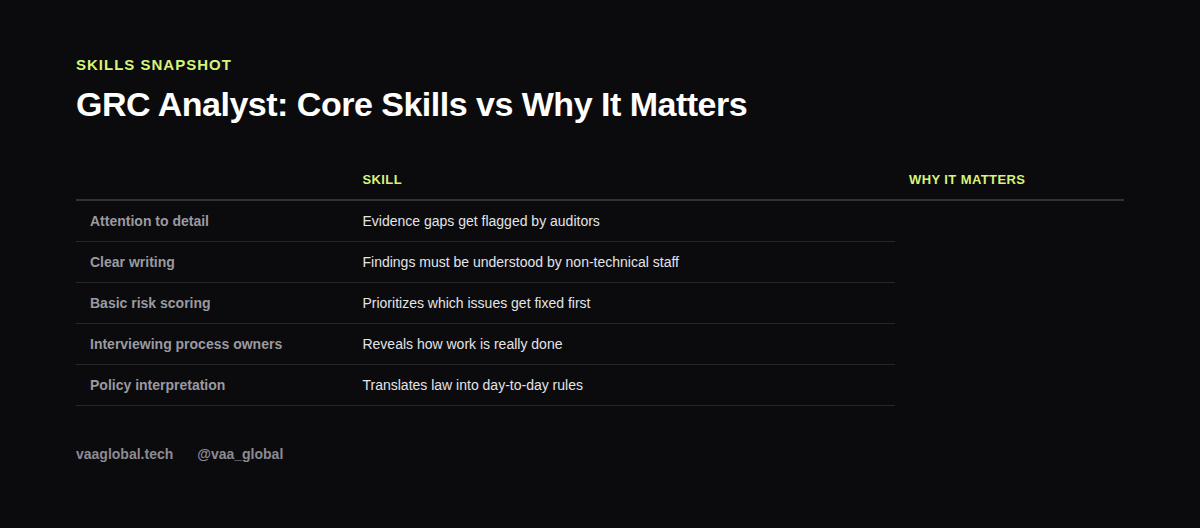
GRC analyst skills that matter most on the job are less technical than people expect. Attention to detail catches evidence gaps auditors would otherwise flag later. Clear writing lets non-technical staff understand a finding without a jargon translation. Basic risk scoring helps prioritize which issues get fixed first instead of treating everything as equally urgent. And because much of the job involves interviewing process owners, comfort with asking direct but diplomatic questions matters as much as any certificate.
The Tools of the Trade
GRC analyst tools vary by company size. Larger organizations often use dedicated GRC platforms that centralize policies, risks and controls in one system. Smaller companies frequently run everything out of spreadsheets, shared drives and ticketing systems instead. Either way, an analyst needs to be comfortable organizing large amounts of structured information and tracking the status of many open items at once, since a single quarter might involve dozens of controls in different stages of testing.
A Realistic Interview Example
If asked in an interview to describe the role, a strong answer sounds something like: “I would spend part of my week testing specific controls against evidence, part of it updating the risk register with new findings, and part of it meeting with process owners to understand how a task is actually performed versus how the policy describes it. My main output is a clear, well-documented finding that someone outside the GRC team can act on.” That kind of concrete answer stands out against candidates who only repeat textbook definitions.
Is GRC Analyst a Stressful Job?
Whether a GRC analyst role feels stressful depends heavily on the company. In organizations with strong leadership support, the job is methodical and predictable. In organizations using GRC as a box-ticking exercise, analysts can feel caught between management pressure to pass an audit and the honest reality that a control is not working. Asking about this dynamic directly in an interview, for example by asking how the company has responded to past audit findings, is a smart way to gauge it in advance. It also helps to review general interview preparation for cybersecurity-adjacent roles, since many questions overlap with GRC interviews.
How This Role Differs From Internal Audit
People often confuse the GRC analyst role with internal audit, since both involve testing controls. The key difference is independence and cadence: internal audit typically operates on a scheduled, independent cycle and reports to an audit committee, while a GRC analyst works more continuously within the business, often supporting the same controls audit later tests. If this distinction interests you, it is worth reading more broadly about compliance and risk career paths, and about how VAA Global's Business Analysis course covers process mapping and requirements modelling, both of which help analysts document controls clearly, even though it is not a GRC-specific program. The Institute of Internal Auditors also publishes useful career and role guidance worth reading alongside this.
What Software Does a GRC Analyst Use, Really
What software does a GRC analyst use in practice often surprises beginners expecting something flashy: it is spreadsheets, a shared drive, a ticketing system, and sometimes a dedicated GRC platform that stores policies alongside the risk register and audit evidence. The control owner for each item is usually logged right next to the finding, so accountability is clear. Many of these habits, like careful file naming and version control, overlap heavily with general remote-work organization; this guide on digital file organization for remote work covers the same discipline from a broader angle. If you are building a resume for this kind of role, it also helps to study how a cybersecurity resume with no experience is structured, since the format translates well to GRC applications too.
The Bottom Line
The real GRC analyst job description is less about writing policy from scratch and more about verifying reality against documentation, tracking risk honestly, and communicating gaps clearly. If you like structured investigation work, consistent record-keeping, and talking to people across a business, the day-to-day of this role is likely to suit you better than the vague buzzwords on most job postings suggest.