Writing a cybersecurity resume with no experience feels like a trap: every job posting wants two or three years of practice, but you cannot get that practice without a job. The good news is that hiring managers in entry-level security roles know this, and they look past job titles for evidence that you can think like a defender. Because cybersecurity rewards curiosity and hands-on problem solving, you can build a credible resume before you ever sit in a Security Operations Center.
Why "No Experience" Doesn't Mean "No Skills"
Every applicant who has never held a security title still has relevant experience, even if it does not look that way on paper. If you troubleshot a family member's Wi-Fi router, flagged a phishing email at your last job, or managed access permissions on a shared drive, that is security-adjacent behavior. The trick is translating it into language a recruiter recognizes. For instance, "helped coworkers avoid suspicious emails" becomes "identified and reported phishing attempts, reducing risk exposure for the team." As a result, your resume reads like someone who already thinks about risk, not someone asking to be taught from zero.
Structuring Your Resume For Maximum Impact
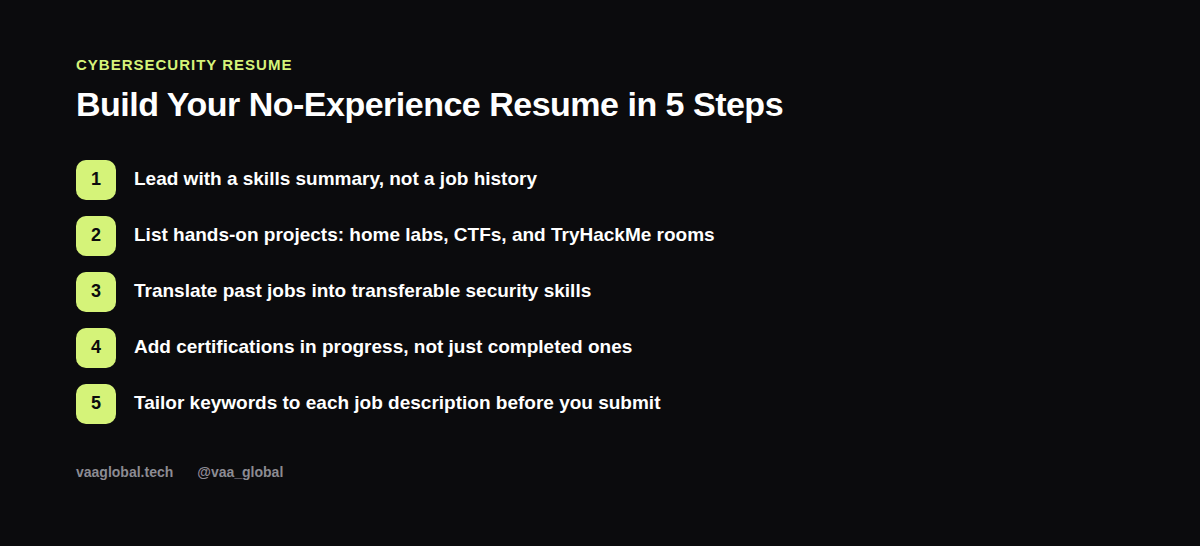
Put a short skills summary at the top, three or four lines that name your strongest technical areas: networking fundamentals, vulnerability scanning tools, basic scripting, or incident response concepts. Below that, list a "Projects" section before your work history, since that is where most of your evidence will live. Then include work experience, even unrelated jobs, framed around transferable skills. Finally, add education and certifications. This order matters because recruiters often skim top to bottom, and you want your strongest signal first, not buried under a retail job title.
Showcasing Projects Instead Of Job Titles
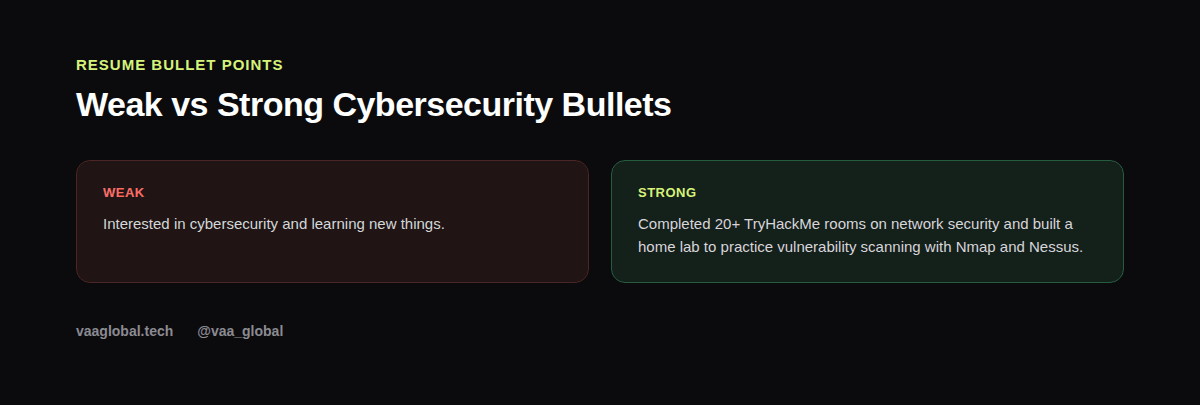
A home lab is the single most convincing thing you can put on a cybersecurity resume with no experience. Spin up a virtual machine, install Kali Linux, and practice scanning your own network with Nmap. Document what you found. Similarly, platforms that run capture-the-flag style challenges let you show measurable progress: "Completed 25 rooms on TryHackMe covering network fundamentals, Linux privilege escalation, and web application security." Because these projects are self-directed, they also demonstrate initiative, which matters just as much as the technical skill itself.
Translating Transferable Skills From Any Background
If you previously worked in customer service, IT support, or even hospitality, you likely already practiced skills that matter in security: attention to detail, documentation, following procedures under pressure, and communicating technical issues to non-technical people. A help desk agent who reset passwords and verified identities before making account changes was effectively doing access control. Write it that way. Recruiters reading an entry-level cybersecurity jobs posting expect candidates to connect these dots themselves, so do not assume they will make the leap for you.
Choosing Certifications That Actually Help
You do not need every certification before you apply, but naming the ones you have completed or are studying for adds credibility. Foundational options that entry-level employers recognize include CompTIA Security+, which is widely referenced by the NIST NICE Cybersecurity Workforce Framework as a baseline credential, alongside vendor-neutral networking basics like CompTIA Network+. If you are still deciding which path fits you, a structured cybersecurity course can walk you through networking, ethical hacking, vulnerability management, web application security, and incident response in a guided ten-week format rather than leaving you to piece it together alone.
Common Resume Mistakes To Avoid
The most frequent mistake is listing tools without context, for example writing "Wireshark, Nmap, Burp Suite" with no explanation of what you did with them. Instead, pair each tool with an outcome. Another common error is a vague objective statement instead of a skills summary; cut it entirely. Beginners also tend to overstate familiarity with tools they have only opened once, which falls apart quickly in an interview. For a broader look at pitfalls beyond cybersecurity specifically, this piece on common resume mistakes remote job seekers make is worth a read before you submit anything.
Tailoring Your Resume To Beat The ATS
Most companies run resumes through an applicant tracking system before a human ever sees them, so matching the language in the job posting matters. If the listing says "vulnerability management," use that exact phrase rather than a synonym like "patch tracking." Keep formatting simple: standard section headers, no tables or text boxes that an ATS might misread, and a standard file name. Because ATS systems scan for keyword matches, a resume written only for human readers can get filtered out before anyone sees your projects section at all.
Handling Career Gaps Or A Non-Technical Background
If you are switching into cybersecurity from an unrelated field, address it briefly and move on; do not apologize for your path. A short line in your summary, such as "Transitioning from customer support to cybersecurity, backed by hands-on lab work and CompTIA Security+ study," frames the change as a decision rather than a liability. If there is also a gap in employment, keep the explanation factual and brief rather than over-justifying it, a technique covered in more detail in this guide on how to explain a career gap on your CV. For a wider view of entry points into the field, how to start a career in cybersecurity from scratch and this guide for overwhelmed beginners both cover where to begin.
What To Do After The Resume Is Ready
Once your resume is in good shape, pair it with a LinkedIn profile that echoes the same keywords and a short cover letter referencing one specific thing about the company you are applying to. Apply broadly to entry-level cybersecurity jobs rather than waiting for a "perfect" match, since many postings labeled mid-level still interview strong junior candidates. If you want a second opinion before sending anything out, tools like VAA Global's CV review resources or a trusted mentor can catch gaps you cannot see yourself. For more on choosing which certifications to prioritize as you keep building your profile, see cybersecurity certifications for beginners in Nigeria.
Quick Answers To What Skills And Certifications Belong On Your Resume
If you are wondering what skills should I put on a cybersecurity resume, start with networking basics, Linux fundamentals, scripting, and at least one security tool you have practiced with directly. If you are asking what certifications help a cybersecurity resume, CompTIA Security+ and Network+ are the two most recognized starting points for junior roles, and naming them by name gives recruiters something concrete to search for. Building cybersecurity skills for beginners does not require a job offer first. It just requires consistent, documented practice. A few solid IT resume tips, like quantifying every bullet point, will carry over into any technical resume you write later in your career.
The Bottom Line
A strong cybersecurity resume with no experience is built, not found. It comes from documented projects, honestly translated transferable skills, and certifications that show momentum rather than completion. Because hiring managers for junior roles expect to train technical depth on the job, what they are really screening for is curiosity and follow-through, and that is exactly what a well-structured resume with no experience can prove.