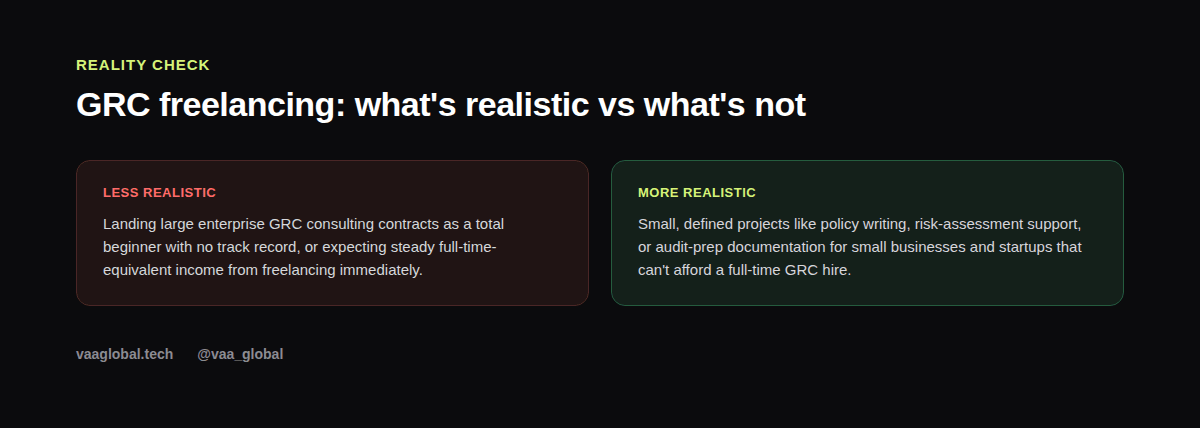
GRC freelancing is possible, but it rarely looks like the large enterprise consulting contracts people imagine when they first hear the term. For most people starting out, realistic freelance GRC work means smaller, well-defined projects for small businesses and startups that need governance, risk, or compliance help but can't justify a full-time hire yet.
Can Beginners Freelance in GRC?
Can beginners freelance in GRC right out of the gate, with no prior work experience at all? Honestly, it's tough. Clients hiring freelance help for anything touching risk or compliance are usually looking for someone who can be trusted with real organizational exposure, which makes pure beginners a harder sell than in fields like general virtual assistance. That said, it's not impossible — a strong portfolio (see our guide on building a GRC portfolio with no experience) combined with transferable experience from an adjacent field can get you in the door for smaller projects.
What GRC Services Can I Offer as a Freelancer?
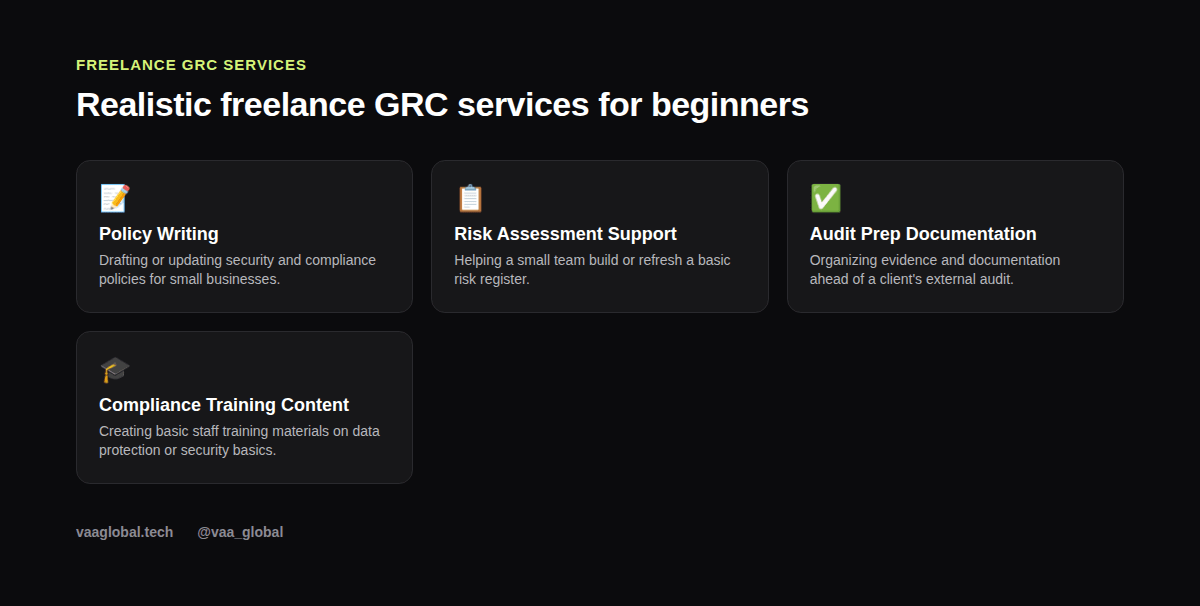
What GRC services can I offer as a freelancer realistically? Policy writing is one of the most approachable — small businesses often need a data protection policy, an acceptable-use policy, or a basic security policy and don't know where to start. Risk assessment support, audit-prep documentation (organizing evidence before an external audit), and compliance training content are all scoped, deliverable-based services that fit a freelance model well.
Who Actually Hires Freelance GRC Help
Small business compliance needs are where most freelance opportunity actually lives: startups preparing for their first external audit or a funding round that requires compliance documentation, and companies that need a one-off project done, like updating policies after a regulatory change. Large enterprises almost always hire GRC work through established consulting firms or full-time staff rather than an independent contractor with no track record, so adjust your expectations and your client search accordingly.
How Do I Find My First GRC Freelance Client?
How do I find my first GRC freelance client when you have no freelance track record yet? Start close to home: small businesses in your existing network, local startup communities, or even a slightly discounted first project to build a genuine case study. Platforms built for freelancers more broadly — the kind covered in our guide to starting freelancing on Upwork as a Nigerian — do list some compliance and risk-adjacent gigs, though you'll need to search specifically rather than expect a flood of listings.
Is GRC Freelancing Profitable?
Is GRC freelancing profitable compared to other freelance paths? It can be, since GRC work is specialized and clients who need it genuinely can't do it themselves, which supports higher rates than more commoditized freelance services. But it's rarely a volume business — you're more likely to do fewer, higher-value projects than constant small gigs. Our general comparison of freelancing versus full-time remote work is worth reading before you decide how much of your income to risk on this path early on.
Pricing Your First Projects
Resist the urge to price purely on hours for your first few projects. Scope the deliverable clearly (a specific policy document, a defined risk register, a set audit-prep package) and price the outcome. This protects you from underselling your time and gives the client clarity on exactly what they're paying for. Our broader piece on pricing freelance services as a beginner covers the general principles that apply here too.
Building Credibility Without a Big-Name Client List
Early on, your credibility comes from specificity, not scale. A detailed case study of one small-business risk assessment, written up honestly about your process and what you learned, does more for your positioning as an independent GRC consultant than vague claims of broad expertise. Consider pairing this with foundational knowledge from VAA Global's Cybersecurity course, which covers vulnerability management and incident response concepts that strengthen the risk side of a freelance GRC offering.
A Note on Scope and Liability
Because GRC work touches sensitive organizational information, be deliberate about what you agree to take on as an independent contractor. Clearly state in your contract what you are and aren't responsible for, avoid implying you're providing formal legal or regulatory compliance certification (that's a different, licensed function in most jurisdictions), and position your work accurately as advisory and documentation support. If you're ever unsure whether a specific regulatory claim you're being asked to make is accurate, point the client toward the relevant regulator's own guidance, or toward resources like ISACA's publicly available materials, rather than guessing.
The Bottom Line
GRC freelancing is possible, but it's a specialized, relationship-driven niche rather than a high-volume gig economy, so plan for fewer, more carefully chosen projects rather than a constant stream of small work, and build your track record deliberately through small businesses and startups before aiming higher. Treat your first two or three clients as reputation-building exercises as much as income, document each one properly, and the bigger opportunities tend to follow naturally once you have real, specific results to point to.