
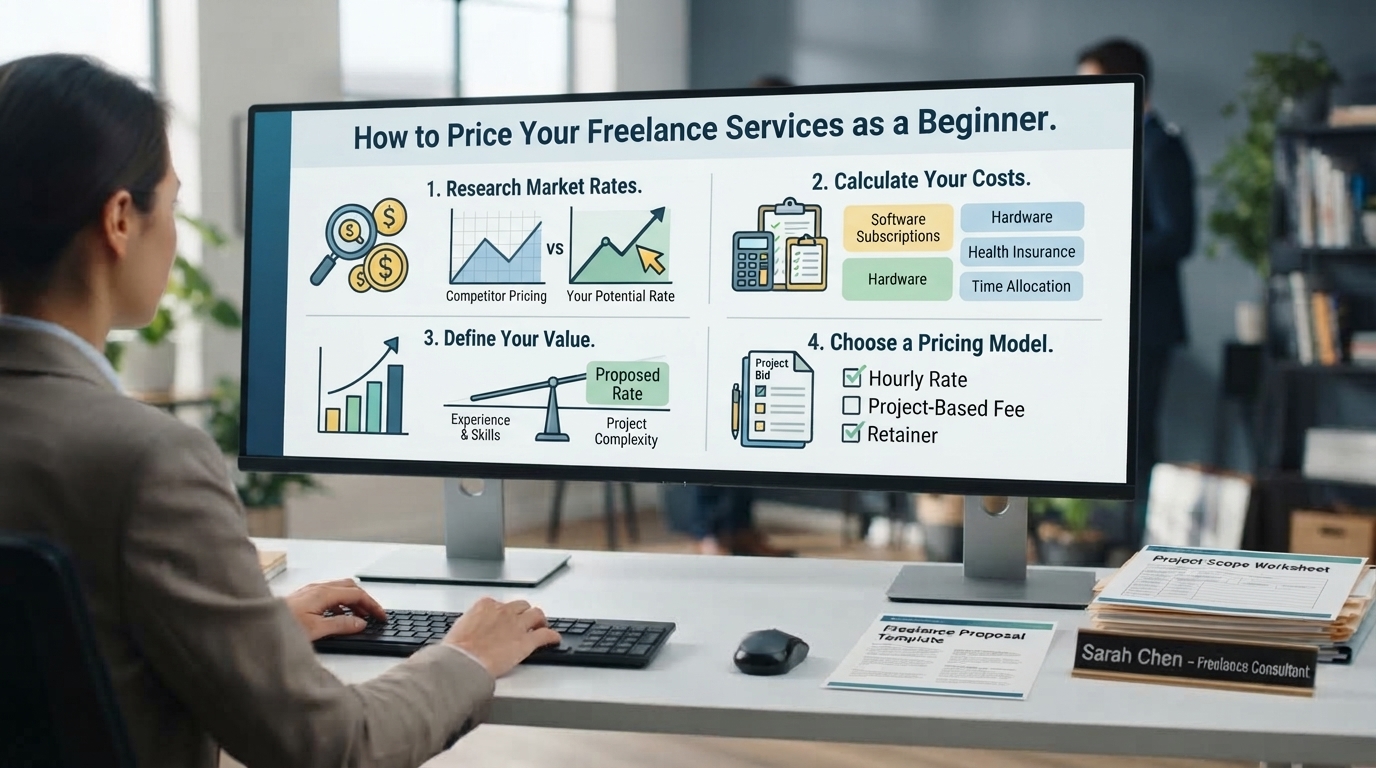
Pricing is one of the more genuinely anxiety-inducing parts of starting freelance work, price too high with no track record and you might not win any clients at all, price too low and you risk both underearning and signaling poor quality.
Why 'Charge What You're Worth' Isn't Actually Useful Advice
This common piece of advice sounds empowering but offers no genuinely practical guidance for a beginner with no track record yet, since your actual market value as a brand-new freelancer is still unproven and unclear even to you. What matters more practically is understanding the specific stage you're at and pricing strategically for that stage, not chasing an abstract, ideal number that doesn't yet reflect your real position in the market.
Pricing Strategically for Your First Few Clients
Early on, your primary goal isn't maximizing per-project income, it's building genuine reviews and a track record that unlocks higher-value clients later. This often means pricing competitively, sometimes at the lower end of a reasonable range for your specific skill, specifically to win those crucial first few projects and reviews.
This is a deliberate, temporary strategy, not a permanent pricing philosophy. Once you have a handful of strong reviews and genuine client testimonials, your leverage to raise rates for new clients increases substantially, since you now have real evidence backing your value, not just a claim.
Avoiding the Trap of Pricing Too Low
While competitive early pricing makes sense, pricing so low that it signals desperation or poor quality can genuinely backfire, some clients specifically avoid unusually cheap freelancers, assuming the low price reflects inexperience or unreliability rather than a genuine bargain.
A reasonable approach is researching what comparable freelancers with similarly limited experience are charging for similar work, then pricing within that realistic range rather than undercutting dramatically, which protects both your income and your perceived credibility.
Hourly vs Project-Based Pricing for Beginners
Project-based pricing often works better for beginners on clearly defined tasks, since it removes the ambiguity and potential awkwardness of a client questioning how many hours something "should" take. It also protects you somewhat as you're still learning to estimate your own working speed accurately.
Hourly pricing can work well for more open-ended or ongoing work, but beginners should be cautious about underestimating their own time when quoting hourly rates, since underestimating consistently erodes your actual effective earnings even at a seemingly reasonable hourly rate.
How VAA Global's Freelancing Course Addresses This Directly
VAA Global's Freelancing course includes practical guidance on pricing strategy as part of its 10-week curriculum, alongside client acquisition, proposal writing, and scope management, giving you a genuinely realistic framework rather than vague, generic advice.
The course's 2-month internship also gives you real, practical experience setting and delivering against actual pricing and scope agreements before you're navigating this entirely on your own with real client relationships and income at stake.
Common Mistakes Beginners Make With Pricing
A common mistake is changing prices inconsistently between similar clients without a clear reasoning behind it, which can create confusion or resentment if clients ever compare notes, a coherent, if evolving, pricing logic protects you from this kind of awkward inconsistency.
A second mistake is failing to account for the real, often invisible time costs beyond the core deliverable itself, client communication, revisions, administrative overhead, all of which should genuinely factor into whatever price you ultimately settle on for a given project.
A Closer Look at Value-Based Thinking
As you gain more experience, shifting from purely time-based thinking toward value-based pricing, charging based on the genuine outcome or value a project delivers for the client rather than strictly the hours it took you, often becomes a more sustainable, and often more lucrative, long-term pricing philosophy worth growing into deliberately.
That shift genuinely marks a real turning point in a freelance career.
It reflects genuine confidence in your own demonstrated skill.
And clients tend to respond well to it too.
This kind of pricing discipline reflects genuine confidence in your own demonstrated skill, and clients tend to respond well to it.
If you're torn between a few different options, the free Career Compass quiz at vaaglobal.tech/career-compass can help narrow it down based on what you actually enjoy.
As you get closer to job-ready, VAA Global Talent at talent.vaaglobal.tech becomes a genuine resource for finding employers actively looking for this skill set.
The free CV and LinkedIn review tool at vaaglobal.tech/cv-review can help you translate this experience into a CV that genuinely stands out.
FlexJobs Remote Work Trends Report has published research specifically on this, and it lines up closely with what's described here.
Research from GitLab Remote Work Report backs this up, consistently finding that this pattern holds across the wider remote job market, not just as an isolated trend.
World Economic Forum Future of Jobs Report has tracked this pattern closely, and their findings reinforce exactly the point made here.
Raising Your Rates as You Grow
Pricing isn't a decision you make once and never revisit, it should evolve as your track record and demand genuinely grow. You can apply to VAA Global's Freelancing course to build both the skill and the pricing strategy together.