If you've spent any time researching risk-focused careers in governance, risk, and compliance, you've probably run into the CRISC certification and wondered whether it's actually worth the time and money. CRISC — Certified in Risk and Information Systems Control — is one of the more specialized credentials in the GRC space, and it isn't right for everyone at every stage. This article breaks down what it covers, who it tends to suit, and how to decide if it belongs on your roadmap.
What CRISC Actually Stands For
If you're wondering what does CRISC stand for exactly: Certified in Risk and Information Systems Control. It's administered by ISACA, the same body behind CISA and CGEIT. Unlike broader security certifications, CRISC is deliberately narrow: it's built around identifying, assessing, and responding to IT-related risk, then making sure the controls that manage that risk actually hold up over time. If your interest leans toward the "R" in GRC more than the "C" or the "G," this is one of the more direct paths toward formalizing that specialty as an IT risk management certification.
What the Exam Domains Cover
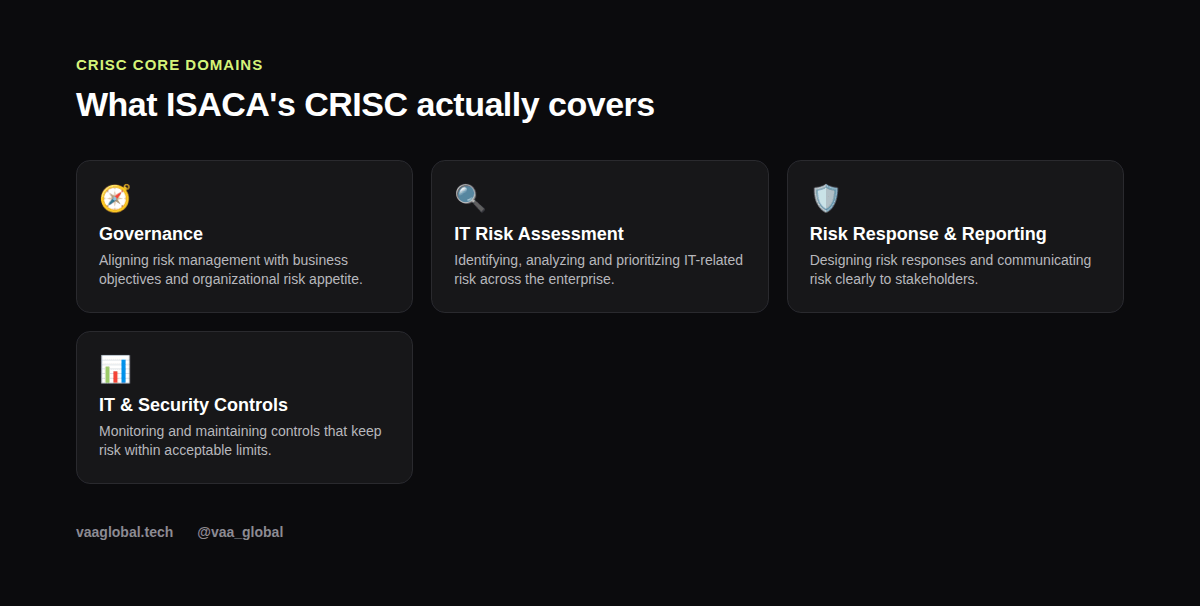
ISACA organizes the CRISC body of knowledge into a handful of core domains covering governance, IT risk assessment, risk response and reporting, and information technology and security control monitoring. In practice, that means you're expected to understand how risk management ties back to business strategy, how to size up and prioritize risks instead of treating every finding as equally urgent, and how to communicate risk in language that non-technical stakeholders, like a finance director or a board member, can actually act on.
Who CRISC Is Actually Built For
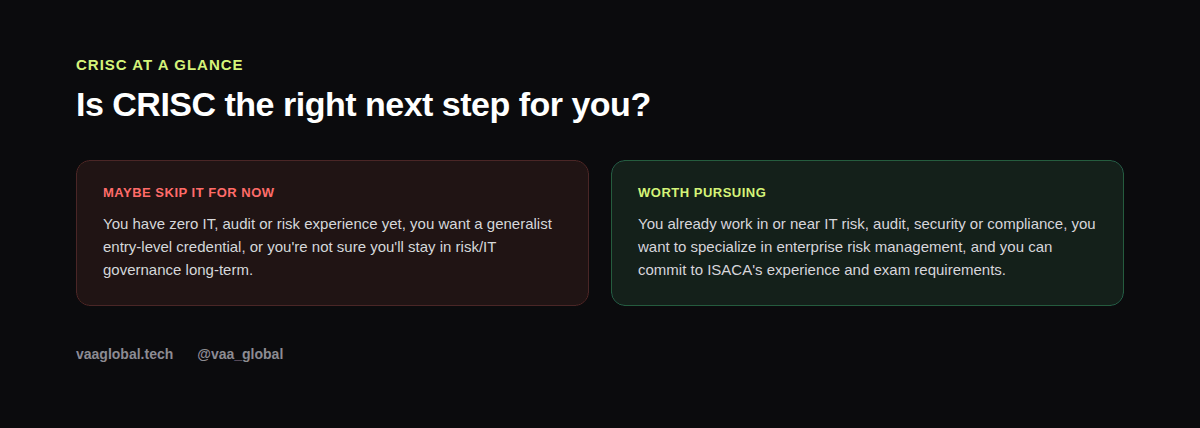
CRISC tends to suit people already doing risk-adjacent work: IT auditors, security analysts, compliance officers, or business analysts who keep bumping into risk registers and control frameworks in their day-to-day work. It's less of a "break into the field" credential and more of a "formalize what I already do" credential. If you're reading this with zero professional exposure to IT, audit, or compliance yet, it's worth building some foundational experience first — through an entry-level role, internship, or even volunteer project work — before sinking study hours into CRISC specifically.
Experience Requirements You Should Verify Yourself
ISACA certifications, CRISC included, generally require a minimum number of years of relevant professional experience across specific domains before you can use the credential (not just pass the exam). Because these requirements, fees, and renewal rules change periodically, don't take anyone's blog post as gospel here — go straight to isaca.org for the current, exact figures before you commit to a study plan or budget.
How CRISC Compares to Other GRC Certifications
It helps to think of CRISC as one tool in a broader toolbox rather than the only option. CISA leans toward IT audit and governance; CISSP (from ISC2) is a broad security-management credential; CRISC sits specifically on the risk side. If you're still mapping out your options, it's worth comparing CRISC against other entry points into IT governance work, including the career path our guide on starting a cybersecurity career from scratch describes, since security, audit, and risk roles frequently overlap. Many GRC professionals end up holding more than one credential over a career, layered in as their role shifts.
What It Signals to Employers
A CRISC credential on a CV tells a hiring manager you can speak the language of enterprise risk — risk appetite, control effectiveness, residual risk — fluently enough to have passed a rigorous exam on it. It won't replace demonstrated experience, but paired with real project work (even portfolio-style projects if you're earlier in your career, similar to the approach in our piece on business analyst portfolio projects for beginners), it adds a layer of third-party validation that's hard to fake. That said, it is genuinely not a magic ticket; recruiters still want to see you can apply the concepts, not just define them. One question people new to this rarely ask upfront: do I need experience for CRISC before I can even sit the exam, or only to use the letters afterward? The answer touches both, which is exactly why reading ISACA's current requirements closely matters.
Realistic Costs: Time and Money
Beyond the exam fee itself (again, confirm current pricing directly on ISACA's site), budget real study time. Risk and information systems control concepts build on each other, and most working professionals study in the evenings or on weekends over a period of weeks to months rather than cramming. If you're also managing a full-time job, be honest with yourself about how many hours a week you can realistically protect for study before you set an exam date.
Is It Worth It For You, Specifically?
So, is CRISC worth it for beginners? Usually not as a first move, and people often ask how hard is the CRISC exam compared to other ISACA credentials — the honest answer is that it depends heavily on your starting point. If you're already in an IT risk, audit, or compliance-adjacent role and want to specialize further, CRISC is a reasonable and well-respected investment. If you're brand new to the field, you'll likely get more immediate traction from building foundational knowledge, a small portfolio of risk-assessment projects (see our guide on building your first portfolio project for the general approach), and maybe a broader entry point first — then circling back to CRISC once you have real work to anchor it to. There's no shame in sequencing your certifications; most experienced GRC professionals did exactly that. A technical foundation also helps: VAA Global's Cybersecurity course covers vulnerability management and incident response basics that overlap with the risk-assessment mindset CRISC expects, which can be a useful stepping stone if you're coming from a non-technical background.
The Bottom Line
The CRISC certification is a solid, respected credential for people who already have a foot in IT risk, audit, or compliance and want to go deeper into enterprise risk management specifically. It's not the best first move for someone with no relevant background, and it's not a replacement for real experience — but as a specialization once you're established, it holds real weight. Whatever stage you're at, verify the current exam requirements and fees directly with ISACA before you commit, and make sure the certification lines up with the specific risk career path you actually want.