

These two terms get used almost interchangeably in casual conversation, but understanding business continuity vs disaster recovery properly matters a lot once you're actually responsible for planning either one. They're related, overlapping, and genuinely different in scope.
Business Continuity: Keeping the Whole Business Alive
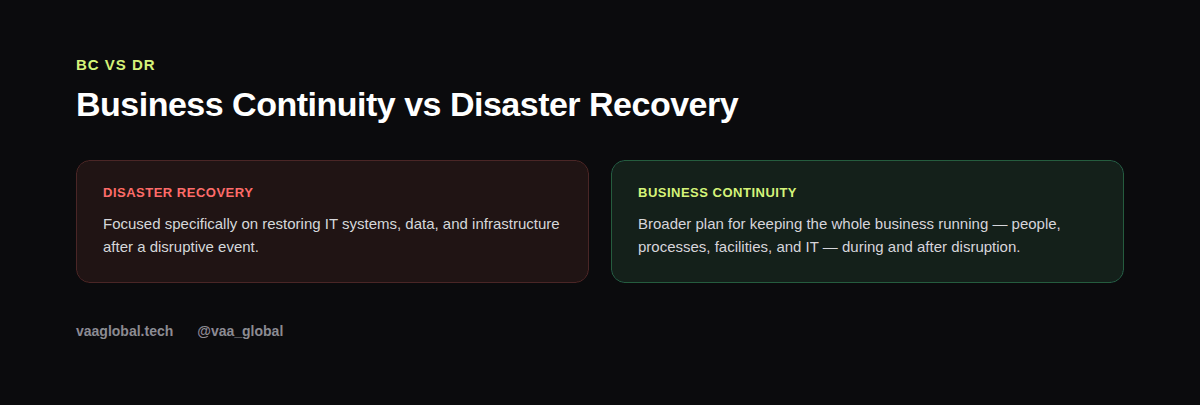
A business continuity plan (BCP) covers how an organization keeps critical functions running during a disruption — not just IT, but people, physical locations, suppliers, and communication with customers. If a flood shuts down a company's main office, business continuity planning covers questions like: where do employees work from, how do customers get served, and what gets prioritized while things stabilize?
Disaster Recovery: The IT-Focused Subset
Disaster recovery (DR) is narrower and more technical. It focuses specifically on restoring IT systems, applications, and data after an outage, cyberattack, or infrastructure failure. A disaster recovery plan usually documents backup locations, failover procedures, and the specific technical steps needed to get systems back online.
Why Disaster Recovery Sits Inside Business Continuity
Think of disaster recovery as one critical piece of a much larger business continuity puzzle. IT recovery matters enormously, but a company can have a flawless DR plan and still fail during a crisis if nobody planned for things like staff communication, physical safety, or which business functions matter most when everything can't be restored at once. That's why mature GRC and risk programs treat DR as a subset of BC rather than a replacement for it.
Two Key Metrics: RTO and RPO
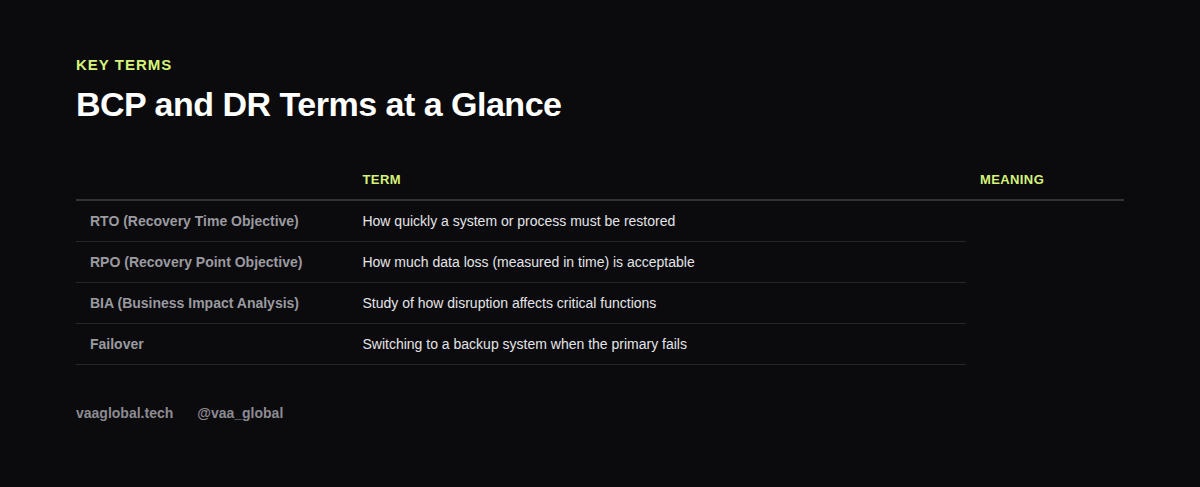
Two terms show up constantly in both BC and DR planning, shown in the table below: Recovery Time Objective (RTO), which is how quickly a system or process needs to be restored, and Recovery Point Objective (RPO), which is how much data loss, measured in time, is acceptable. A system with an RTO of four hours and an RPO of fifteen minutes needs to be back online within four hours, having lost no more than fifteen minutes of data.
Business Impact Analysis: Where Planning Starts
Before writing either plan, most organizations run a business impact analysis (BIA) — a structured study of how disruption would affect different business functions, and which ones absolutely cannot go down without serious consequences. The BIA is what tells you which systems deserve an aggressive RTO and which ones can realistically wait a few days to come back online.
A Worked Example
Imagine an online retailer whose main data center loses power. Disaster recovery kicks in first, failing over to a backup data center to restore the website and order-processing systems within the planned RTO. Business continuity covers the rest: customer service staff working from a backup communication channel, a public statement acknowledging the outage, and a plan for catching up on any orders placed during the gap. Both plans run in parallel, but they're solving different problems.
Common Questions Beginners Ask
A frequent question is is disaster recovery part of business continuity — yes, as explained above, DR is generally treated as one component within the broader BC umbrella. People also ask what is RTO and RPO, which are the two metrics covered in detail above: how fast you need to recover, and how much data loss is tolerable. On how do you write a business continuity plan, it typically starts with a business impact analysis, followed by documented recovery strategies, assigned responsibilities, and regular testing. And who is responsible for disaster recovery — usually IT and security teams own the technical execution, though overall accountability often sits with a risk, operations, or GRC function overseeing the whole continuity program.
Crisis Management: The Human Layer
Crisis management sits alongside both plans, covering how leadership communicates and makes decisions during the actual event, in the moment, rather than the pre-written procedures themselves. A disaster recovery plan (DRP) might flawlessly fail over every system on schedule, but if nobody's communicating clearly with staff and customers during the chaos, the business can still suffer real reputational damage. That's why continuity programs increasingly treat crisis communication as its own workstream, tested separately from the purely technical DRP steps. The U.S. government's planning resources at ready.gov offer a useful, non-technical starting point for thinking through this human side of continuity planning.
Why This Matters for Your Career
Understanding both BC and DR planning is a strong, practical skill for GRC, operations, and IT-adjacent roles alike, since almost every organization needs some version of both plans. If you're building toward operations-focused roles, our guide on key metrics every operations manager should track and how to transition into operations management pair well with this topic, and VAA Global's Operations Management course covers process design and improvement skills that overlap directly with continuity planning.
Downtime: The Cost That Ties It All Together
Every hour of downtime, whether caused by a technical failure or a facility issue, carries a real cost: lost revenue, frustrated customers, and sometimes regulatory exposure if service-level commitments get breached. That's the real reason RTO and RPO targets matter so much; they translate an abstract fear of disruption into concrete numbers a business can plan, budget, and test against, instead of just hoping things go smoothly during the next outage.
The Bottom Line
When people ask about business continuity vs disaster recovery, remember that one is the whole umbrella — keeping the organization running — and the other is the specific technical piece focused on IT restoration. Understand both, and understand how they fit together, and you'll be able to speak credibly about resilience planning in almost any interview.