Getting policy management basics right matters more than most people expect, because a policy nobody follows is often worse than having no policy at all — it creates a documented promise the company isn't keeping, and that's exactly the kind of gap an auditor or regulator will find. Policy management is the discipline of creating, approving, publishing, and maintaining the rules an organization lives by, and then actually keeping those rules current as the business changes.
Why Policy Management Is Its Own Discipline
At a small company, policies can live in someone's head and that mostly works. Once a company grows past a certain size, though, unwritten rules create real risk. New hires don't know what's expected. Auditors have nothing to test against. And when something goes wrong, nobody can point to what the standard actually was. Policy management exists to close that gap, turning informal expectations into documented, enforceable rules with a policy owner responsible for keeping each one current.
Policy vs Standard vs Procedure
So what is the difference between a policy and a procedure? People use these words loosely, but in a mature GRC program they mean different things.
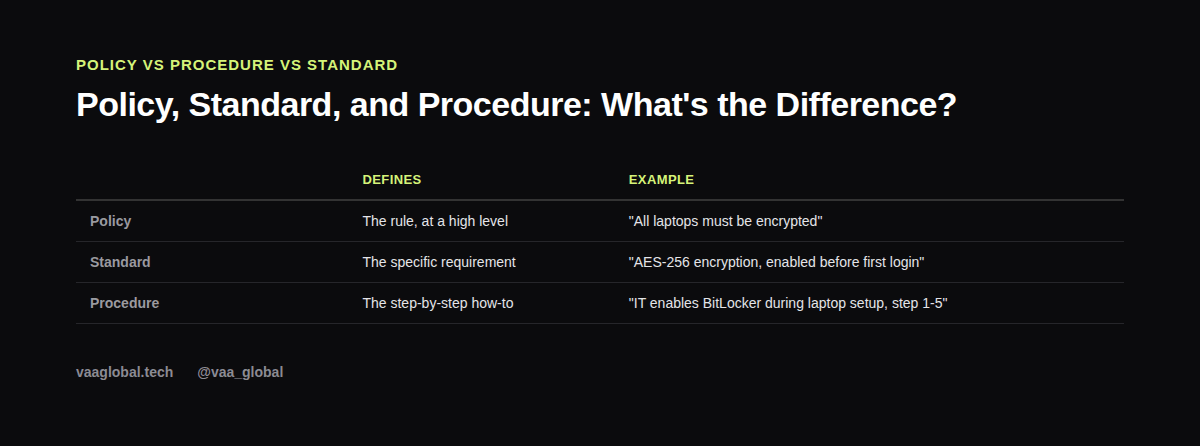
A policy states the high-level rule — what must happen and why. A standard gets more specific about the exact requirement that satisfies the policy. A procedure is the step-by-step instructions someone follows to actually do it. Keeping these layers separate matters because policies should rarely change, while procedures might need updating every time a tool or process shifts slightly.
The Policy Management Lifecycle
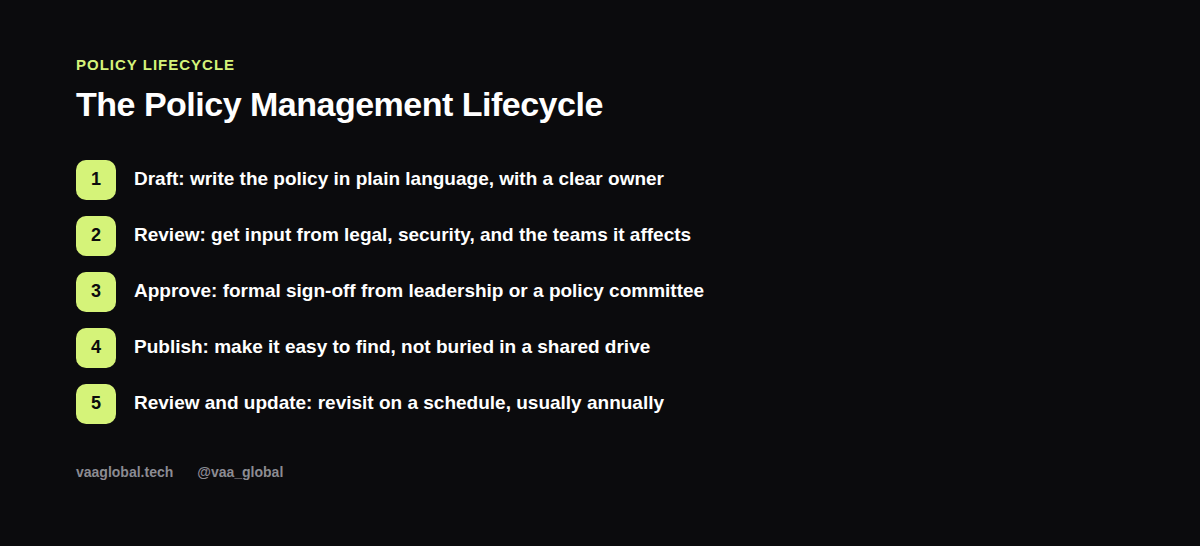
Most effective policy management programs follow a five-stage lifecycle. First, draft: write the policy in plain language, with a named owner responsible for it. Second, review: get input from legal, security, and the teams the policy will actually affect — this step catches unworkable rules before they get approved. Third, approve: formal sign-off, typically from leadership or a dedicated policy committee. Fourth, publish: make the policy genuinely easy to find, not buried three folders deep in a shared drive nobody checks. Fifth, review and update: revisit the policy on a set schedule, commonly annually, and update it whenever the underlying business process changes.
How Often Should Policies Be Reviewed?
How often should policies be reviewed is one of the most common questions beginners ask, and the honest answer is: it depends on risk and change frequency. A data retention policy tied to a slow-moving regulation might only need annual review. A policy covering a fast-changing area, like remote work or acceptable use of AI tools, might need review every six months, because the underlying reality keeps shifting faster than an annual cycle can track.
Who Owns a Company Policy?
Who owns a company policy is a question that trips up a lot of new GRC analysts. The answer should never be "nobody" or "whoever wrote it originally and then left the company." Every policy needs a named, current owner — usually a department head or subject matter expert — responsible for keeping it accurate, answering questions about it, and driving the review cycle. Without clear ownership, policies quietly go stale and stop matching reality.
What Makes a Policy Enforceable
What makes a policy enforceable comes down to a few practical things: it has to be written clearly enough that people can actually follow it, it has to be realistic given how the business actually operates, and there has to be some mechanism — training, monitoring, or consequences — that connects the written rule to real behavior. A policy that's vague, unrealistic, or never checked is effectively unenforceable, no matter how official it looks.
A Worked Example: Sample Policy Document Outline
A clean, enforceable policy document usually includes these sections:
- Purpose: Why this policy exists and what risk it addresses.
- Scope: Who and what systems the policy applies to.
- Policy statement: The actual rule, written in plain, direct language.
- Roles and responsibilities: Who owns it, who enforces it, who must comply.
- Exceptions process: How someone requests a documented exception, and who approves it.
- Review cycle: How often it's reviewed and by whom.
- Revision history: A simple log of what changed and when.
This structure also pairs directly with the practical guidance in how to write a GRC policy document, since the outline above is the skeleton most real policies are built on.
Policy Management Software
As the number of policies grows, spreadsheets and shared drives start to break down. Policy management software helps by tracking review dates, routing approvals, keeping version history, and linking each policy to the controls and risks it supports. It's not mandatory for a small team, but it becomes genuinely useful once you're managing more than a handful of policies across multiple departments.
Policy Management as a GRC Career Skill
Policy management is a core, highly transferable GRC analyst skill. It rewards clear writing, stakeholder diplomacy (since policies touch nearly every department), and consistent follow-through on review deadlines. If you're exploring related operational skills, VAA Global's Operations Management course covers process design and improvement, which overlaps meaningfully with how policies get turned into working procedures, even though it isn't a GRC-specific program. For readers mapping out a broader path, how to become a business analyst in 2026 covers adjacent documentation and stakeholder skills worth building alongside policy work, and best tools for business analysts is a useful companion read since several of those tools double as policy documentation tools. The Institute of Internal Auditors publishes broader governance and controls guidance worth reading if you want the fuller picture of how policy fits into a governance framework.
The Bottom Line
Policy management basics come down to treating policies as living documents, not one-time paperwork. Draft them clearly, assign real owners, review them on a schedule that matches their risk, and make sure there's a mechanism connecting the written rule to actual behavior. Done consistently, this is what keeps a GRC program credible — both to auditors and to the people expected to follow the rules every day.