

Medical virtual assistant patient satisfaction surveys often get treated as an afterthought, sent out automatically and rarely read closely, but they're actually one of the clearest signals a practice has about what's working and what's quietly driving patients away. If you're supporting a clinic remotely, knowing how to build, send, and act on these surveys turns a routine task into something that genuinely shapes patient experience.
What a Good Survey Actually Measures
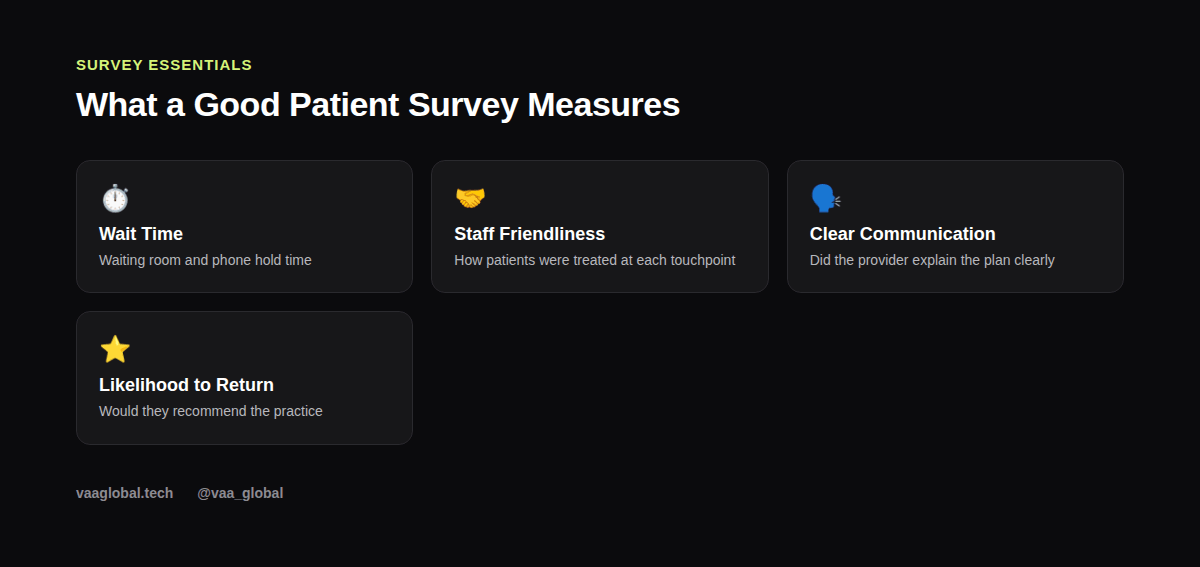
Most useful surveys focus on a handful of core areas: wait time (both in the waiting room and on hold by phone), staff communication and friendliness, how clearly the provider explained the diagnosis or plan, ease of scheduling, and overall likelihood to recommend the practice. Keeping the survey short, five to eight questions at most, dramatically improves completion rates compared to a long form that feels like homework.
Sample Survey Questions (For Training Purposes Only)
Here are simplified example questions a practice might use: "On a scale of 1-5, how satisfied were you with your wait time today?" "Did our staff explain your treatment plan clearly?" (Yes/No/Somewhat) "How likely are you to recommend our practice to a friend or family member?" (1-10 scale) "Is there anything we could have done better during your visit?" (open text). Notice the mix: a few quick scaled questions for easy analysis, plus one open-ended question that often surfaces the most useful, specific feedback.
When and How to Send the Survey
Timing matters more than most people expect. Sending a survey within 24 to 48 hours of the visit, while the experience is still fresh, gets noticeably better and more accurate responses than waiting a week. Text message and email both work well, but text tends to get a faster, higher response rate for short surveys. A medical VA typically automates this through the practice's patient communication tool, though manual sending is still common in smaller practices without that software in place.
Step-by-Step: Running a Survey Program
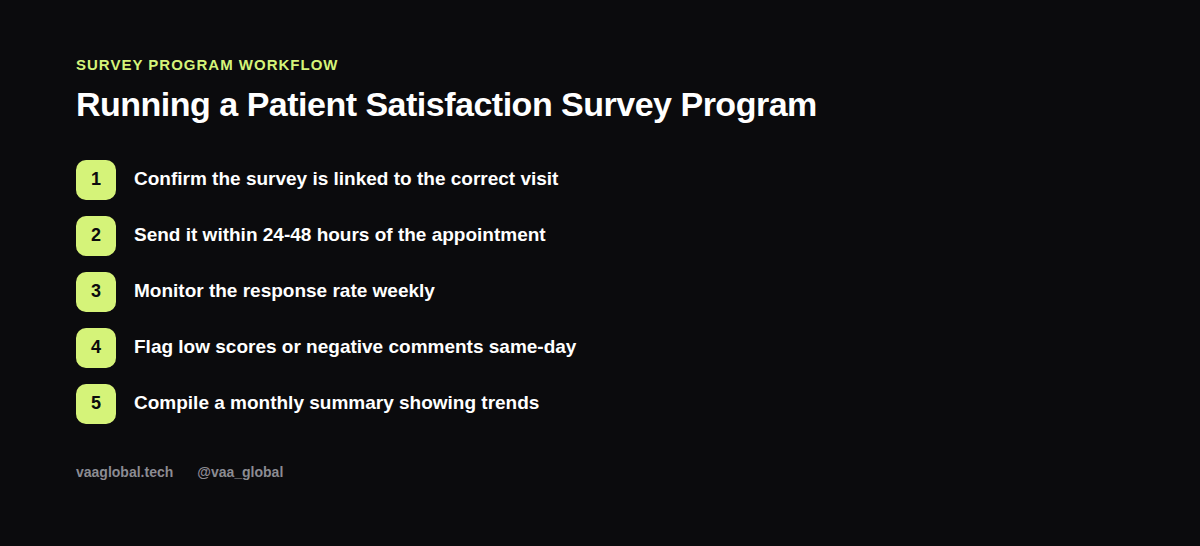
A simple, repeatable process looks like this: first, confirm the survey is attached to the correct visit and patient; second, send it within the 24-to-48-hour window after the appointment; third, monitor the response rate weekly rather than letting responses pile up unseen; fourth, flag any low scores (typically a 1 or 2 out of 5, or any negative open-text comment) to the practice manager within the same day; and fifth, compile a simple monthly summary showing trends, not just raw numbers. This patient feedback collection habit is what turns scattered responses into something a practice can actually act on.
Improving a Low Survey Response Rate
If your response rate is stuck below 15 to 20 percent, a few fixes usually help: shorten the survey further, send it through the channel the patient actually prefers (check their contact preference on file), and make sure the message doesn't look like spam or a sales pitch. A subject line or text preview that clearly says it's a quick feedback request from the practice performs noticeably better than a generic "We value your feedback!" message that patients learn to ignore.
Turning Feedback Into Real Action
Collecting surveys is pointless if nothing changes because of them. A useful habit is grouping comments by theme each month: scheduling friction, wait times, billing confusion, or communication gaps. If three patients in a month mention the same front-desk frustration, that's a pattern worth raising directly, not a coincidence to ignore. This kind of analysis connects naturally with other patient-experience work covered in VA Global's guide on phone etiquette on patient calls and appointment scheduling, since both are frequent sources of patient frustration that surveys reliably surface.
Handling Negative Feedback Professionally
A low score or an angry comment isn't a personal attack, and treating it that way helps no one. Flag it, pass it along per the practice's process, and if you're the one following up directly with the patient, acknowledge their concern specifically rather than offering a generic apology. This overlaps closely with the skills covered in VA Global's guide to difficult patient calls, since a frustrated survey respondent and a frustrated caller need a very similar tone from you.
Building This Skill From the Start
You don't need a background in data analysis or market research to run a solid survey program; you need consistency, basic spreadsheet comfort, and a genuine interest in what patients are telling the practice. VA Global's Medical Virtual Assistant Training course covers healthcare administration fundamentals like this across its six beginner-level modules, with no prior medical background required to get started. For broader research on measuring patient experience, the AHRQ CAHPS program is a widely referenced federal resource on standardized patient experience surveys.
The Bottom Line
Medical virtual assistant patient satisfaction surveys work best when they're short, sent promptly, reviewed consistently, and actually acted on. Build that habit early in your career, and you'll become the person a practice relies on to catch small problems before they turn into lost patients.
Simple Metrics Worth Tracking Over Time
Beyond individual responses, it helps to track a few patient experience metrics month over month: average satisfaction score, response rate, and a rough net promoter score if your survey includes a recommend-to-a-friend question. For example, if average scores dip two months in a row right after a new scheduling system launches, that's a clear signal worth investigating further rather than dismissing as noise. Similarly, if your response rate climbs after you switch from email to text reminders, that single data point can justify the switch practice-wide. Response tracking like this turns a pile of individual comments into a feedback loop the whole practice can actually use, instead of a folder of surveys nobody revisits.



