
Medical virtual assistant patient consent forms show up constantly in healthcare administration, whether it's a general treatment consent at intake, a HIPAA acknowledgment, or authorization for a specific procedure, and understanding the different types matters because each one serves a very different legal and clinical purpose. Mixing them up, or treating them as a quick formality, is one of the easiest ways a practice ends up with a documentation gap.
The Main Types of Consent Forms
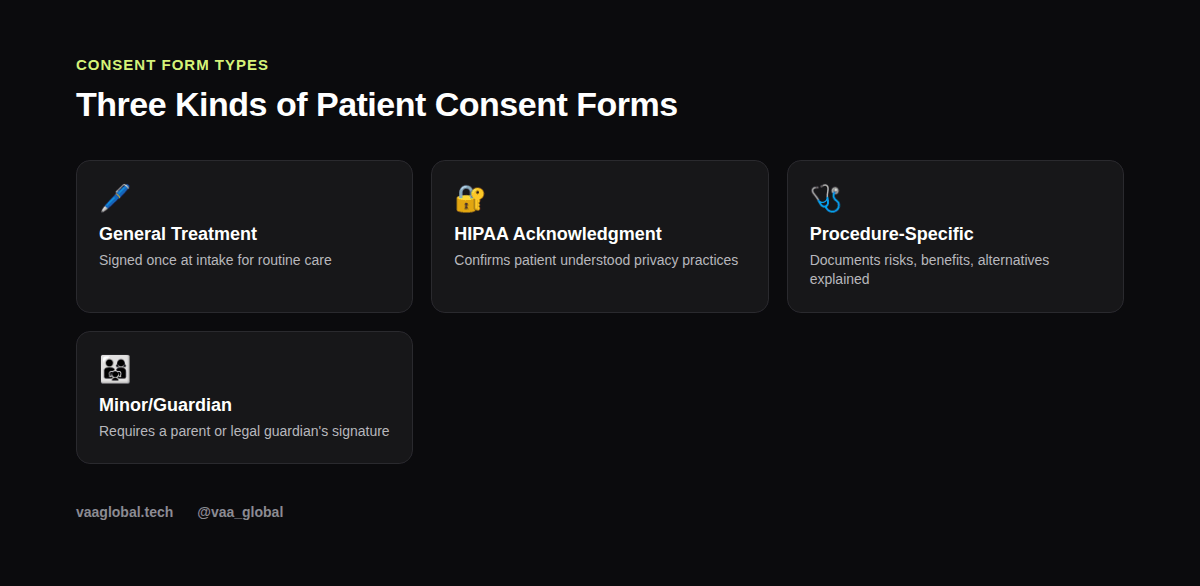
A general consent for treatment is usually signed once at intake and covers routine care at the practice. A HIPAA consent form (more precisely, a Notice of Privacy Practices acknowledgment in most practices) confirms the patient received and understood how their health information will be used and shared. A procedure-specific informed consent form documents that a provider explained a specific procedure's risks, benefits, and alternatives before the patient agreed to it. Each has a different purpose, and none of them substitute for another.
What Is Informed Consent in Healthcare?
Informed consent means a patient has been given enough information, in understandable terms, to make a genuinely voluntary decision about their care. It's not just a signature; it's a conversation that should have already happened before the form is even presented. A signed form with no real explanation behind it is a documentation risk, not a protection, for the practice, which is exactly why the conversation matters as much as the paperwork.
Can a Medical VA Collect a Consent Form?
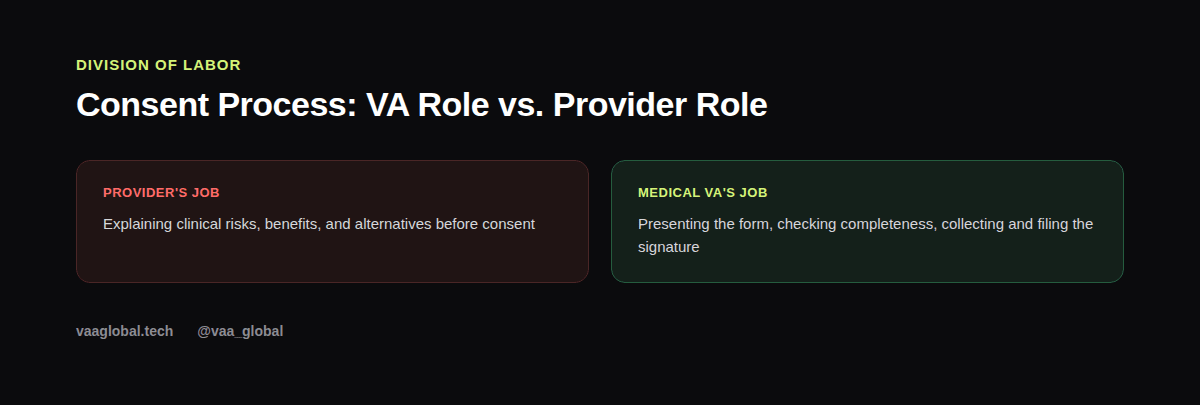
Yes, in most cases a medical VA can manage the logistics: presenting the form (often electronically through a patient portal or intake system), confirming all required fields are completed, collecting the signature, and filing it correctly in the chart. However, a medical VA should never be the one explaining the clinical risks and benefits of a procedure; that conversation belongs to the provider. If a patient has questions about what they're consenting to beyond basic form navigation, route them straight to clinical staff rather than trying to answer yourself.
A Simple Pre-Visit Consent Checklist
Before a visit requiring a new or updated consent form, a reliable checklist includes: confirming the correct form version is being used (forms get updated periodically), verifying the patient's name and date of birth match the chart, checking that all required fields and dates are filled in, confirming a signature and date are present, and, where required, confirming a witness signature is included. Missing any single field can make a form legally insufficient, which is why this quick check matters every single time, not just occasionally.
What Happens If a Consent Form Is Incomplete?
An incomplete form is treated, for practical and legal purposes, as if consent was never properly documented at all. Depending on the situation, this might mean rescheduling a procedure, delaying treatment until the form is corrected, or in a worst case, exposing the practice to real liability if something goes wrong and documentation can't support that the patient was properly informed. Catching an incomplete form before a visit, rather than during or after, is one of the most valuable things a detail-oriented medical VA does.
Special Considerations for Minors and Guardianship
Consent forms for minor patients typically require a parent or legal guardian's signature instead of (or alongside) the patient's own, and practices often require documentation confirming the signer's legal authority to consent on the minor's behalf. A medical VA should always follow the practice's specific policy here rather than assuming, since state rules and practice policy both affect exactly who can sign for a minor's care.
How This Connects to Broader Compliance Work
Consent forms sit closely alongside other documentation tasks, including release of information requests and general patient data protection practices, since both involve carefully controlling who sees or shares a patient's health information. For authoritative guidance on HIPAA and patient rights, the U.S. Department of Health and Human Services HIPAA resources are the right reference point for anything beyond your practice's own policy. VA Global's Medical Virtual Assistant Training course covers HIPAA compliance as one of its six beginner-level modules, building the foundation needed to handle consent paperwork responsibly.
The Bottom Line
Medical virtual assistant patient consent forms work best treated as a careful, checklist-driven process rather than a quick formality. Know which form covers which purpose, verify every field before filing, and always route clinical explanation questions to the provider rather than answering them yourself.
Storing Consent Forms Correctly
Once a form is signed, filing matters just as much as collecting it. Scan or upload the signed form into the correct patient chart on the same day, because a signed paper form sitting in a drawer offers no legal protection to anyone. Also tag or label the form by type and date so a future audit or a question from a provider can locate it quickly. For example, if a malpractice question ever comes up about a procedure from two years ago, the practice needs to find that exact signed authorization within minutes, not hours. Building this filing habit from your very first week saves real stress down the line.
Renewing Consent When Things Change
Consent forms are not permanent. A general treatment consent often needs renewal annually, and a procedure-specific consent only ever covers the exact procedure described, not a related or follow-up procedure added later. If a provider decides mid-visit to perform something beyond what was originally consented to, a new form is usually required before proceeding, except in a genuine emergency. Flagging this gap for the provider, instead of assuming the original form still applies, is one of the simplest ways a medical VA adds real protection to a practice.



