

The medical billing specialist vs medical virtual assistant question comes up a lot from beginners trying to pick a starting point in remote healthcare support, and the honest answer is that these are genuinely different roles with some overlap, not just two names for the same job. Understanding the real difference helps you choose the path that actually fits your strengths rather than picking blindly.
What A Medical Billing Specialist Actually Does
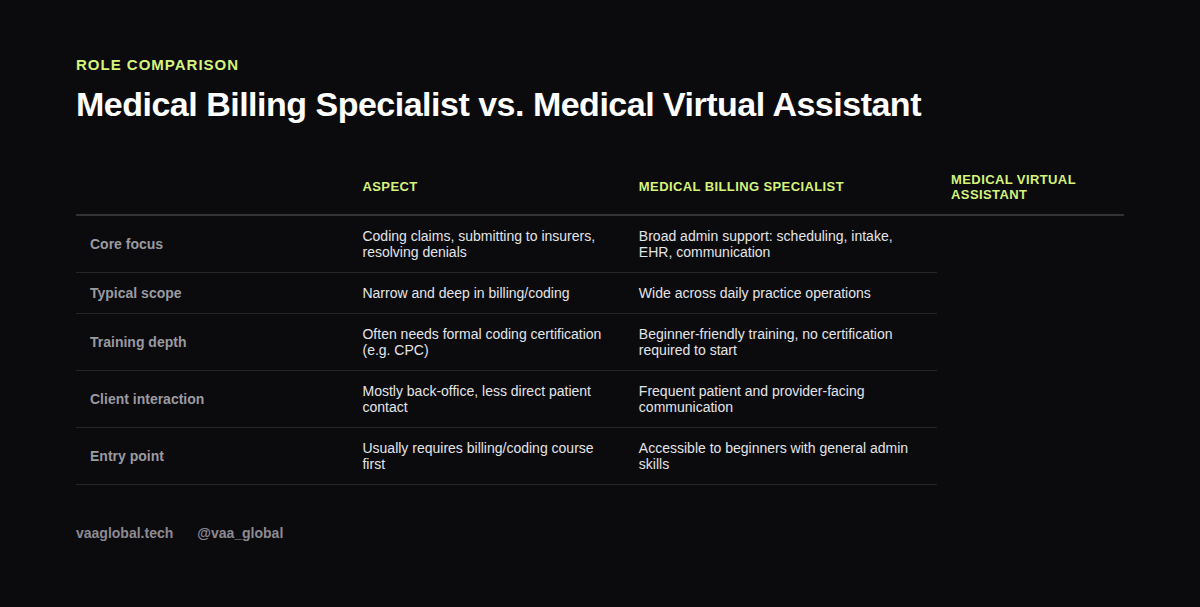
A medical billing specialist works deep inside the revenue cycle: assigning correct codes to procedures and diagnoses, submitting claims to insurers, tracking payments, and resolving denied or rejected claims. It's detail-heavy, repetitive-in-a-good-way work that rewards accuracy and a strong grasp of coding systems. Our piece on medical billing and coding workflow goes deeper into what this actually looks like day to day.
The Scope Of A Medical Virtual Assistant, By Comparison
The scope of a medical virtual assistant is intentionally broader. You might handle scheduling in the morning, patient intake forms at noon, and EHR data entry in the afternoon, often for the same practice in the same day. If you want the full picture, our guide on daily tasks walks through a realistic day.
Medical Billing Certification Requirements Vs MVA Training
Medical billing certification requirements are more formal than what's needed to start as an MVA. Many billing specialists pursue certifications like the CPC (Certified Professional Coder) before they're hired, since coding accuracy has direct financial consequences for a practice. A medical virtual assistant role, by contrast, is generally beginner-friendly; VAA Global's own Medical Virtual Assistant Training course is a 6-module, beginner-level program with no prior medical background required, and it includes job assistance after graduation.
Where The Two Roles Overlap
There's real overlap: both roles need HIPAA awareness, EHR comfort, and attention to detail, and MVAs often touch basic billing tasks like insurance verification or light billing support, understanding our guide on medical coding boundaries for an MVA. The key difference is depth versus breadth, not a complete absence of overlap.
Healthcare Admin Career Paths: Where Each Role Can Lead
Healthcare admin career paths from a billing specialist role often lead toward specialized coding, auditing, or compliance roles over time. An MVA's path tends to branch wider, from general admin support toward specialization in a specific type of practice, team leadership, or eventually building an agency of your own.
Choosing A Remote Healthcare Role That Fits You
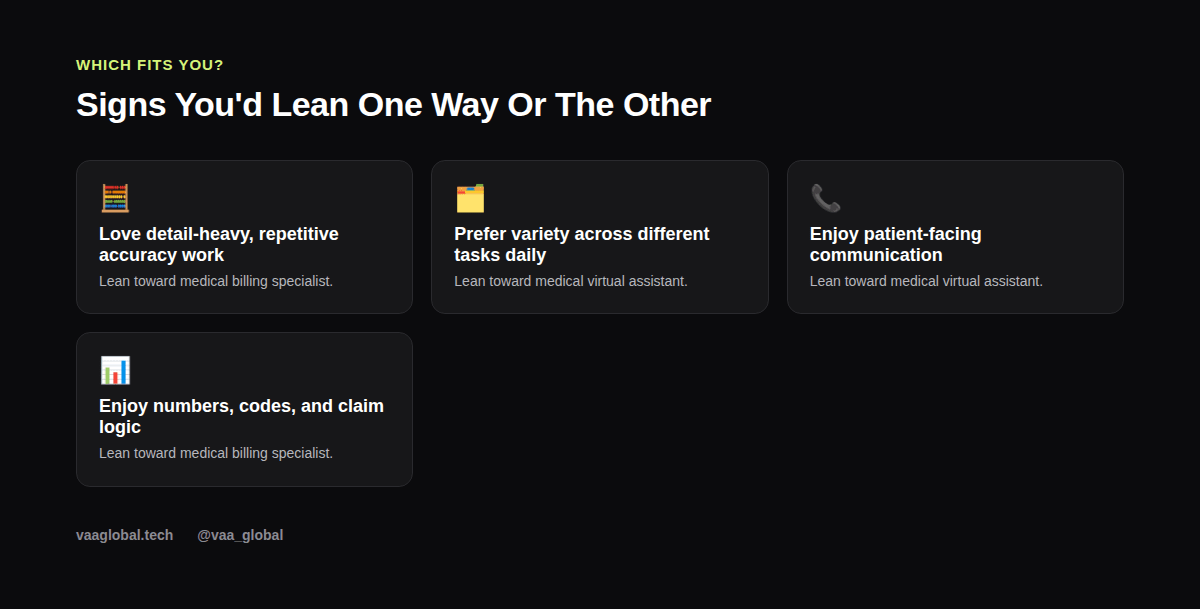
Choosing a remote healthcare role comes down to honest self-assessment. If you love detail-heavy, numbers-and-codes work with less day-to-day variety, billing specialist work likely suits you better. If you enjoy variety, patient-facing communication, and juggling several different task types in one day, medical virtual assistant work is probably the better fit.
Pay Potential: A Realistic, General Comparison
Pay potential varies significantly by client, experience, and location, so specific numbers aren't reliable to quote here, but generally, specialized billing and coding roles can command a premium once certified, while MVA roles offer more flexibility and a faster, lower-barrier entry point. For accurate, current U.S. salary benchmarking on either role, the U.S. Bureau of Labor Statistics is a reliable, independent source; see their occupational outlook on medical records and billing roles for general context.
Which Should A Beginner Choose First?
For most beginners without a healthcare background, medical virtual assistant work is the more accessible starting point, since it doesn't require formal coding certification before you can begin earning. You can always layer billing-specific skills on top later if that path interests you, rather than needing to choose irreversibly on day one.
What Is The Difference Between Medical Billing And Medical Virtual Assistant Work?
What is the difference between medical billing and medical virtual assistant work, in one sentence? Depth versus breadth. A biller goes deep into one process: claims. An MVA goes wide across many processes in a single day. Neither is harder across the board. They're just structured differently, and that structure suits different kinds of people.
Do I Need Certification To Be A Medical Biller?
Do I need certification to be a medical biller before anyone will hire me? Often, yes, especially for higher-paying or specialized roles. Some entry-level positions train on the job, but most employers prefer a recognized credential. This is one of the clearest practical differences from MVA work, where formal certification generally is not required to start.
Which Role Pays More: Medical Billing Or MVA?
Which role pays more, medical billing or MVA, in general terms? It depends heavily on experience, certification, and client type, so treat any specific number you see online with caution. As a rough pattern, certified billing specialists can earn a premium for their specialization, while MVA work tends to offer faster entry and more flexible, varied income streams instead.
The Bottom Line
Medical billing specialist vs medical virtual assistant isn't a question of which role is better, it's a question of which scope and skill set fits you. Billing rewards deep, detail-focused accuracy; MVA work rewards versatility and comfort with variety. Either path builds a legitimate remote healthcare career, and understanding the real difference now helps you start in the right place.



