
Salary isn't the only thing on the table once an offer lands. Learning how to negotiate start date and remote flexibility can matter just as much to your day-to-day life, especially if you need time to wrap up a current role or you work best outside a rigid nine-to-five. Most candidates never ask, assuming the terms are fixed, when in reality most hiring managers expect this request and usually welcome it.
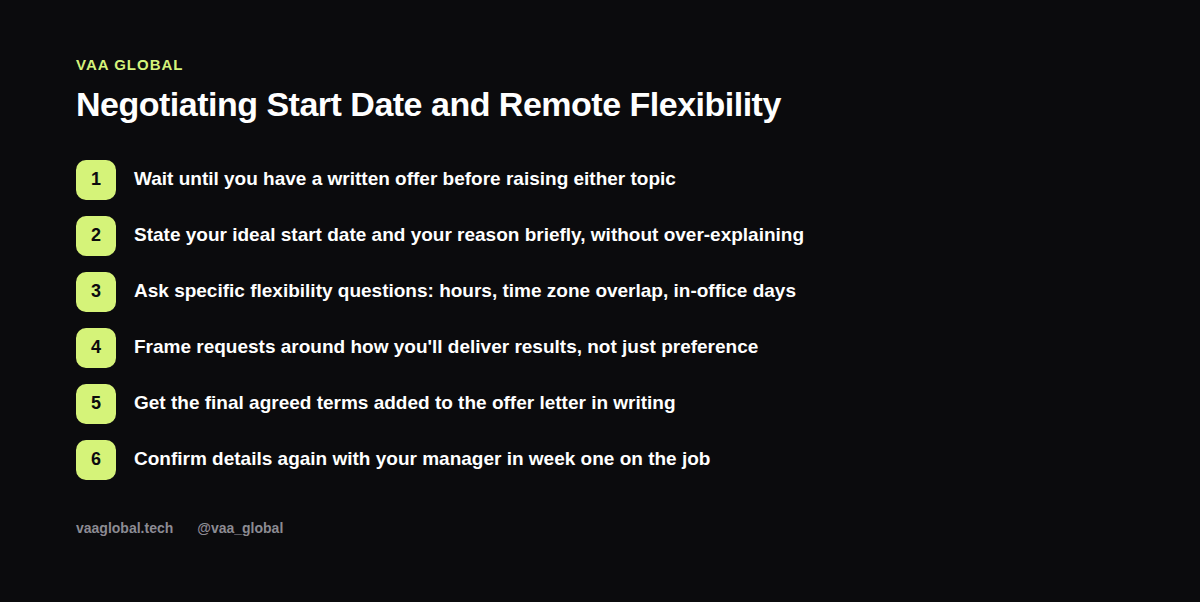
Wait Until You Have a Written Offer
Raising either topic too early, before an offer exists, can sound presumptuous. Once you have something in writing, you're negotiating details of a job you've already been offered, which is a very different conversation than negotiating whether you'll get the job at all.
How to Ask for a Later Start Date
Keep it short and give one honest reason. Here's a usable script:
“I'm excited to accept and start contributing. Given my notice period at my current role, would it be possible to start on [date], about three weeks out, rather than [original date]? I want to leave my current team in good shape before I move on.”
How Much Delay Is Reasonable?
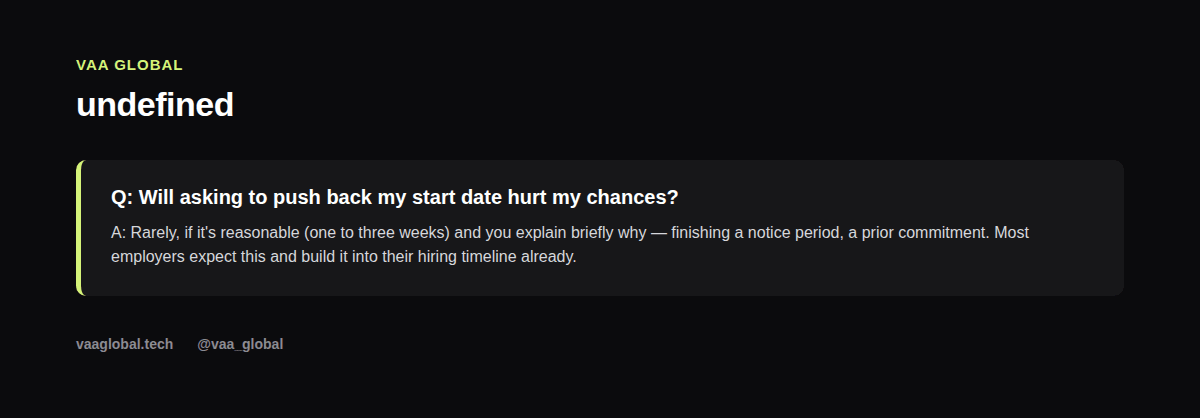
Most hiring managers see one to three weeks as reasonable, and it rarely raises concerns. Anything beyond a month starts to require a stronger reason, and the employer may simply have a hard deadline tied to a project or team need, so be ready to hear “no” to a longer delay even if the shorter version is easy to grant.
Negotiating Remote Flexibility Specifically
“Remote” can mean fully async, or it can mean remote with mandatory nine-to-five availability and daily video calls. Before assuming either, ask direct questions: what are the core hours, how much time zone overlap is expected with the team, and does the offer include any in-office requirement that the job posting didn't mention.
Frame Flexibility Requests Around Delivery, Not Preference
“I work better with flexible hours” is a weaker ask than “I'll have [X hours] of overlap with the team daily and can deliver [specific outcomes] on the agreed timeline, with flexibility on exactly when I do the rest of my work.” Employers mostly care that results show up on time — show them that flexibility won't change that.
Sample Script for Flexible Hours
“I'd love to confirm the expected working hours before I start. I can commit to [X hours] of overlap with the team each day — would it be possible to have flexibility on the remaining hours, as long as deadlines and meetings are met?”
Get It in Writing
Verbal agreements have a way of getting lost once the hiring manager moves on to the next thing. Whatever you agree on — start date, hours, flexibility terms — ask the hiring manager to add it to the written offer letter or a follow-up email before you sign anything. This is also a good moment to revisit how to get a job offer letter if you haven't already received formal documentation.
Confirm Again in Your First Week
Once you start, briefly confirm the agreed terms with your manager during your first week, especially anything about hours or flexibility. Teams change, managers get busy, and you can clear up small misunderstandings far more easily on day three than three months in, once expectations have quietly drifted from what you actually agreed.
What If You're Comparing Several Opportunities?
Negotiating start date and remote flexibility gets trickier when you're weighing offers from different companies at the same time, since the timelines rarely line up neatly. If salary is also still an open question in one of those conversations, how to answer the expected salary question in a remote job interview is worth reviewing before you finalize terms with any one employer.
Why This Negotiation Is Usually Low-Risk
Unlike salary negotiation, which some candidates worry could cost them the offer, negotiating start date and remote flexibility rarely carries that risk once an offer is already in hand. Companies build in buffer for exactly this kind of request, and a brief, reasonable ask almost never changes an employer's mind about wanting you on the team. Candidates often build up more anxiety about this conversation than the actual risk ever justifies.
The Bottom Line
Negotiating start date and remote flexibility is a normal, expected part of accepting an offer, not an overreach. Wait for a written offer, ask clearly and briefly, frame flexibility around your delivery rather than just preference, and lock in whatever you agree on in writing — that last step of negotiating start date and remote flexibility in writing is what actually protects you once the role begins. If you're also weighing more than one offer at the same time, how to evaluate a job offer beyond salary covers the fuller picture, and a resource like Indeed's guide to negotiating a start date has additional phrasing examples if you want more scripts to draw from.