Figuring out how to break into supply chain with no experience feels harder than it actually is. Most entry-level postings list requirements that sound intimidating. However, those requirements are often negotiable once you have the right fundamentals and a certification to back them up. Supply chain is also one of the more accessible fields for career changers. Much of the work is learnable logic, not years of tacit experience.
Why Supply Chain Is More Accessible Than It Looks
Unlike some technical fields, supply chain management doesn't require years of coding. It doesn't require a specific degree either. Instead, it rewards people who understand how sourcing, inventory, logistics, and planning connect. As a result, a motivated beginner with the right certification can realistically compete against people holding unfocused "general business" degrees.
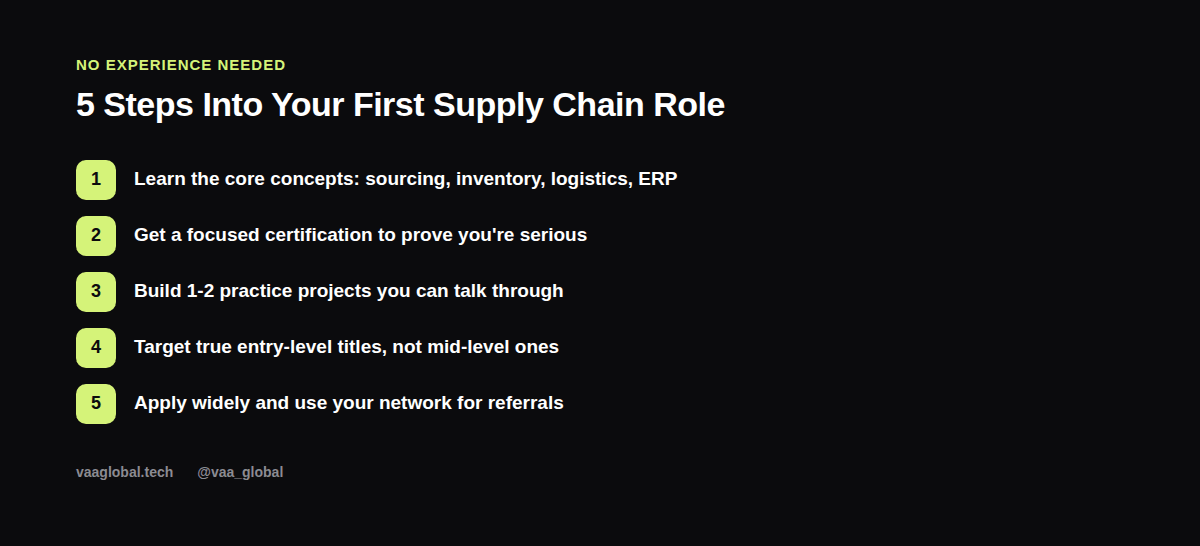
Step 1: Learn the Core Concepts First
Before applying anywhere, make sure you genuinely understand sourcing and procurement, inventory management, logistics, and the basics of ERP systems. This isn't about memorizing jargon. Instead, it's about explaining things in your own words. For example, why does a company need safety stock? How does a reorder point actually get calculated? For the inventory piece specifically, see inventory management basics for beginners.
Step 2: Get a Certification That Covers Real Ground
Do I need a degree for supply chain management? No — most entry-level roles don't require one. However, a focused certification signals to employers that you've put in structured effort, rather than just reading a few blog posts. Look for programs that cover sourcing, procurement, demand planning, inventory management, logistics, ERP systems, the SCOR model, and risk management, since these map directly onto real job requirements.
Step 3: Build Practice Projects You Can Talk Through
Since you likely won't have paid experience yet, build one or two practice projects: a simple inventory tracker in a spreadsheet, a mapped-out supply chain for a fictional product, or a short analysis of a real company's public supply chain disruption and how you'd have responded. These give you concrete things to discuss in interviews instead of vague claims about "being a fast learner."
Step 4: Target True Entry-Level Titles
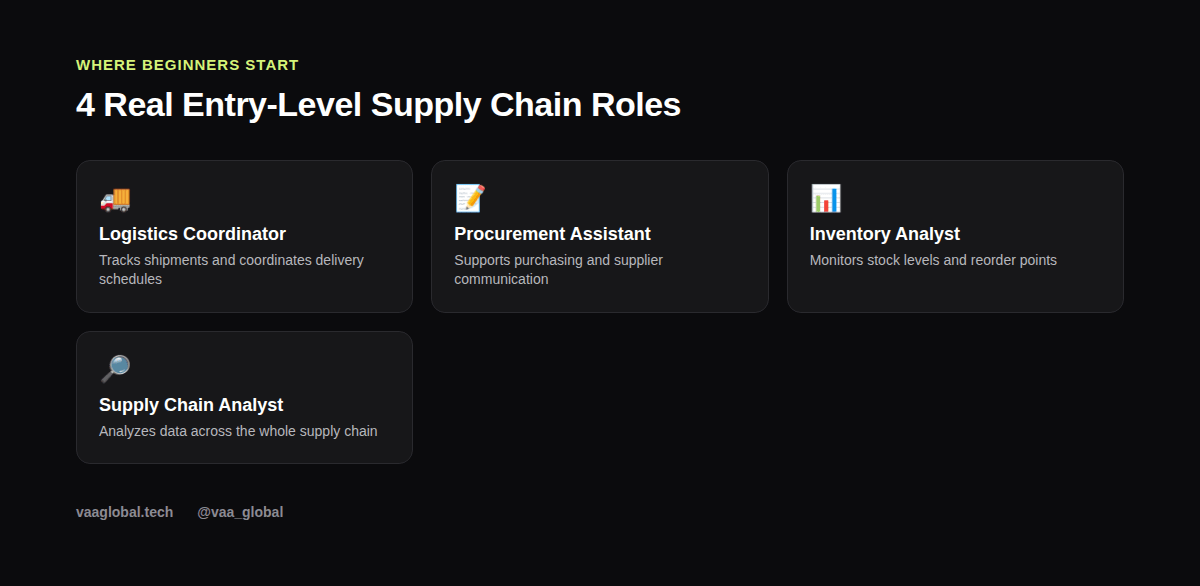
What entry-level jobs exist in supply chain? Logistics coordinator, procurement assistant, inventory analyst, and junior supply chain analyst are all genuinely entry-level titles that beginners regularly land. Avoid applying only to "supply chain manager" or "senior analyst" roles, which almost always expect years of hands-on experience that a beginner simply won't have yet.
Step 5: Apply Widely and Use Every Network Connection
Supply chain roles exist across almost every industry: retail, manufacturing, healthcare, e-commerce. So cast a wide net instead of fixating on one sector. Reach out to anyone in your network who works in operations or logistics, even loosely. Ask for a short, informational conversation. Referrals carry real weight for entry-level hiring, often more than a cold application does.
What Hiring Managers Actually Look For at This Level
At the entry level, hiring managers are mostly checking for three things: do you understand the fundamentals, can you communicate clearly under pressure, and are you coachable. Rehearsing how you'd answer common interview scenarios helps enormously here — see supply chain interview questions and answers for exactly what tends to come up, including scenario questions about handling supplier delays.
How Long Does It Realistically Take?
How long does it take to get a supply chain job with no experience? There's no universal number, but a focused path — a few weeks on a certification, a few weeks building practice projects, then a steady stream of applications — often produces an offer within 2-4 months. The timeline stretches if you're inconsistent with applications or skip the practice-project step entirely, since that's what makes your interview answers concrete instead of generic.
Understanding the Terminology Before You're in the Room
It also helps to be fluent in the vocabulary before interviews, especially the difference between closely related terms. See supply chain versus logistics and the SCOR model explained for beginners to make sure you're not confusing terms that sound similar but mean different things in practice. The Association for Supply Chain Management also offers free resources worth browsing.
A Simple Weekly Plan to Follow
Here's a plan you can start this week. Week one: learn the core concepts and start a certification. Weeks two and three: finish the certification and build your first practice project. Week four: build a second practice project and tidy up your resume and LinkedIn. From week five onward: apply to five entry-level roles a week, every single week, without exception. This simple cadence, done consistently, is what actually moves beginners from "studying" to "interviewing."
The Bottom Line
You absolutely can break into supply chain with no experience — the field rewards clear fundamentals and demonstrated effort more than it rewards a specific pedigree. Learn the core concepts, get a focused certification, build practice projects, target true entry-level titles, and apply consistently. VAA Global's 6-week Supply Chain Management Certification is built exactly for this path, covering sourcing, procurement, demand planning, inventory management, logistics, ERP systems, the SCOR model, and risk management.