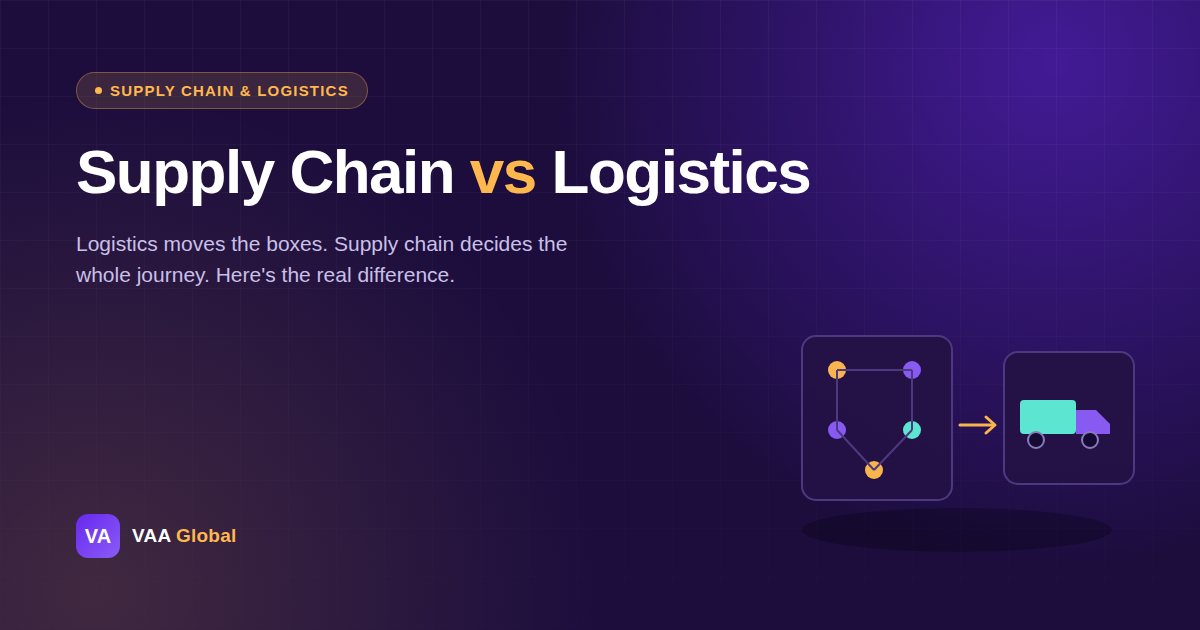
Supply chain vs logistics gets mixed up quite a lot. Even people already working in the field mix them up. Is logistics the same as supply chain? Not quite. Logistics is one part of a much bigger picture. This guide breaks down the real difference, in plain terms.
The Core Difference in One Sentence
Supply chain management is the whole journey. It runs from raw materials all the way to the final customer. Logistics is just one part of that journey. It handles moving and storing goods along the way. That one line explains almost everything else below.
What Supply Chain Management Actually Covers
Supply chain management includes sourcing raw materials. It includes coordinating with suppliers. It includes planning production and managing customer service policies. In fact, it looks at the entire chain of companies involved in creating and selling a product. Because of this, it is a strategic, long-term function, not a daily task list.
What Logistics Actually Covers
Logistics focuses on moving and storing goods within one organization. For example, think warehousing, transportation, and inventory management. It is tactical, not strategic. As a result, logistics teams handle the daily execution. That execution keeps products flowing smoothly from one point to the next.
Internal vs External: Where They Really Differ
Logistics operates mostly inside a single company. Supply chain management, by contrast, coordinates across many companies at once. This includes suppliers, manufacturers, and retailers. As a result, supply chain roles often involve more negotiation and relationship building than logistics roles typically do day to day.
Which Skills Matter Most for Each Field?
Supply chain professionals lean on strategic planning and procurement. They also rely on supplier relationship management. Logistics professionals lean more on scheduling, warehousing, and transportation coordination instead. Because of this split, a logistics coordinator role often suits people who prefer hands-on, operational work. Broader supply chain roles, on the other hand, suit people who enjoy strategy and negotiation.
Supply Chain vs Logistics: Which Pays More?
Broader supply chain roles often pay more than pure logistics roles. This is because they carry more strategic responsibility. They also typically sit higher up in a company's overall organizational structure. However, both fields offer strong entry points. According to independent comparisons of the two fields, logistics is best understood as one function nested inside the broader discipline of supply chain management.
Can You Move Between the Two Fields Later?
Yes, and many people genuinely do exactly that over time. Some logistics coordinators move into broader supply chain roles once they want more strategic responsibility. Others stay in logistics for years instead, since hands-on operational work genuinely suits them well. Either direction is realistic, so your first choice does not have to be a permanent, locked-in decision at all.
How to Start Building a Career in Either Field
Both fields reward real training over guesswork. Each one has its own tools, vocabulary, and best practices to learn. If you want a guided path, explore VAA Global's Supply Chain Management training program, built for beginners with no prior experience. You can also take VAA Global's free Career Compass quiz to confirm this path fits you, browse the full list of 33 VAA Global courses if you are still deciding between tracks, or read about VAA Global's story and approach to training.
Do You Need a Degree for Either Career?
Not necessarily. Many logistics and supply chain roles hire based on demonstrated skill and practical training, not a specific degree. That said, structured training still helps a lot, since it teaches the tools and vocabulary that employers expect on day one, without years of trial and error along the way.
The Bottom Line
Supply chain vs logistics is not really a rivalry. Logistics sits inside the bigger supply chain picture. If you enjoy hands-on, daily coordination, logistics is a strong starting point. If you enjoy strategy and supplier relationships, broader supply chain management fits better. Either path is a real, in-demand career worth building, and both remain in steady demand across nearly every industry that moves physical goods.