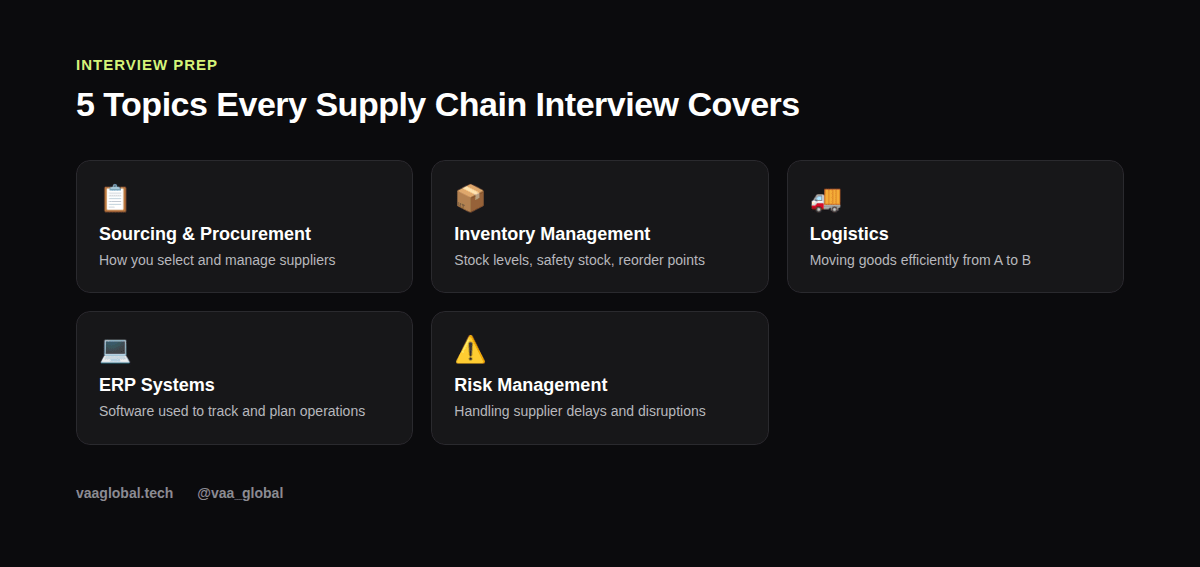
Getting ready for supply chain interview questions and answers is much less stressful once you realize most interviewers ask variations of the same core topics: sourcing, inventory, logistics, ERP systems, and risk management. Instead of memorizing scripts, focus on understanding how these pieces connect, because that's what interviewers are really testing.
Why These Questions Keep Coming Up
Because entry-level supply chain jobs genuinely revolve around sourcing, inventory, logistics, and systems, interviewers test your grasp of these basics directly. If you can speak clearly about each area, with one example apiece, you'll handle most of what comes up. Scenario questions are where candidates often get nervous, so we'll spend extra time there.
Question 1: "What Is Supply Chain Management, in Your Own Words?"
Interviewers ask this to check whether you can explain things simply, not textbook-perfect. A strong answer: "Supply chain management is the process of getting a product from raw materials to the end customer efficiently — covering sourcing, production, inventory, and delivery, while managing cost and risk at each step."
Question 2: "Walk Me Through How You'd Manage Inventory for a Retailer"
This checks your process, not a perfect textbook answer. For example: "I'd start by understanding demand patterns. Then I'd set safety stock levels to avoid stockouts, and define reorder points based on lead time. Finally, I'd regularly review slow-moving stock so cash doesn't stay tied up." For the fundamentals behind this answer, see supply chain management explained.
Question 3: "What's the Difference Between Supply Chain and Logistics?"
Supply chain is the whole network. It covers sourcing, production, inventory, and distribution. Logistics, on the other hand, is specifically about moving and storing goods efficiently within that network. A clean answer: "Logistics is one part of the supply chain, focused on transportation and warehousing, while supply chain management covers the full picture end to end." This exact distinction is explored in supply chain versus logistics.
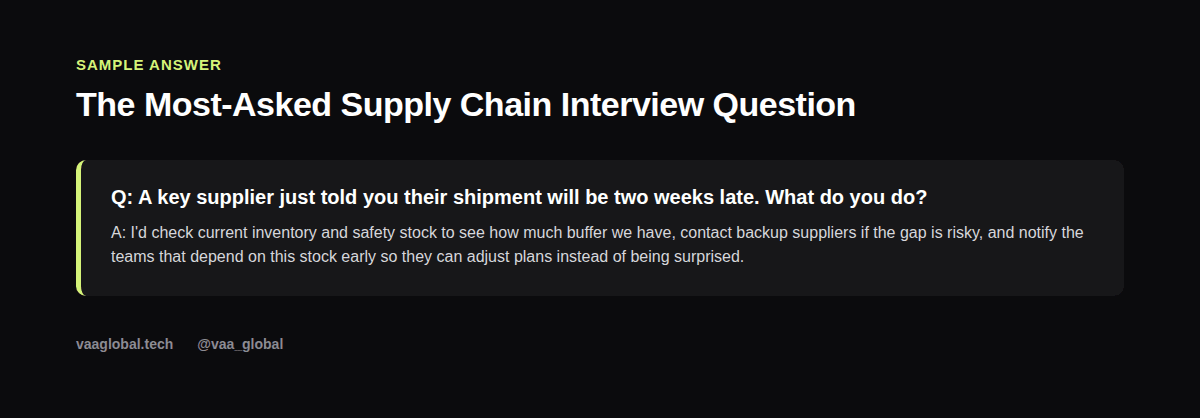
Question 4: "A Key Supplier Just Told You Their Shipment Is Two Weeks Late. What Do You Do?"
This scenario question tests problem-solving under pressure. Walk through it out loud: check current inventory and safety stock, look at backup suppliers, notify dependent teams early, and quantify the real business impact before panicking. Calm, structured thinking matters more than a flawless answer here.
Question 5: "What Do You Know About the SCOR Model?"
SCOR stands for Supply Chain Operations Reference, and it breaks supply chain activity into five phases: Plan, Source, Make, Deliver, and Return. You don't need to recite it word for word, but being able to name the phases and give one example of each shows real understanding. See the SCOR model explained for beginners for a full breakdown.
Question 6: "Which Supply Chain Software or ERP Systems Have You Used?"
If you've only used practice tools or none at all, say so honestly — many entry-level roles train you on their specific ERP system anyway. Mention any spreadsheet-based inventory tracking you've done, and emphasize that you understand the underlying logic (stock levels, reorder points, supplier lead times) that any ERP system is built around.
Question 7: "How Would You Reduce Costs Without Hurting Service Levels?"
This tests whether you understand trade-offs. A good answer references consolidating orders to get better supplier pricing, improving demand forecasting to reduce excess stock, and renegotiating shipping routes — while being careful not to cut safety stock so low that stockouts start happening.
What to Do If You Have No Paid Supply Chain Experience
If you're applying with no paid experience, lean on practice projects: build a simple inventory tracker in a spreadsheet, map out a fictional company's supply chain, or research a real company's public supply chain disruptions and explain how you'd have handled them. This is the kind of concrete example that works well alongside how to start a career in supply chain management.
What Does a Supply Chain Analyst Do Day to Day?
So what does a supply chain analyst do day to day, once hired? In practice, most days mix reviewing inventory reports, checking demand forecasts against actual sales, following up with suppliers on open orders, and flagging anything unusual to a manager. The ASCM's SCOR framework is a useful mental model for organizing all of this, because it groups daily tasks under Plan, Source, Make, Deliver, and Return.
Questions to Ask the Interviewer Back
Strong candidates ask questions too. Try: "What ERP or planning software does the team use day to day?" or "What's the biggest supply chain challenge this team is dealing with right now?" These show genuine interest in contributing, not just getting hired.
What Questions Are Asked in a Supply Chain Interview, Overall?
To summarize, what questions are asked in a supply chain interview usually fall into three buckets: definitions (what is safety stock, what is lead time), process questions (walk me through how you'd manage X), and scenario questions (a supplier just told you Y, what do you do). Preparing one answer per bucket, rather than memorizing dozens of individual questions, covers you for almost anything an interviewer throws at you.
The Bottom Line
The best way to handle supply chain interview questions and answers isn't memorization — it's understanding how sourcing, inventory, logistics, ERP systems, and risk management connect, and having at least one real or practice example for each. If you want structured, hands-on training across all of these areas, VAA Global's 6-week Supply Chain Management Certification covers sourcing, procurement, demand planning, inventory management, logistics, ERP systems, the SCOR model, and risk management.