Every product on a shelf, from a bag of rice to a smartphone, travelled through a hidden network before it reached you. That network is supply chain management, and it is one of the most in-demand skill sets in business today. Understanding it can open doors to remote jobs, better business decisions, and real career growth.
Quick answer: Supply chain management is the coordination of everything it takes to move a product from raw material to the customer, including sourcing, manufacturing, warehousing, transportation, and delivery, done in sync, on time, and within budget.
In this guide, we break supply chain management down in plain language. We cover what it actually is, how it differs from logistics, the stages every product passes through, the metrics that decide whether a chain is healthy, the technology reshaping the field, and how you can start building a career in it.
What Is Supply Chain Management?
Supply chain management is the coordination of everything it takes to move a product from raw material to the customer's hands. That includes sourcing inputs, manufacturing, warehousing, transportation, and final delivery.
A company rarely does all of this alone. Instead, it works with suppliers, manufacturers, distributors, and retailers. Supply chain management is the discipline that keeps all of them moving in sync, on time, and within budget.
Think of it as the choreography behind the scenes. The customer only sees the finished product arrive. Supply chain management is everything that had to go right, quietly, before that moment.
Supply Chain Management vs. Logistics: What's the Difference?
People often use these terms interchangeably, but they are not the same thing. Logistics is one part of supply chain management, not the whole picture.
Logistics covers the physical movement and storage of goods: transportation, warehousing, and order fulfilment. Supply chain management is the broader umbrella. It includes logistics, but also procurement, supplier relationships, production planning, and demand forecasting.
Put simply: logistics gets the product from point A to point B. Supply chain management decides what should be made, how much, from whom, and how it all connects end to end.
Why Does Supply Chain Management Matter for Businesses?
Strong supply chain management keeps products in stock, costs under control, and customers satisfied. Without it, businesses face stockouts, wasted inventory, and missed delivery deadlines. In competitive markets, an efficient supply chain often decides who wins the customer, not just who makes the better product.
Consider two competing retailers selling the same phone at the same price. If one consistently has it in stock and the other doesn't, the customer's loyalty goes to whichever one solved the availability problem. That is supply chain management working in the background, quietly deciding market share.
For small and growing businesses especially, weak supply chain management shows up fast: cash tied up in excess stock, angry customers waiting on delayed orders, or margins eaten by rushed, last-minute freight costs. Getting the fundamentals right early prevents these problems from compounding as the business scales.
The Core Stages of a Supply Chain
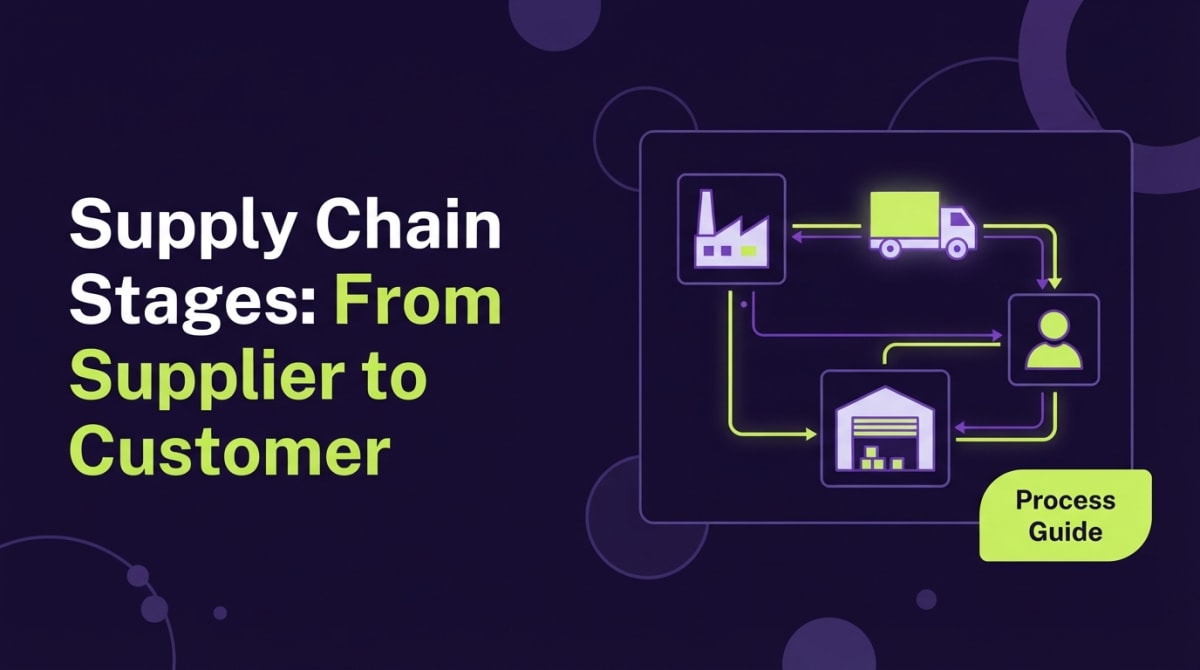
Most supply chains follow five connected stages. Each one hands off to the next, and a delay anywhere in the chain ripples through the rest.
1. Plan
This is the forecasting stage. Teams estimate future demand and decide how much raw material, labour, and capacity they will need. Poor planning here is the root cause of most downstream problems, including the bullwhip effect described below.
2. Source
Here, businesses select suppliers, negotiate contracts, and purchase raw materials or components. Good sourcing decisions protect quality and control cost. This stage also includes vetting suppliers for reliability, since a single unreliable supplier can stall an entire production line.
3. Make
Raw materials are converted into finished goods. This stage covers production scheduling, quality checks, and packaging. Manufacturers balance speed against quality control, since rushing this stage tends to create expensive problems later, at the return stage.
4. Deliver
Also called logistics, this stage covers warehousing, order processing, and transportation to get goods to the customer. This is the stage customers actually see and judge a business by, even though it depends entirely on the three stages before it going right.
5. Return
Sometimes called reverse logistics, this stage handles returns, repairs, and recycling. It is often overlooked, yet it directly affects customer trust. A business that makes returns painless earns repeat customers; one that makes it difficult loses them, regardless of how good the original product was.
Common Supply Chain Challenges
Even well-run supply chains run into recurring problems. Three show up again and again, across industries and company sizes.
- The bullwhip effect. Small shifts in customer demand get amplified as orders move upstream. A retailer slightly over-orders to be safe, the distributor over-orders on top of that to cover the retailer, and by the time the signal reaches the manufacturer, a minor blip in real demand has become a major swing in production plans.
- Demand forecasting errors. Seasonal spikes, emerging trends, or one-off events can throw off inventory planning if they are not modelled properly, leading to either wasted stock or missed sales.
- Disruptions. Port delays, currency shifts, and supplier failures can stall an otherwise healthy supply chain overnight. Businesses with only one supplier for a critical input are especially exposed to this risk.
Professionals who can spot and manage these issues early are valuable in almost any industry, from retail to manufacturing to e-commerce.
How Supply Chains Are Measured
Businesses don't just run supply chains, they measure them, using a handful of recurring metrics:
- Inventory turnover: how many times stock is sold and replaced over a period. Low turnover often signals cash tied up in slow-moving goods.
- Order fulfilment rate: the percentage of orders delivered complete and on time, a direct measure of customer experience.
- Lead time: how long it takes from placing an order to receiving the goods, whether from a supplier or to a customer.
- Perfect order rate: the share of orders that arrive complete, on time, undamaged, and with accurate documentation.
These numbers are how supply chain professionals prove their value to a business. Knowing how to track and improve them is often what separates an entry-level hire from someone trusted with bigger decisions.
Technology Reshaping Supply Chain Management
Modern supply chain management increasingly runs on software, not spreadsheets. Enterprise Resource Planning (ERP) systems like SAP and Oracle centralise inventory, orders, and supplier data in one place. Warehouse management systems track stock in real time. Demand-forecasting tools use historical sales data to flag likely spikes before they happen.
For remote and entry-level professionals, this shift is an opportunity. Businesses increasingly need people who can operate these systems, interpret the data they produce, and act on it, without necessarily needing a warehouse floor or an office desk. This is part of why supply chain management has become a genuinely remote-friendly career path.
Key Skills for a Supply Chain Career
A career in supply chain management rewards people who are comfortable with both numbers and negotiation. The most sought-after skills include:
- Inventory and demand forecasting
- Procurement and supplier negotiation
- Logistics and warehouse coordination
- Data analysis and reporting tools (including ERP systems)
- Vendor relationship management
According to the U.S. Bureau of Labor Statistics, logisticians earned a median annual wage of $80,880 in May 2024, with employment projected to grow 17% by 2034, much faster than average. This confirms what many hiring managers already know: supply chain management skills travel well across borders and industries, and demand for supply chain management jobs is not slowing down.
How to Start a Career in Supply Chain Management
You do not need a warehouse or an MBA to break into supply chain management. What you need is a working understanding of how the stages connect, plus hands-on practice with the tools and frameworks employers actually use.
That is exactly what VAA Global's Supply Chain course is built to deliver: practical, project-based training that takes you from the basics of supply chain management to job-ready skills, backed by VAA Global's track record of 1,400+ graduates, SDC Canada-endorsed training, and 405+ students placed in paid roles.
If you are still weighing your options, VAA Global's Career Compass tool can help you figure out whether supply chain management fits your strengths, and our recruitment and talent team can point you toward where the roles actually are. When you are ready to commit, you can apply here to start your supply chain management training with VAA Global.
FAQ
What is supply chain management in simple terms? Supply chain management is the process of coordinating every step it takes to get a product from raw material to the final customer, including sourcing, production, warehousing, and delivery. It matters because it keeps costs down, products in stock, and customers satisfied, which is why businesses of every size invest in getting it right.
What is the difference between supply chain management and logistics? Logistics is one part of supply chain management, not the whole thing. Logistics covers the physical movement and storage of goods, including transportation, warehousing, and fulfilment. Supply chain management is the broader discipline that also includes procurement, supplier relationships, production planning, and demand forecasting.
What are the 5 stages of supply chain management? The five core stages are Plan (forecasting demand), Source (selecting suppliers and purchasing materials), Make (converting raw materials into finished goods), Deliver (warehousing and transportation, also called logistics), and Return (handling returns, repairs, and recycling, also called reverse logistics).
What is the bullwhip effect in supply chain management? The bullwhip effect is when small shifts in real customer demand get amplified as orders move upstream through a supply chain. A retailer over-orders slightly to be safe, the distributor over-orders further to cover the retailer, and by the time the signal reaches the manufacturer, a minor blip in demand has become a major, costly swing in production.
Is supply chain management a good career? Yes. According to the U.S. Bureau of Labor Statistics, logistician roles carried a median annual wage of $80,880 in May 2024, with employment projected to grow 17% by 2034, much faster than average. Many supply chain roles are also remote-friendly, since much of the work involves data, planning, and coordination rather than physical warehouse presence.
Do I need a degree to work in supply chain management? Not necessarily. While some senior roles prefer a degree, many entry-level supply chain positions prioritise practical skills, including inventory forecasting, procurement basics, and familiarity with ERP tools like SAP or Oracle, over formal qualifications. Project-based, hands-on training can be a faster path in for career changers.
Key Takeaways
Supply chain management touches nearly every industry, and the skills behind it, forecasting, sourcing, logistics, and vendor coordination, are transferable and in demand. Whether you are running a business or building a career, understanding supply chain management is no longer optional. It is foundational.
Ready to go deeper? Explore VAA Global's full Supply Chain training programme and start building skills employers are actively hiring for.