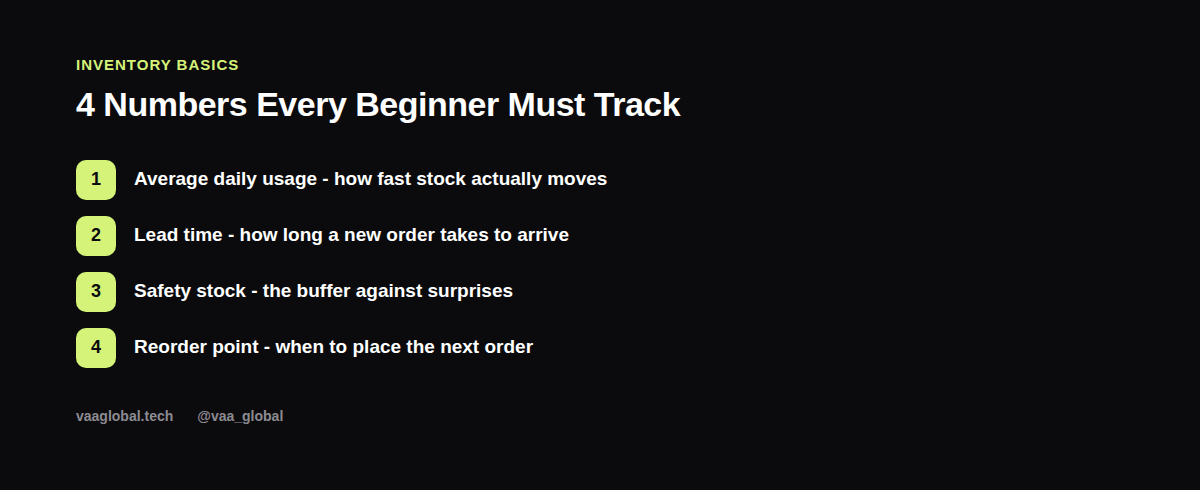
Learning the inventory management basics for beginners comes down to four connected numbers: how fast stock moves, how long a new order takes to arrive, how much buffer you need, and when to reorder. Once these four ideas click, the rest of inventory management is mostly variations on the same logic.
Why Is Inventory Management Important for a Business?
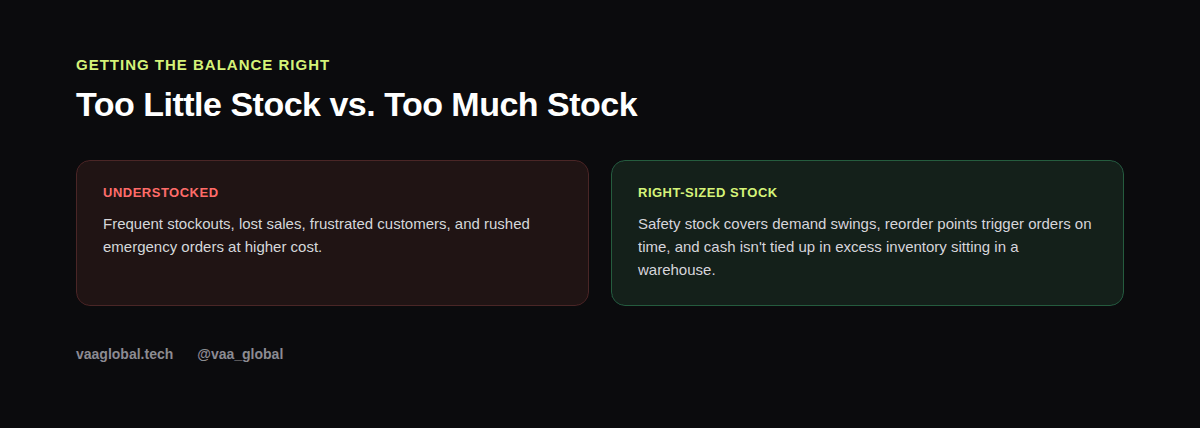
Inventory sits right in the middle of a business's cash flow and customer experience. Hold too little stock, and you get stockouts — lost sales, frustrated customers, and expensive rush orders. Hold too much, and cash sits locked up in a warehouse instead of growing the business elsewhere. Good inventory management finds the balance between these two failure modes, and that balance is what every technique in this article is working toward.
Concept 1: Average Daily Usage
Average daily usage (sometimes called demand rate) is simply how many units of a product get sold or used per day, on average. For example, if a shop sells 300 units of a product over 30 days, average daily usage is 10 units per day. This number is the foundation everything else is built on, because it tells you how fast inventory is actually moving.
Concept 2: Lead Time
Lead time is how long it takes from placing an order with a supplier to actually receiving the stock. If your supplier takes 7 days to deliver after you order, your lead time is 7 days. Because lead time varies by supplier and sometimes by season, it's worth tracking real historical lead times rather than just trusting what a supplier promises on paper.
Concept 3: Safety Stock
What is safety stock in inventory management? It's extra inventory held beyond expected demand, specifically to protect against unexpected spikes in sales or supplier delays. Safety stock is your buffer — without it, any small surprise (a late shipment, an unusually busy week) turns into a stockout. A simple way to estimate safety stock is to look at your worst historical demand spike during a typical lead time period and hold enough extra stock to cover it.
Concept 4: Reorder Point
How do you calculate a reorder point? The basic formula is: reorder point = (average daily usage × lead time in days) + safety stock. So if you use 10 units a day, lead time is 7 days, and your safety stock is 20 units, your reorder point is (10 × 7) + 20 = 90 units. Once stock drops to 90 units, it's time to place a new order — not before, and not after.
Stock Turnover: A Health Check for Your Inventory
Stock turnover (or inventory turnover) measures how many times inventory is sold and replaced over a period, usually a year. It's calculated as cost of goods sold divided by average inventory value. A low turnover rate often means money is sitting idle in slow-moving stock, while a very high turnover rate can be a warning sign that you're understocked and risking stockouts.
Putting It Together: Inventory Control in Practice
Inventory control is the day-to-day discipline of applying these numbers consistently — counting stock accurately, updating reorder points when demand or lead time changes, and reviewing slow-moving items regularly. Many businesses now do this through an ERP system rather than spreadsheets, because it's faster to update and less error-prone, though the underlying math is exactly the same either way.
How This Fits Into the Bigger Supply Chain Picture
Inventory management doesn't exist in isolation — it connects directly to demand forecasting upstream and to logistics and delivery downstream. The SCOR model explained for beginners places inventory decisions squarely within the "Plan" and "Source" stages, and understanding the difference between supply chain and logistics helps clarify where inventory control fits versus the physical movement of goods.
Practicing These Concepts Without a Job Yet
You can practice all four concepts with nothing more than a spreadsheet and a made-up product. Pick a fictional product, assign it a daily usage rate and lead time, calculate safety stock and a reorder point, and simulate a few months of sales to see how your numbers hold up. This kind of practice project is exactly what's covered in how to start a career in supply chain management, and the Council of Supply Chain Management Professionals has free glossary resources if you want to go deeper on terminology.
A Worked Example You Can Follow Along With
Let's walk through one complete example. Say a small shop sells 300 units a month, so average daily usage is about 10 units. Its supplier has a lead time of 7 days. Looking at past data, the worst demand spike during a 7-day window was 20 extra units, so safety stock is set at 20. Using the formula from above, the reorder point becomes (10 × 7) + 20, which equals 90 units. As a result, the shop knows to place a new order the moment stock touches 90, instead of guessing or waiting until shelves look empty.
The Bottom Line
Mastering inventory management basics for beginners isn't about memorizing jargon — it's about understanding how average daily usage, lead time, safety stock, and reorder points work together to keep a business supplied without wasting cash. Once these click, every more advanced inventory topic builds naturally on top of them. VAA Global's 6-week Supply Chain Management Certification covers inventory management alongside sourcing, procurement, demand planning, logistics, and ERP systems in depth.