Looking up GRC salary numbers online can be misleading, because most published figures blend together wildly different markets, experience levels and industries into one average that does not describe anyone's real offer. Rather than quoting a specific number that may be wrong for your city or country, it is more useful to understand exactly what drives pay up or down so you can research your own market accurately.
Why a Single GRC Salary Number Is Misleading
Compliance analyst salary range figures you find online usually combine data from wildly different contexts: a large multinational bank in a major financial hub, a small nonprofit, and a startup in a completely different country. Averaging these together produces a number that describes nobody's actual offer accurately. Instead of anchoring on a headline figure, search for current job postings in your specific city, industry and company size, since that gives a far more honest picture of what to expect.
Factors Affecting GRC Pay You Can Actually Control
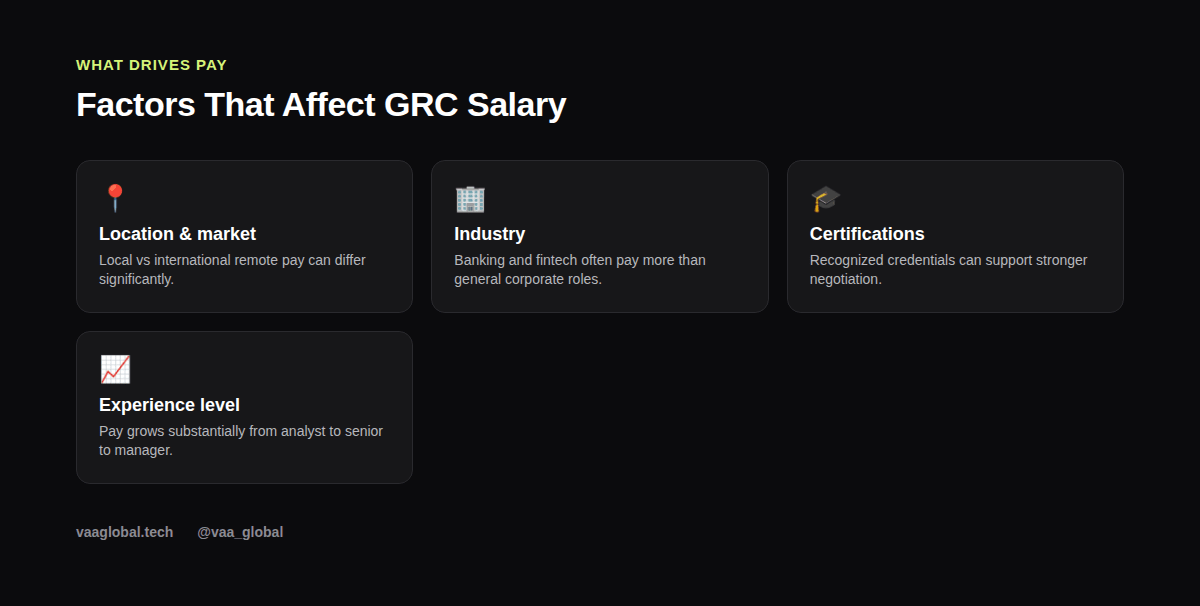
Factors affecting GRC pay fall into things you can influence and things you mostly cannot. Location and industry are largely fixed by where you choose to work; banking and fintech tend to pay more than general corporate compliance roles because regulatory stakes are higher. What you can influence more directly includes certifications, demonstrated project work, and willingness to pursue international remote roles where pay may be benchmarked differently than your local market. Risk analyst compensation specifically tends to track closely with how directly a role touches financial or regulatory risk, since higher-stakes risk categories usually command a premium.
Does GRC Pay Well Compared to Other Careers?
Does GRC pay well compared to other careers? It generally compares favorably to many entry-level office roles, largely because the regulatory and financial stakes involved tend to justify stronger compensation than roles with lower accountability. That said, specific numbers vary enormously by country and company, so the honest answer is to benchmark against similar accountability-heavy roles in your own market rather than trusting a single blog's claimed figure, including this one. The U.S. Bureau of Labor Statistics O*NET database offers a useful, regularly updated reference point for compensation data across risk and compliance-related occupations, even though it is most directly useful for U.S.-based research.
How Does Location Affect GRC Salary?
Does location affect GRC salary significantly? Yes, dramatically, and this cuts both ways. A role based in a high cost-of-living financial center typically pays more than the same role in a smaller market, but that higher figure also has to stretch further against higher local costs. International remote roles complicate this further, since some companies benchmark pay to the employee's location while others pay a flatter global rate regardless of where the employee lives. Clarifying which model a specific employer uses, early in the hiring process, avoids an unpleasant surprise later.
How Do I Negotiate a GRC Salary Offer?
How do I negotiate a GRC salary offer without overplaying a weak hand as a beginner? First, research your specific market honestly before the conversation even starts, using real current listings rather than generic averages. Second, let the employer name a number first whenever possible, since this gives you room to negotiate upward rather than anchoring low yourself. Third, justify any counter-offer with something concrete, such as a finished certification or a specific portfolio project, rather than a vague claim about your potential. Our detailed guide on negotiating a salary offer for a remote job walks through this conversation step by step and applies directly to GRC roles.
Looking Beyond Base Pay
Total compensation package matters more than base salary alone, especially for remote roles. Benefits like flexible hours, genuine professional development budget for certifications, and a clear path toward promotion can meaningfully offset a slightly lower base figure, particularly early in your career when skill-building matters as much as income. Before accepting any offer, it also helps to review signs a remote job offer is too good to be true, since compensation promises that sound unrealistic for an entry-level GRC role usually are.
Industry Benchmarking Beats Guessing
Proper industry benchmarking means comparing your target role against three or four similar current postings in the same sector, not against a single number someone mentioned on social media. For GRC specifically, compare postings within the same industry category, since a bank's compliance analyst and a small retailer's compliance coordinator are not really the same job despite similar titles. If you are also weighing a GRC path against a related field, our comparison of GRC versus cybersecurity is useful context, since cost of living and remote compensation benchmarks often differ between the two even within the same company.
The Bottom Line
GRC salary depends heavily on your specific market, industry, and experience level, which means the most useful preparation is researching real current listings rather than trusting a single average number anywhere online, including this article. Treat certifications and demonstrated project work as genuine negotiation leverage, understand whether a remote offer is location-adjusted or flat-rate, and evaluate the whole compensation package rather than base pay alone.