Finding GRC remote jobs takes more than typing “remote GRC analyst” into a single job board, because many legitimate remote postings use different titles, sit on company career pages instead of aggregator sites, and get buried under outdated or fake listings that waste your time. A more deliberate search strategy, combined with the ability to spot a scam quickly, saves you months of frustration.
Search Beyond the Exact Title
GRC job boards and general search engines return far more results when you search multiple job titles instead of one exact phrase. Remote compliance jobs, remote risk analyst positions, and GRC specialist or GRC coordinator roles all describe overlapping work that fits the same skill set. Because companies name these roles inconsistently, limiting yourself to one exact title filters out a large share of relevant openings you would otherwise never see.
Which Companies Hire Remote GRC Analysts
Which companies hire remote GRC analysts most consistently? Fintech companies, software-as-a-service businesses handling customer data, international consulting firms, and healthcare technology companies all tend to have genuinely remote-friendly GRC functions, since much of the work is documentation and evidence review rather than physical, on-site tasks. Checking these companies' own career pages directly often surfaces work from home GRC roles that never get cross-posted to major job aggregators at all.
How Do I Know If a Remote Job Posting Is Fake?
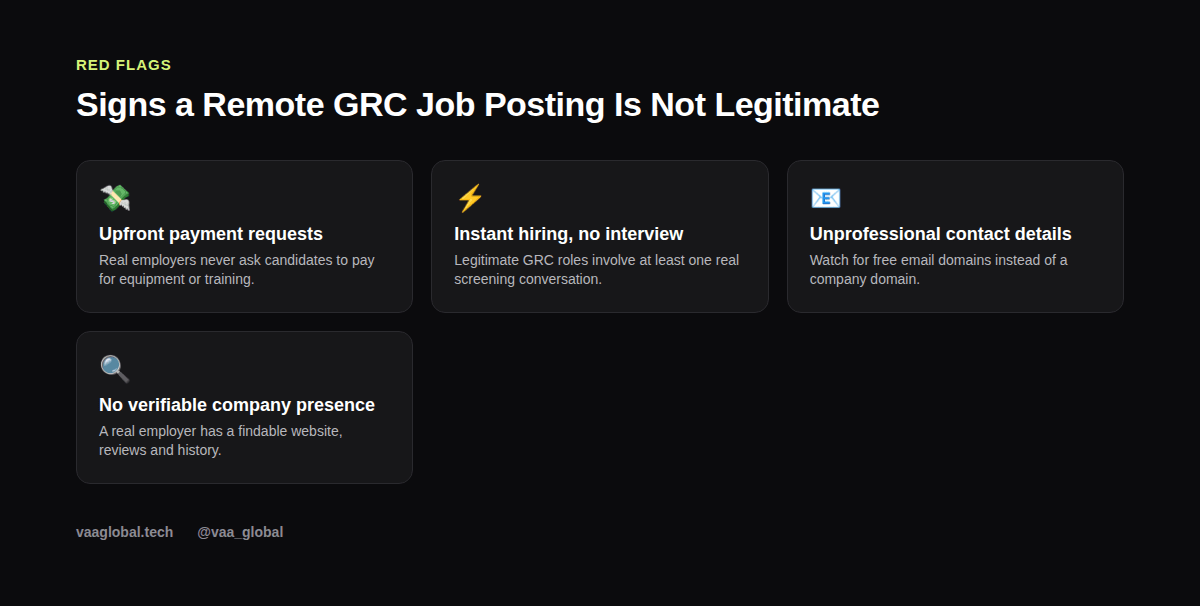
How do I know if a remote job posting is fake, especially for a field like GRC where scammers sometimes exploit the appeal of documentation-only work? A few consistent red flags apply: any request for upfront payment for equipment, training or background checks is disqualifying, since legitimate employers absorb these costs themselves. Instant hiring with no real interview is another warning sign, since even a fast-moving legitimate employer conducts at least one genuine screening conversation. Unprofessional contact details, like a free email domain instead of a company domain, and the absence of any verifiable company presence online, such as a findable website or employee reviews, round out the common patterns worth checking before you proceed.
Are There Legitimate Remote Compliance Jobs?
Are there legitimate remote compliance jobs in real numbers, or is this mostly scam territory as some online commentary suggests? Legitimate remote compliance jobs are genuinely common, particularly because so much GRC work, policy review, control testing documentation, and risk register maintenance, does not require physical presence in an office. The scams that circulate tend to target the appeal of this field specifically, which is exactly why verifying legitimacy carefully matters more here than in less-targeted job categories.
Tailoring Applications for Documentation-Heavy Roles
Documentation heavy roles reward applications that reference the employer's actual regulatory context specifically. For example, if a fintech company handles payments, mentioning familiarity with relevant payment card industry requirements in your cover letter shows you researched the role rather than sending a generic application. This kind of specificity matters more in GRC hiring than in many other fields, since the entire job is about precise, context-specific documentation.
Using General Remote Job-Search Skills Alongside GRC-Specific Ones
Many of the general remote job-search skills that apply broadly also apply directly to GRC. Our guide on signs a remote job offer is too good to be true covers verification steps worth applying to any GRC posting that seems unusually generous. It is also worth reviewing why remote job applications get ignored, since many of the same application mistakes that sink other remote applications also hold back strong GRC candidates.
Building Your Application Before You Start Searching
Before you start applying broadly, make sure your resume and portfolio project are ready to go, since a strong search strategy is wasted if your materials are not prepared. Our guide on building a GRC resume with no experience walks through exactly this preparation. For a broader reference on verifying unfamiliar companies and roles, ISACA's career resources are a credible starting point beyond this guide.
Setting Up a Weekly Search Routine
Instead of searching randomly whenever you remember to, set up a short weekly routine: spend thirty minutes checking five target company career pages directly, another thirty minutes on broader search terms across job boards, and a final stretch sending two or three tailored applications rather than many generic ones. This steady cadence beats an occasional burst of applications, because new remote GRC postings appear continuously rather than all at once, and consistency catches openings closer to when they are first posted, which matters since early applicants are often reviewed first, before a hiring manager's inbox fills up with dozens of later submissions.
The Bottom Line
Finding real GRC remote jobs takes a broader search strategy than most beginners start with: varied job titles, direct company career-page checks, careful scam verification, and applications tailored to each employer's actual regulatory context. Put these pieces together, and the search becomes far more productive than scrolling the same handful of job boards repeatedly.