
Data privacy impact assessments sound intimidating the first time you hear the term, but once explained simply, they're really just a structured way of asking "what could go wrong with this personal data, and how do we reduce that risk before it happens?" A DPIA (data privacy impact assessment) is a documented process companies use to evaluate privacy risk before launching a new product feature, tool, or data processing activity that touches personal information.
What Is a DPIA?
What is a DPIA, in plain terms? It's a documented, structured review of a planned activity — a new feature, a new vendor, a new data collection form — that looks specifically at privacy risk to individuals, not just general business risk. The idea, sometimes called privacy by design, is to catch privacy problems while a project is still being planned, when fixing them is cheap, rather than after launch, when fixing them might mean rebuilding a feature or facing regulatory consequences.
When Is a DPIA Required?
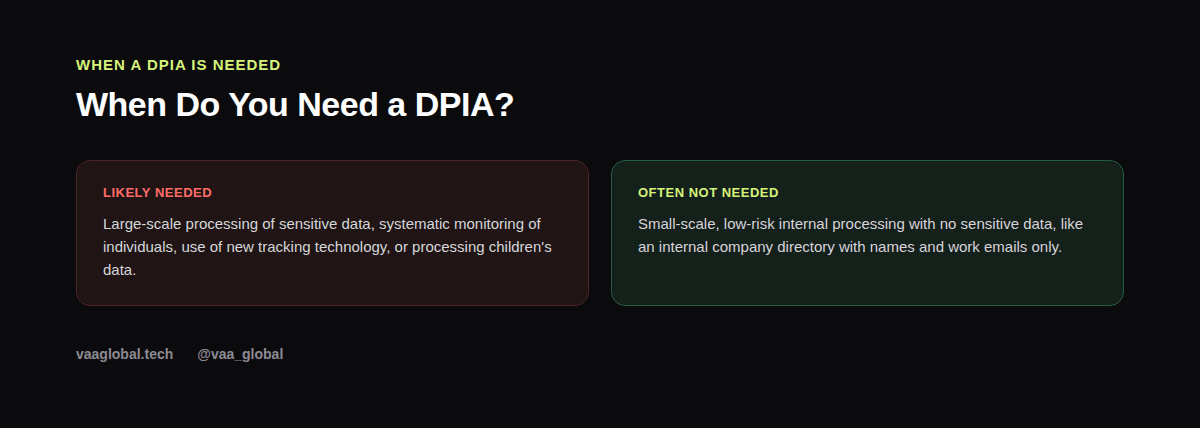
When is a DPIA required depends on which privacy law applies to your organization, but the general pattern is consistent across most frameworks: a DPIA is typically expected for large-scale processing of sensitive personal data, systematic monitoring of individuals (like certain kinds of tracking or profiling), the use of new tracking technology, or processing children's data. Lower-risk, small-scale internal processing — like a basic employee directory with names and work emails — usually doesn't need a full DPIA, though it's still good practice to think through the risk briefly.
The DPIA Process, Step by Step
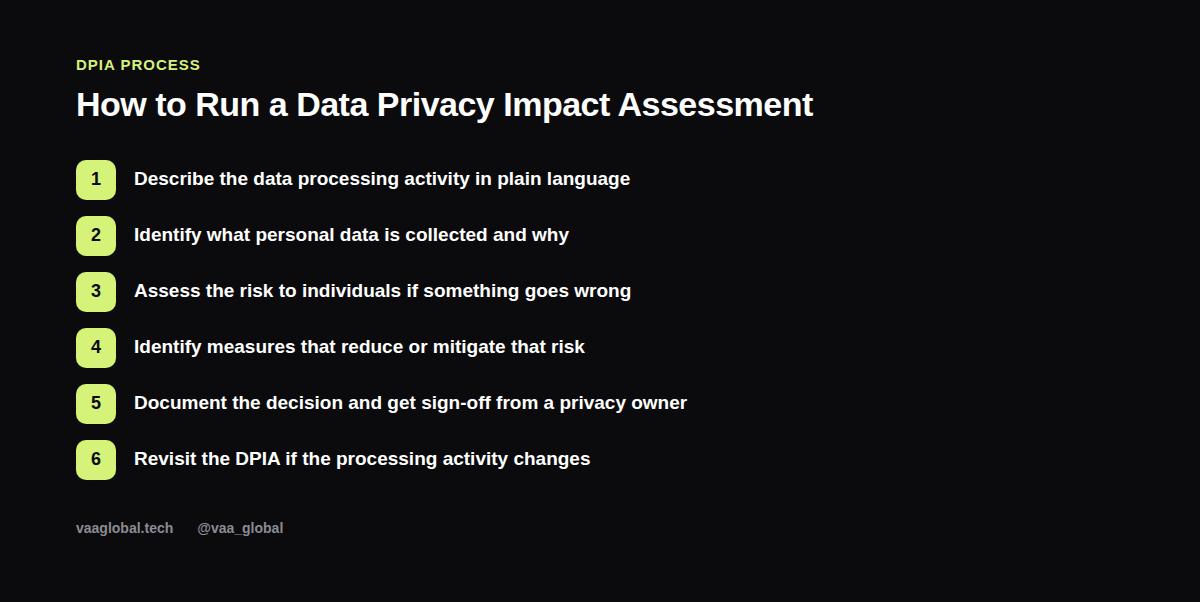
A typical DPIA follows six steps. First, describe the processing activity in plain, specific language — what data, collected how, used for what. Second, identify exactly what personal data is involved and why it's actually necessary for the stated purpose. Third, assess the risk to individuals if something goes wrong, like a data breach or misuse. Fourth, identify measures that reduce that risk — encryption, access restrictions, data minimization, shorter retention periods. Fifth, document the decision and get sign-off from a privacy owner, often called a data protection officer at larger organizations. Sixth, revisit the DPIA whenever the processing activity itself changes meaningfully.
Who Conducts a Privacy Impact Assessment?
Who conducts a privacy impact assessment varies by company size. At larger organizations, a dedicated data protection officer or privacy team usually leads the process, pulling in product, engineering, and legal as needed. At smaller companies without a dedicated privacy role, this often falls to whoever owns GRC or compliance more broadly, working closely with whoever's building the feature or process in question. Either way, the people actually building the thing being assessed need to be in the room, since they know the real data flows best.
A Worked Example: Assessing a New Feature
Say a company is building a new feature that uses location data to show nearby service providers. A simple DPIA might look like this: Processing description: The app collects a user's real-time location to display nearby providers within a 10-mile radius. Data involved: Precise GPS coordinates, timestamped. Risk identified: Precise location history could reveal sensitive patterns, like home address or daily routine, if the data is ever exposed or misused. Mitigations: Store only an approximate location (rounded to the nearest mile) rather than precise coordinates, delete location data after 24 hours, and never share raw location data with third parties without separate consent. Decision: Approved with mitigations in place, reviewed by the privacy owner, revisit if location precision or retention changes.
What Happens If You Skip a DPIA?
What happens if you skip a DPIA when one was genuinely required? Beyond the real privacy risk to users, skipping a required assessment can mean regulatory exposure once an incident or complaint surfaces, and it almost always means discovering privacy problems far later and more expensively than if they'd been caught during planning. It also weakens your position with any customer who asks about your privacy practices during a vendor security questionnaire, since a mature privacy program is increasingly something enterprise buyers expect to see evidence of.
DPIAs and the Broader Privacy Landscape
DPIAs connect closely to access control reviews and incident response planning, since all three are about managing risk to personal data from different angles — before, during, and after something could go wrong. If your work touches healthcare-related data specifically, what is HIPAA, a beginner's guide is a useful companion read, since HIPAA has its own specific privacy risk assessment expectations. For general data protection standards, the U.S. Department of Health and Human Services (hhs.gov) is a solid authoritative resource, particularly for health-related privacy questions.
Building This Skill as a Beginner
If you want to practice, try writing a mock DPIA for a hypothetical feature — a loyalty program that tracks purchase history, for example. Walk through the six steps honestly: what data, why, what risk, what mitigation. This kind of practical exercise builds real judgment faster than reading about privacy law in the abstract, and it pairs well with the broader documentation skills covered in how to become a business analyst in 2026.
The Bottom Line
A data privacy impact assessment is really just structured, documented risk thinking applied to personal data, done early enough to actually change the outcome. Describe the processing, name the real data involved, assess the risk honestly, build in mitigations, and get sign-off before launch. Companies that build this habit catch privacy problems while they're still cheap to fix.