Learning compliance monitoring basics is one of the fastest ways to understand how a company actually stays compliant day to day, not just on paper. So what is compliance monitoring, in plain terms? It's the ongoing work of checking whether an organization's controls, policies, and processes are still working the way they're supposed to, and catching problems before they turn into real incidents or audit findings.
Why Compliance Monitoring Matters
An audit happens once or twice a year. But risk doesn't wait for the audit calendar. A control that worked fine in January can quietly break by June — an employee leaves and nobody disables an old automated alert, or a vendor contract expires and nobody notices the renewed terms dropped a security clause. Compliance monitoring exists to catch exactly this kind of drift, in between the formal checkpoints.
The Four Pillars of a Compliance Monitoring Program
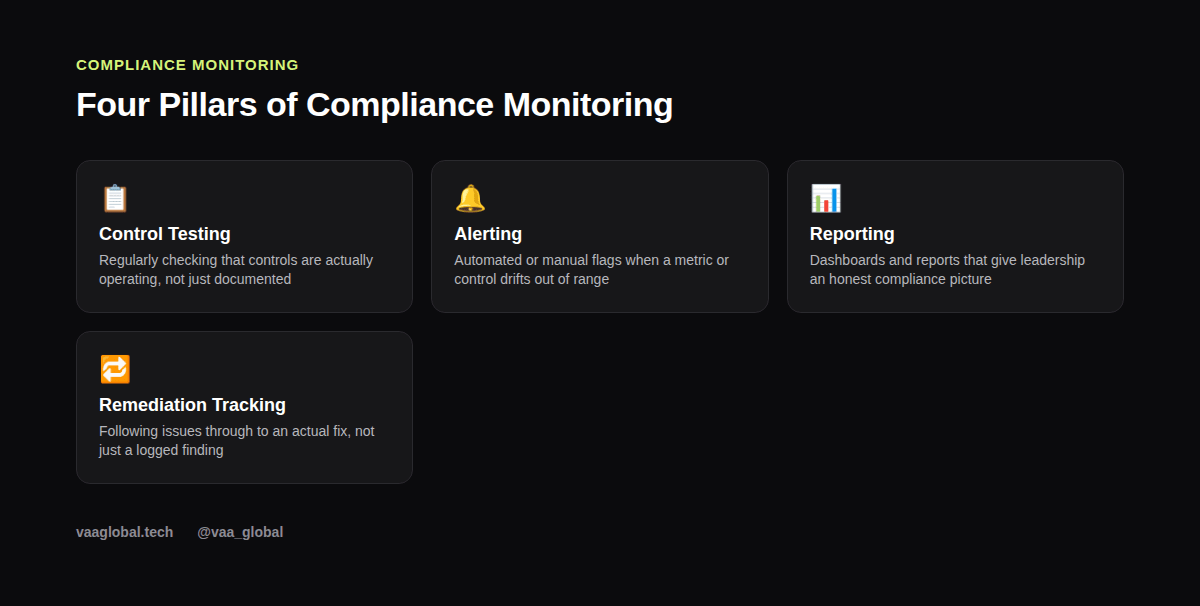
Most solid compliance programs rest on four connected pieces. First, control testing: actually checking, on a schedule, whether a control is operating as designed. Second, alerting: a way to flag it immediately when something drifts outside the expected range, instead of waiting for the next scheduled review. Third, reporting: dashboards or summaries that give leadership an honest, current view of compliance health. Fourth, remediation tracking: following every flagged issue all the way to a real fix, not just logging it and moving on.
Continuous Monitoring vs Periodic Reviews
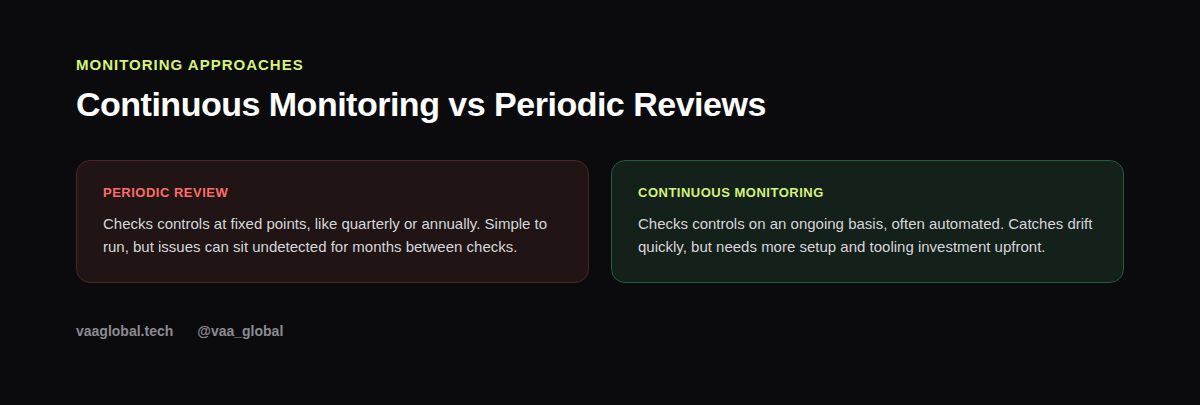
A periodic review checks things at fixed points, like once a quarter. It's simple and cheap to run, but gaps can sit undetected for weeks or months. Continuous monitoring checks things on an ongoing basis, often with automated tooling, and catches drift much faster. Most mature compliance programs blend both: continuous monitoring for high-risk controls like access management, and periodic reviews for lower-risk areas where constant checking isn't worth the cost.
How Often Should Controls Be Tested?
There's no single universal answer to how often should compliance controls be tested, because it depends on risk. High-risk controls — things tied to customer data, financial transactions, or system access — often get tested monthly or even continuously. Lower-risk, administrative controls might only need a quarterly or annual check. A good rule of thumb: match your testing frequency to how much damage a failure in that control could cause.
What Tools Are Used for Compliance Monitoring
When people ask what tools are used for compliance monitoring, the honest answer is that it ranges from spreadsheets to dedicated GRC platforms. Smaller teams often start with a shared tracker and calendar reminders. As the control count grows, many move to dedicated GRC software that can pull evidence automatically from connected systems, flag overdue reviews, and generate a compliance dashboard without manual data entry. The right tool depends on team size, budget, and how many frameworks you're tracking at once.
A Worked Example: Building a Simple Monitoring Plan
Say you're responsible for monitoring access control compliance at a mid-sized company. A simple plan might look like this:
- Control: All employee system access is reviewed quarterly by managers.
- Test: Pull the access list every quarter and confirm each manager signed off.
- Alert: If a manager hasn't completed their review within 10 days of the deadline, send an automated reminder, then escalate to their director after 20 days.
- Report: A monthly dashboard shows the percentage of reviews completed on time, broken down by department.
- Remediate: Any access flagged as no-longer-needed during review gets a ticket, and that ticket is tracked until access is actually removed.
This kind of structure turns a vague policy into something you can actually measure and improve over time.
Why Continuous Monitoring Is Important for Growing Companies
Why is continuous monitoring important as a company scales? Because manual, periodic checks don't scale well. A 20-person startup can get away with a founder eyeballing access logs once a quarter. A 500-person company with dozens of systems cannot — the volume of changes happening daily makes periodic-only reviews almost guaranteed to miss something. This is exactly why compliance monitoring and internal audit work overlap so much, and why experience in one often opens doors into the other, similar to how business analyst interview questions and GRC analyst interviews end up testing a lot of the same structured-thinking skills.
Common Mistakes in Early-Stage Compliance Monitoring
The most common mistake is building a monitoring plan that nobody actually checks. A beautiful dashboard that no one looks at monthly is functionally the same as having no monitoring at all — it's the same trap as skipping a hotel night audit checklist because nothing went wrong last week. Another frequent mistake is tracking so many metrics that the important signals get buried — it's better to monitor fewer things well than many things poorly. Finally, teams sometimes stop at reporting and skip remediation tracking, which means issues get identified but never actually get fixed.
Compliance Monitoring as a Career Skill
If you enjoy this kind of structured, repeatable work, compliance monitoring is a genuinely strong GRC analyst skill to build. It doesn't require a specific degree, but it does reward people who are comfortable with spreadsheets, dashboards, and follow-through. For readers weighing which remote career path fits, high-paying remote jobs in Nigeria for 2026 is a useful companion read, and the Institute of Internal Auditors publishes solid guidance on monitoring and control testing if you want to go deeper.
The Bottom Line
Compliance monitoring basics come down to one idea: don't wait for the next audit to find out something's broken. Test controls regularly, set up alerts for drift, report honestly, and track every fix through to completion. Done well, compliance monitoring turns compliance from an annual scramble into a steady, manageable habit.