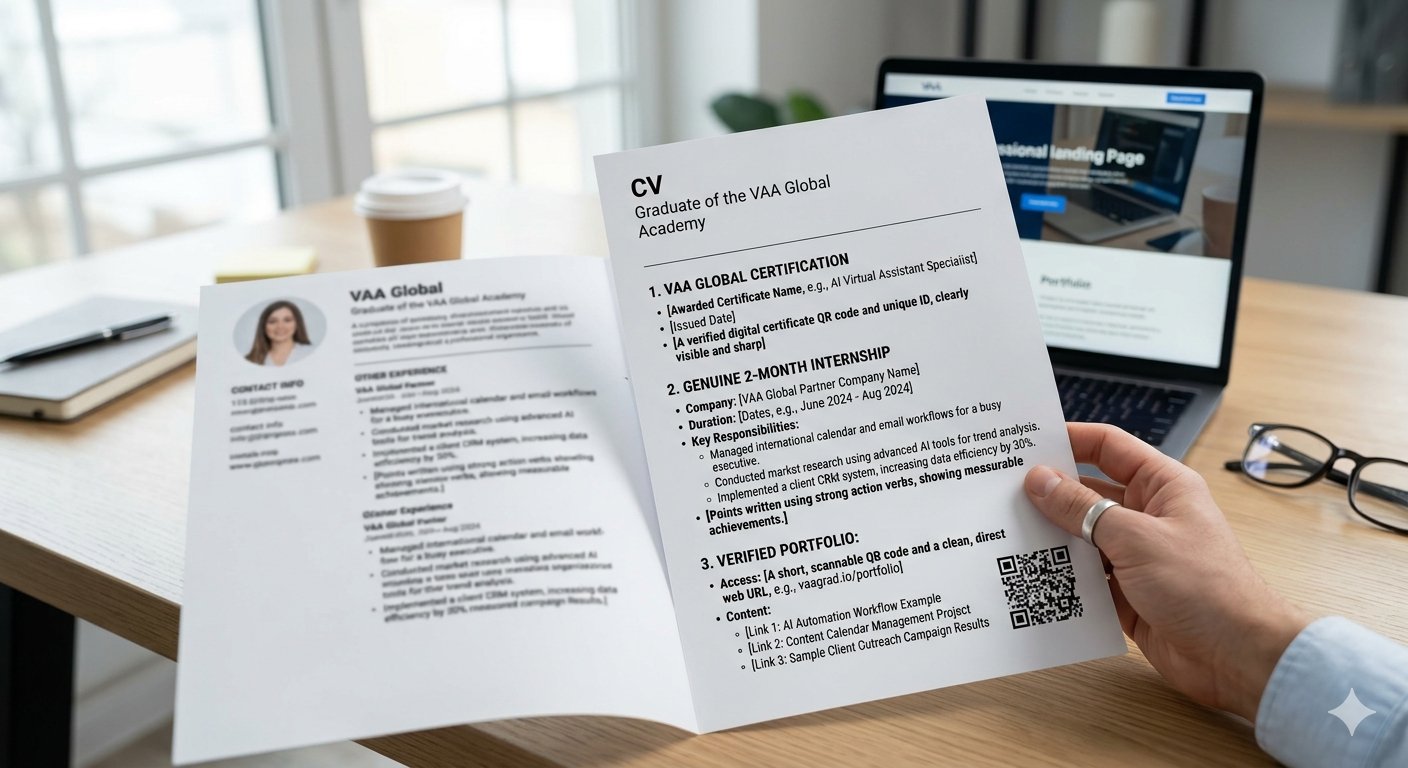
Employers reading through remote job applications see the same pattern constantly: a CV that says someone completed a course, with nothing behind it. That pattern is exactly what makes a VAA Global graduate's CV different. Instead of a single line claiming course completion, it carries three things together: a real certificate, a genuine 2-month internship a graduate can describe and discuss, and a portfolio the employer can actually open and review. That combination is what separates a CV that gets a second look from one that gets skimmed and set aside.
A Course Completion Claim Alone Doesn't Prove Anything
Most hiring managers have seen enough CVs listing "completed [X] course" to be skeptical of the phrase on its own. It tells them a candidate paid for and attended something, but it says nothing about whether that candidate can actually do the job. There's no way to verify the depth of learning, no work to look at, no evidence of how the person handles a real task under real constraints.
This is the gap that shows up most often in applications from people who took passive, video-based courses. The certificate might be genuine, but there's nothing else attached to it, so it carries very little weight in an employer's decision.
The Certificate Still Matters, It's Just Not the Whole Story
A VAA Global certificate is a real credential, and it's the first thing that signals a candidate went through structured, live training rather than something self-paced and unverified. But VAA Global treats the certificate as the starting point of a CV's credibility, not the whole of it, which is why it's never presented alone.
Think of the certificate as the thing that gets a CV past the first filter, confirming that the candidate actually completed structured training. What keeps an employer reading past that point is everything that comes after it, the internship and the portfolio, which is where the real evaluation starts.
The 2-Month Internship Gives a CV Something to Point To
This is the piece that changes how a CV reads. A candidate who can say "I completed a 2-month internship where I [specific task]" is giving an interviewer something concrete to ask about. It shifts the conversation from "tell me what you learned" to "tell me what you did," and the second question is far easier to answer convincingly when there's real experience behind it.
The internship structure is laid out on the internship page, and it's built specifically so graduates leave with tasks and outcomes they can describe in interviews, not just a line item on a CV.
A Portfolio Turns Claims Into Evidence
The final piece is a portfolio an employer can actually look at. Instead of asking someone to trust that they're skilled, a portfolio shows the work directly. Graduates build theirs using the portfolio builder, which turns coursework and internship output into something shareable and presentable, formatted the way employers expect to see it.
A portfolio also gives a candidate something concrete to walk through during an interview, rather than trying to describe their skills in the abstract. Being able to open a link and point to specific work is a very different conversation than simply claiming a skill exists.
How the CV and LinkedIn Review Tool Ties It Together
Having a certificate, internship, and portfolio doesn't automatically mean they're presented well. A lot of strong experience gets buried in a poorly structured CV or an outdated LinkedIn profile. The CV and LinkedIn review tool helps graduates put these three pieces in front of employers clearly, in the order and language that actually gets read.
This step matters more than most graduates expect, since a CV that buries the internship experience under generic wording can end up looking weaker than the actual experience deserves. Getting the presentation right is what makes sure the substance behind the CV actually comes through.
Why This Combination Works With Remote Employers Specifically
Remote hiring managers often can't rely on an in-person interview or a trusted local network to vet a candidate the way they might for an office role, so they lean more heavily on what's documented. A CV with a certificate, a described internship, and a linked portfolio gives a remote employer exactly the kind of evidence that's hard to fake and easy to verify, which is a large part of why this combination performs better than a course claim on its own.
If you're building toward a CV that actually gets noticed, the certificate is only step one. Look at the course catalogue to find a path that leads into a real internship and portfolio, and start an application when you're ready to build all three.