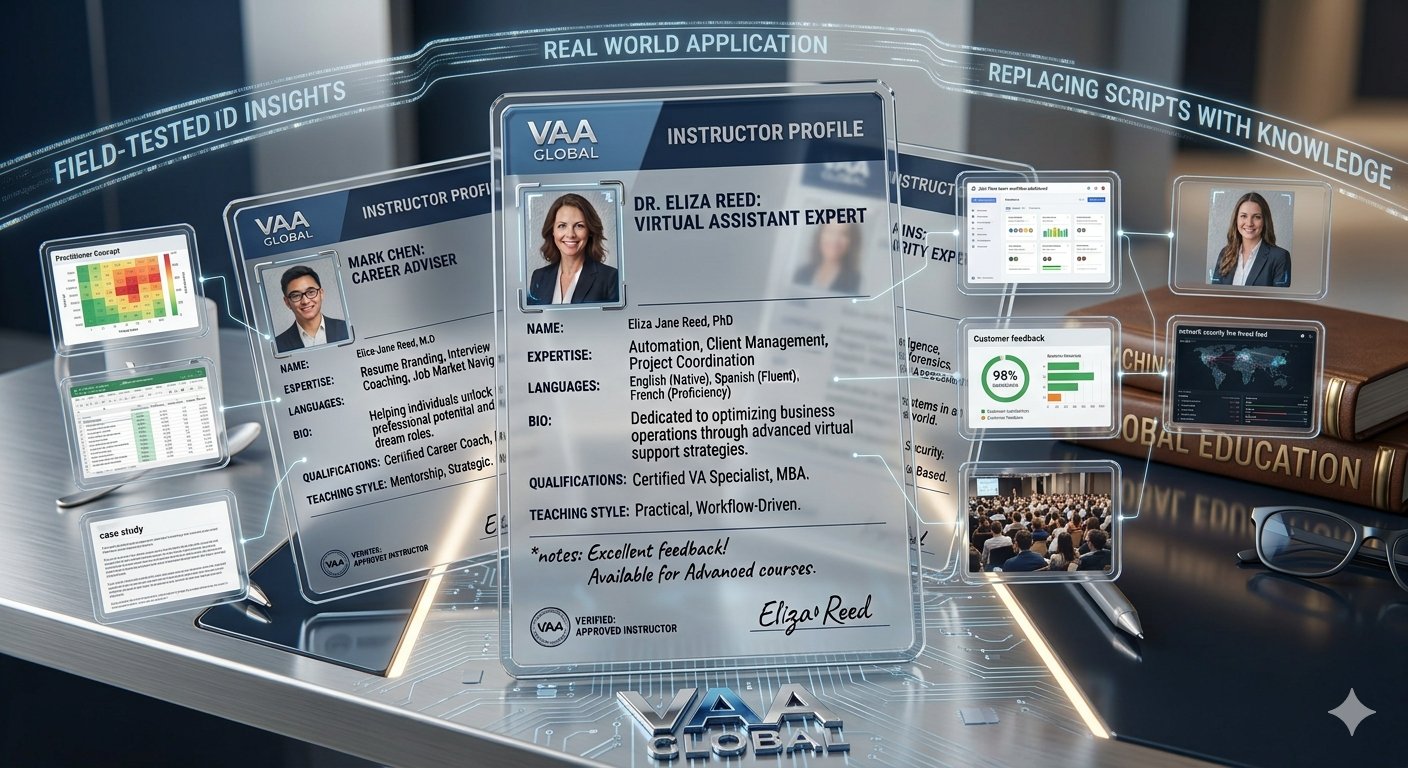
What matters most about a VAA Global instructor isn't a list of credentials, it's that they're a practitioner in their subject area teaching live. That distinction, real working knowledge delivered in real time, is what separates useful instruction from someone reading through a slide deck. Rather than listing specific degrees or company names that vary instructor to instructor, it's more useful to understand what the live, practitioner-led model actually means for a student sitting in class.
Practitioners, Not Just Presenters
VAA Global's instructors are chosen because they have real working knowledge of the subject they teach, not just familiarity with a script or a set of slides someone else wrote. This matters because a lot of the value in a course like this comes from an instructor's ability to answer a question that isn't in the curriculum, or to explain why something works a certain way in actual practice rather than just in theory.
This is a different standard than simply hiring someone who can present a slide deck clearly. It requires an instructor to have actually done the kind of work a student is training for, so that when a student's question veers outside the planned lesson, the instructor can still give a grounded, useful answer.
Why Live Instruction Changes the Learning Experience
Because instruction happens live, students can ask questions in the moment and get an answer shaped by someone who actually understands the material, not a pre-written FAQ. This real-time back and forth is a large part of what separates VAA Global's format from a passive video course, where a confusing point just stays confusing until you find an answer somewhere else.
Live instruction also means instructors can adjust on the fly, spending more time on a concept the class is struggling with or moving faster through something that's clearly landing well. That kind of responsiveness isn't possible with pre-recorded content.
What This Looks Like in Practical Assignments
The practitioner model shows up clearly in how practical assignments get reviewed. Because instructors have real working knowledge of the subject, the feedback they give on assignments reflects how the work would actually be judged in a professional setting, not just whether it technically followed the instructions.
This is a meaningful difference for a student preparing for a remote job. Feedback grounded in real practice tends to flag the kind of small issues an actual employer would notice, which is far more useful preparation than feedback focused only on whether an assignment matched a template.
What VAA Global Doesn't Claim About Instructors
VAA Global doesn't publish a roster of instructor credentials, degrees, or specific past employers as a marketing point, and it's worth being direct about that rather than implying otherwise. What's consistent across instructors is the practitioner model itself: people with real working knowledge of their subject, teaching live. That's the standard being applied, even without a public list of individual resumes attached to it.
Why This Model Matters More Than a Credentials List
A long list of credentials doesn't tell a prospective student much about whether an instructor can actually teach or answer a hard question in real time. What matters more is whether the person in front of the class has done the work they're teaching and can explain it clearly when a student is stuck. That's the standard VAA Global applies to its instructors, and it's reflected in the live, interactive format of every class rather than in a static bio page.
What to Expect as a Student
As a student, this means showing up to class expecting real engagement, not a one-way lecture. Instructors are there to answer questions, review your practical work directly, and give feedback grounded in actual experience with the subject. That's the working relationship the live format is built around.
Students tend to get the most out of this setup when they actually take advantage of it, asking questions in real time rather than saving them for later, and treating instructor feedback on assignments as something to act on rather than skim past.
This is worth keeping in mind if you're comparing VAA Global to a purely self-paced alternative. The value of a live, practitioner-led class comes specifically from that back-and-forth, so getting the most out of it means participating actively rather than sitting through it passively the way you might a recorded video.
If practical, practitioner-led instruction is what you're looking for, browse the course catalogue and start an application to see it firsthand, and to sit in a live class taught by someone who actually works in the field rather than someone reading a script.