This is a fair question to ask before spending any money, and it deserves an honest answer rather than a dismissive one.
What Free Content Is Genuinely Good For
YouTube tutorials, free articles, and platforms like Coursera's audit tracks are genuinely useful for exploring whether a field interests you at all, before committing real money or time. There's no reason to pay for that exploration stage.
Where Free Content Consistently Falls Short
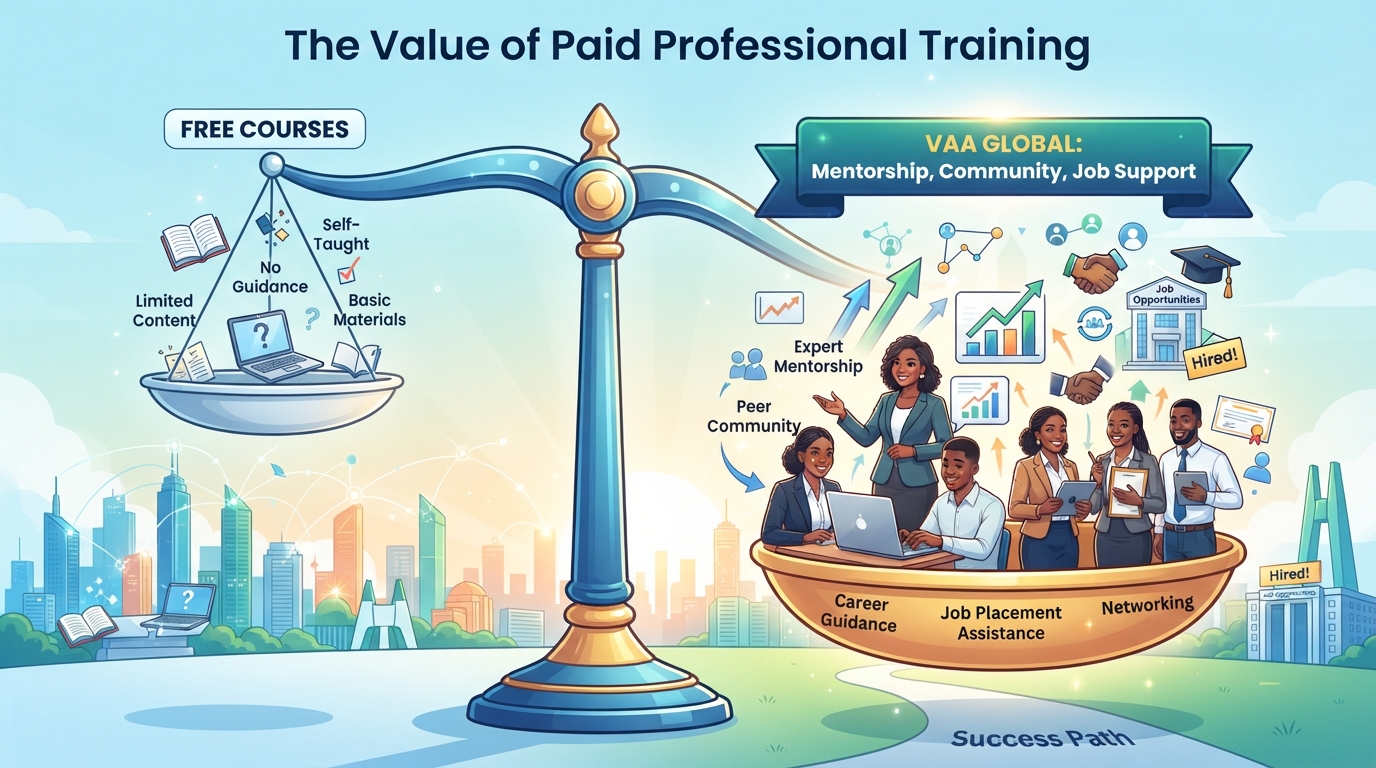
The gap shows up once you move past exploring a topic and need to actually build a job-ready skill. Free content rarely offers feedback on your specific work, a structured deadline that keeps you accountable, or a way to demonstrate what you've learned to an employer afterward.
What VAA Global Adds to the Equation
VAA Global's courses run 10 weeks of live, instructor-led classes, where an actual person reviews your work and answers questions in real time, something no pre-recorded video can do. That's followed by a 2-month internship, which is the piece free content essentially never includes: real, supervised, applied work you can point to afterward.
The Completion Problem With Free Learning
Self-paced, free courses have a well-documented completion problem, without a live class or a real deadline, most people who start never finish. Structure isn't a minor convenience here, it's often the difference between learning something and actually finishing it.
A Fair Way to Decide
If you're still exploring whether a field genuinely interests you, free resources are a reasonable place to start. Once you're ready to become job-ready in it specifically, with real accountability and a real next step, that's the point where a structured programme like VAA Global's courses starts to earn its cost.
According to FlexJobs' ongoing remote work research, employers hiring into competitive remote roles consistently favour candidates who can demonstrate applied, practical experience, exactly what a structured internship is built to produce.
What This Looks Like in Practice
Picture two people starting the same week, one working through free YouTube tutorials alone, one in a live VAA Global cohort. Ten weeks later, one has scattered notes and an unfinished playlist. The other has a portfolio project, a certificate, and an internship about to begin. The free content isn't wrong, it's simply missing the structure that turns learning into a documented outcome.
The Hidden Cost of "Free"
Free content has its own cost, just not a financial one. Time spent working through disorganised material, without feedback to catch mistakes early, often takes considerably longer than a structured course covering the same ground with proper guidance.
That hidden time cost is worth factoring in honestly when comparing a free path against a paid one, especially for someone trying to change careers within a specific timeframe.
What This Looks Like Across Different Learning Styles
Some people genuinely thrive with self-directed, free content and the discipline to push through alone. Others learn far more effectively with structure, deadlines, and direct feedback. Neither approach is wrong, but being honest about which one actually describes you matters more than assuming free is always the more efficient choice.
Making the Decision With a Clear Head
Ultimately, the choice between free content and structured training isn't about which is objectively superior, it's about being honest with yourself about your learning style, your timeline, and what specific outcome you actually need.
If you need a job-ready skill within a few months and a documented internship to show for it, that specific outcome points fairly clearly toward structured training. If you're still exploring and have no fixed timeline, starting free and upgrading later is entirely reasonable.
The Long-Term View Worth Considering
Skills learned through scattered free resources without structured application tend to be harder to speak about confidently in an interview than skills built through a documented, structured process with a real outcome attached. That confidence, being able to describe specifically what you learned and how you applied it, compounds well beyond the initial job search into how you perform once actually hired.
One Last Thing Worth Weighing
It's also worth remembering that the decision isn't permanent or exclusive. Plenty of people use free resources to confirm genuine interest, then move to structured training once they're confident the field is right for them, treating the two approaches as sequential stages rather than a single, irreversible choice made upfront.
Ready to Start?
If you've already explored the basics and you're ready for real structure and a genuine outcome, you can browse VAA Global's courses and apply to get started.