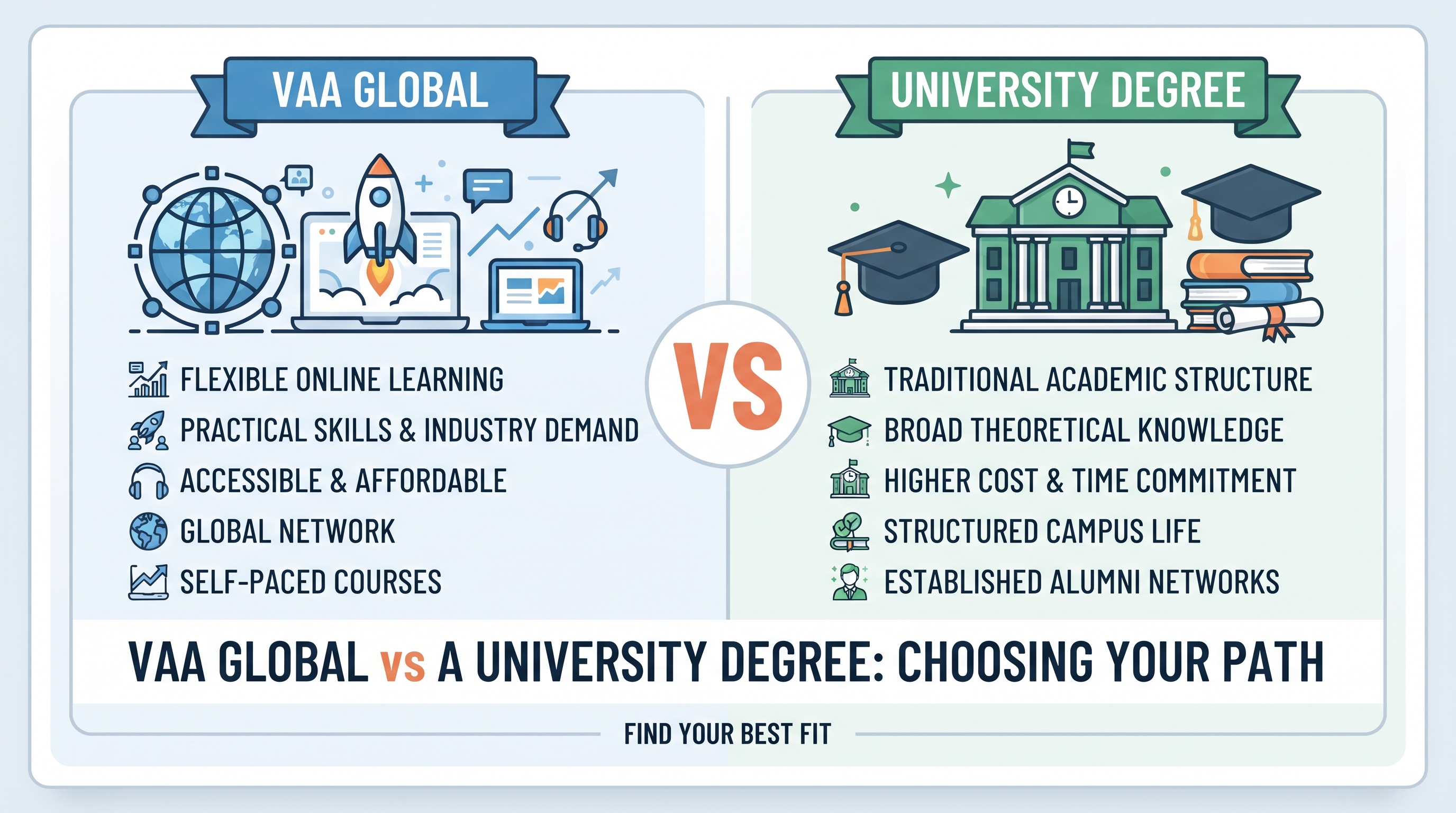
What a Degree Is Actually Good For
A university degree builds broad academic knowledge and is still genuinely required for certain regulated professions, law, medicine, and similar fields. It also takes years and a significant financial investment, which is a real cost worth weighing against the specific outcome you're after.
What VAA Global Is Built For
VAA Global's courses run 10 weeks, focused entirely on one practical, in-demand skill, followed by a 2-month internship, 2 certificates, and job placement assistance. According to FlexJobs' remote work research, remote job categories like virtual assistance, digital marketing, and data-related roles have shown consistent growth in postings, and employers hiring for these roles are typically screening for demonstrated skill over a specific degree.
Where the Real Difference Shows Up
The gap isn't training quality, it's speed and specificity. A degree covers broad ground over several years. A focused course gets you job-ready in a specific, in-demand skill in a matter of months, with practical experience from the internship to back it up. For someone trying to start earning in a remote career sooner rather than later, that difference matters a great deal.
They're Not Always Mutually Exclusive
Plenty of VAA Global students already hold a degree and are using the course to pivot into a new, more remote-compatible field, or to add a specific, marketable skill on top of what they already have. It's rarely an either-or decision in practice. Once you're ready to apply, the free CV and LinkedIn review tool helps present a practical portfolio clearly alongside any existing credentials.
A Question Worth Asking Before You Decide
The more useful question usually isn't “which is better” but “what is the specific role I'm targeting actually screening for.” Checking a handful of real job postings in your target field, and noting whether they ask for a degree or a demonstrated skill set, answers that far more reliably than a general debate.
A Real-World Way to Test This For Yourself
Pull up five current job postings in the specific remote field you're interested in and read the requirements section closely. Count how many explicitly require a degree versus how many list specific skills, tools, or demonstrated experience instead.
For most remote, digital-first roles, that exercise makes the answer far clearer than any general debate about degrees versus certificates could, because it's based on what employers are actually asking for in your specific target field right now.
Why This Gap Is Widening, Not Shrinking
As remote hiring has matured, more employers have built their own internal ways of assessing practical skill directly, take-home tasks, portfolio reviews, working interviews, rather than relying on a degree as a proxy for capability. That shift consistently favours candidates who can demonstrate applied skill quickly, which is precisely what a focused, practical course is built to produce.
Neither path is inherently wrong, the right answer depends entirely on the specific role you're targeting and how quickly you need to be qualified for it.
What Employers in Remote-First Companies Actually Prioritise
Companies built around remote work from the outset tend to have the most skills-first hiring practices of all, since they've never relied on in-person presence or campus recruiting pipelines the way traditional companies historically have. These are often exactly the employers most open to a strong practical portfolio over a specific degree.
Reading a company's own careers page, not just a general job board listing, often makes this even clearer, since many remote-first companies now explicitly describe skills-based hiring as part of how they operate.
It's a pattern worth watching for specifically if you're targeting fully remote-first companies over traditional ones with hybrid arrangements.
None of this means a degree has no value, it simply means the specific comparison depends heavily on which door you're actually trying to open.
Checking both the job posting language and the actual hiring outcomes for people you know in that field gives a more complete picture than either signal alone.
It's a small amount of research that pays off considerably more than relying on general assumptions about what "employers want" in the abstract.
Ready to Start?
If speed and a specific, hireable skill matter more to you right now than a broad credential, the free Career Compass quiz can help you find the right course, and you can apply once you've decided.