
If you're studying to become a remote healthcare assistant, you've probably seen Epic mentioned in job postings and wondered what it actually is. Medical virtual assistant Epic EHR basics come up constantly in this field, because Epic is one of the biggest electronic health records systems used by hospitals and large health networks. First, you don't need to be a software engineer to work around it. However, you do need to understand what it's for, how it fits into a patient's visit, and where a virtual assistant typically helps.
What Is Epic, Really?
Epic is one of the largest electronic health records companies in the world. Large hospital systems and academic medical centers use it. Increasingly, mid-sized practices do too. The system keeps a patient's medical history in one place: visit notes, lab results, medication lists, and billing codes. Because Epic is so widely adopted, many MVA job listings mention it by name, even for support-level remote roles.
Where Medical Virtual Assistants Fit In
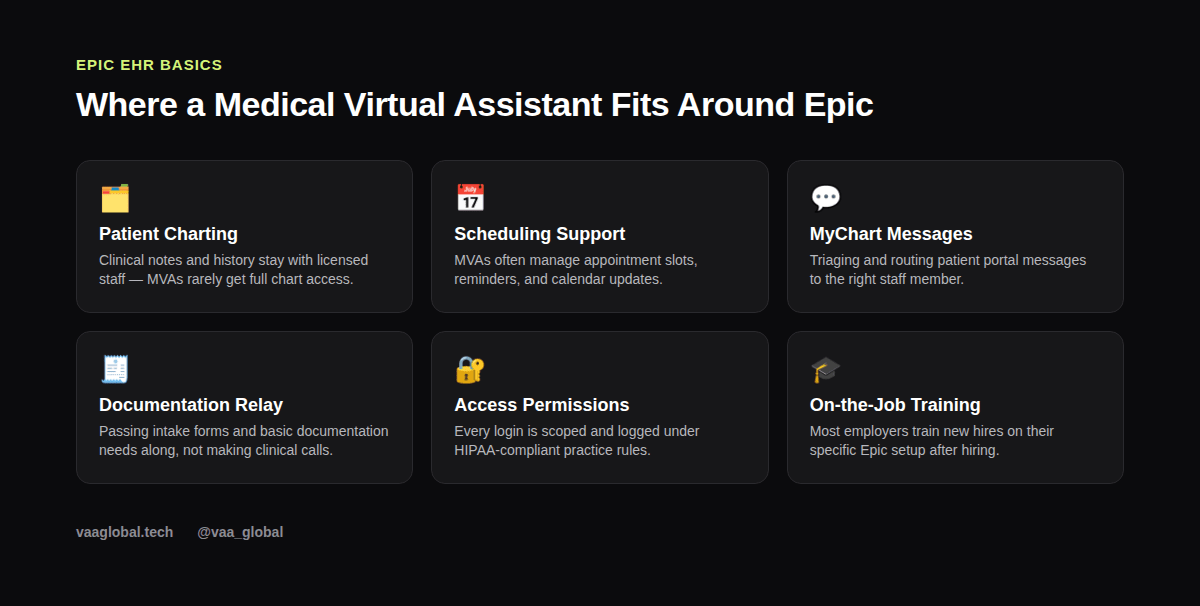
An MVA rarely gets full clinical access inside Epic. Instead, you're more likely to work with front-office modules: appointment scheduling, patient messaging, and intake forms. Some practices route patient portal messages, sent through Epic's MyChart, to a virtual assistant for triage. Meanwhile, clinical judgment calls always stay with the licensed provider.
Why Employers Mention Epic in Job Posts
When a clinic lists “Epic experience” as a plus, they usually mean comfort navigating a chart, scheduling a visit, or sending a secure message. They rarely mean deep system administration. If you've never touched Epic, that's normal for a beginner. What matters more is that you understand medical terminology, HIPAA basics, and general EHR workflows, since those transfer across any software a practice happens to use.
Epic Compared to Other EHR Platforms
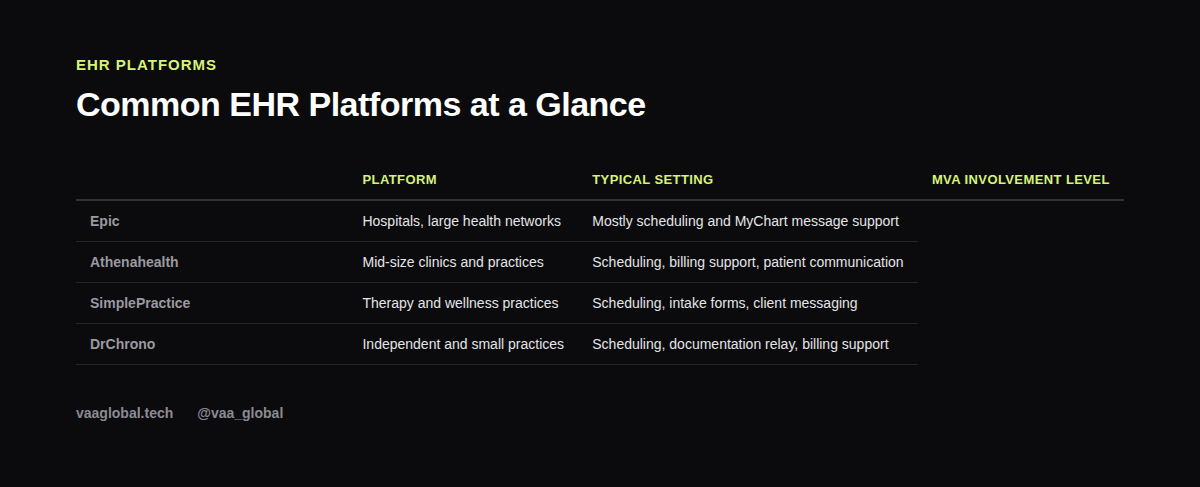
Epic isn't the only electronic health records training ground out there. Smaller practices often use Athenahealth, SimplePractice, or DrChrono instead. Each platform organizes patient data a little differently, but the underlying concepts, such as charting, scheduling, and secure messaging, stay consistent. For a side-by-side look, our guide on medical virtual assistant tools and software comparison breaks down several platforms at once.
What You Can Learn Without Hospital Access
You won't get a free Epic login to practice on as an outsider, and that's okay. Instead, you can study general EHR navigation concepts and learn the vocabulary: chart, encounter, MyChart, and superbill. Also, get comfortable with the idea of structured patient records. Courses that cover EHR vs EMR differences and general charting logic prepare you faster for whichever platform an employer uses later.
Data Security Expectations Around Epic
Any EHR, including Epic, holds protected health information. As a result, everything you do inside it is governed by HIPAA. That means logging in only with your own credentials, never sharing screenshots of patient charts, and following your employer's exact access rules. For a refresher, see our piece on patient data protection and the official overview of HIPAA rules at HHS.gov.
Realistic Expectations for Beginners
Don't let job listings that mention Epic scare you off. Most remote MVA roles that reference Epic want comfort with structured digital systems in general, plus strong communication and organization skills. Typically, employers provide short onboarding once you're hired, because every practice configures Epic a little differently anyway.
How to Position Yourself in Interviews
If you're asked about Epic experience and haven't used it directly, be honest and pivot to transferable skills. For instance: “I haven't used Epic specifically, but I understand EHR structures, patient scheduling logic, and HIPAA-compliant documentation, and I pick up new systems quickly.” That answer reads as confident rather than evasive, and it's the truth for most career-changers entering this field.
Is Epic Hard to Learn for a New MVA?
Honestly, Epic can feel a little overwhelming at first glance, mostly because it has so many modules built for different staff roles. But the parts a new MVA actually touches, like a shared calendar or a secure inbox, aren't hard to learn once someone walks you through them. Most people pick up the basics within their first week or two on the job. If you already understand general EHR logic from your training, Epic simply becomes one more interface wrapped around a concept you already know. So the honest answer to whether Epic is hard to learn for a new MVA is: not as hard as the name makes it sound, especially with good onboarding.
The Bottom Line
Medical virtual assistant Epic EHR basics aren't about becoming a certified Epic technician. Instead, they're about understanding what the platform does, where an assistant's role begins and ends, and how to talk about EHR systems confidently in interviews. Build the foundational skills first, stay patient with the learning curve, and the specific software will make sense fast once you're actually on the job. VAA Global's Medical Virtual Assistant Training is a 6-module, beginner-level course covering EHR concepts, HIPAA compliance, and medical billing basics, with no prior medical background required, plus job assistance after graduation.



