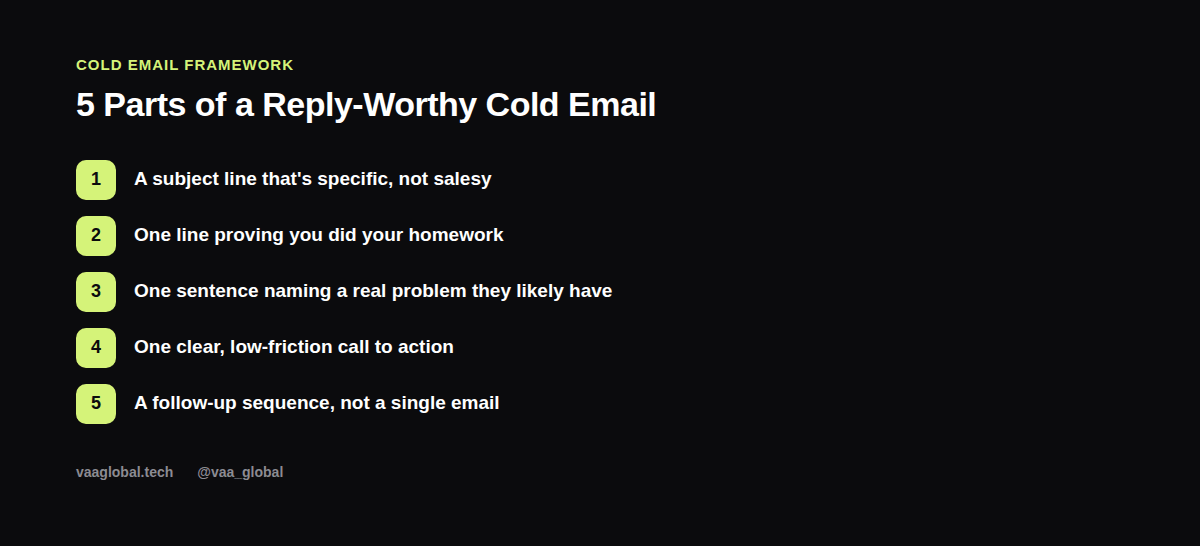
Writing a cold email that gets replies in tech sales comes down to five things: a specific subject line, proof you did real homework, a named problem, a clear ask, and a follow-up sequence. Most cold emails fail because they skip straight to the pitch, which signals to the prospect that this is a mass email, not a genuine message meant for them.
Why Is Nobody Replying to My Cold Emails?
If your reply rate is near zero, it's usually one of four things: the subject line looks like spam, the opening line is generic, there's no clear reason you're emailing this specific person, or you're only sending once instead of following up. Fixing personalization and follow-up alone often triples reply rates, even before touching anything else.
Part 1: Write a Subject Line That Isn't Salesy
Cold email subject lines work best when they're specific and low-key, not exciting. "Question about [specific team/project]" or "Saw your post about [X]" outperforms "Boost Your Productivity Today!" almost every time, because the second one screams mass outreach and triggers immediate deletion.
Part 2: Prove You Did Your Homework in One Line
The opening line should reference something specific and real — a recent job posting, a product launch, a LinkedIn post they made, or a specific detail about their company. For example: "Noticed your team just posted three ops roles" is far stronger than "I hope this email finds you well," because it proves a real person wrote this, not a template.
Part 3: Name a Problem, Don't List Features
Instead of describing what your product does, name a specific problem the prospect likely has, and let them connect the dots. For example: "Usually a sign manual reporting is getting painful" names a problem instead of pitching a feature list. This is the single biggest difference between emails that get replies and emails that get ignored.
Sample Email: Full Template
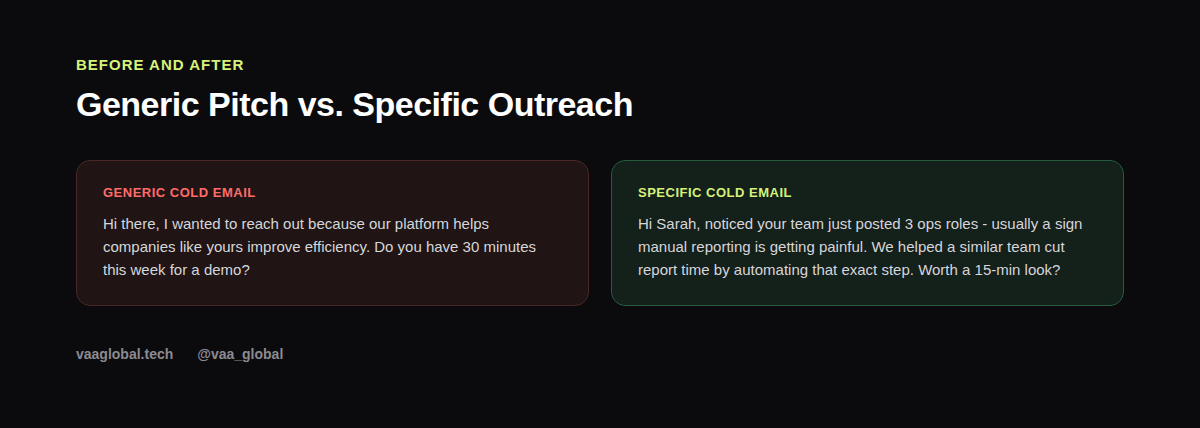
Here's a complete example you can adapt: "Hi [Name], noticed your team just posted 3 ops roles — usually a sign manual reporting is getting painful. We helped a similar team cut report time by automating that exact step. Worth a 15-minute look? [Your name]." Notice it's under 60 words, references something specific, names a problem, and ends with one easy yes-or-no ask.
Part 4: End With One Clear, Low-Friction Call to Action
Avoid vague asks like "let me know if you're interested." Instead, give one specific, easy option: "Worth a 15-minute look?" or "Open to a quick call Thursday?" The lower the friction to say yes, the more replies you'll get, even if some of those replies are a polite "not right now."
Part 5: Build a Follow-Up Sequence, Not a Single Email
How many follow-up emails should I send? Three to five, spread across 2-3 weeks, is a reasonable range for most tech sales outreach. Each follow-up should add something new — a relevant case study, a different angle on the same problem, or simply a polite, short bump — rather than repeating "just following up" with nothing new to offer.
How Long Should a Cold Sales Email Be?
Short. Aim for 50-100 words total. Busy prospects skim their inbox, and a long email signals you haven't put in the work of being specific and concise. If you find yourself writing three paragraphs, cut it down — the sample template above works precisely because it's brief.
Putting This Into Your Daily Prospecting Routine
Cold email works best as one channel among several, not a standalone tactic. Combine it with LinkedIn outreach and, where appropriate, phone calls, and track everything in a CRM so you know who's been contacted and when to follow up. This fits directly into the broader prospecting process covered in tech sales interview questions and answers, where interviewers often ask you to walk through exactly this kind of outreach plan.
Learning the Fundamentals Behind Great Outreach
Good cold email isn't a trick — it's applied discovery and qualification skills, written down before the call even happens. If you're new to the field entirely, how to break into tech sales without experience covers the broader skill set, and SDR versus Account Executive explains where outreach like this typically sits in a sales team.
A Quick SDR Outreach Checklist
Before hitting send on any SDR outreach, run through this checklist: Is the subject line specific, not salesy? Does the first line prove real research, not a mail-merge field? Does it name a problem instead of listing features? Is the call to action small and easy to say yes to? And is this email part of a planned 3-5 message sequence, not a one-off? HubSpot's sales blog on cold email is a solid free resource with more examples worth studying.
The Bottom Line
A cold email that gets replies in tech sales isn't about clever tricks — it's about being specific, naming a real problem, asking for something small, and following up consistently. Nail these five parts and your reply rate will climb noticeably. VAA Global's 10-week Tech Sales course covers prospecting and lead generation as one of its core modules, alongside discovery, demos, objection handling, and account management.