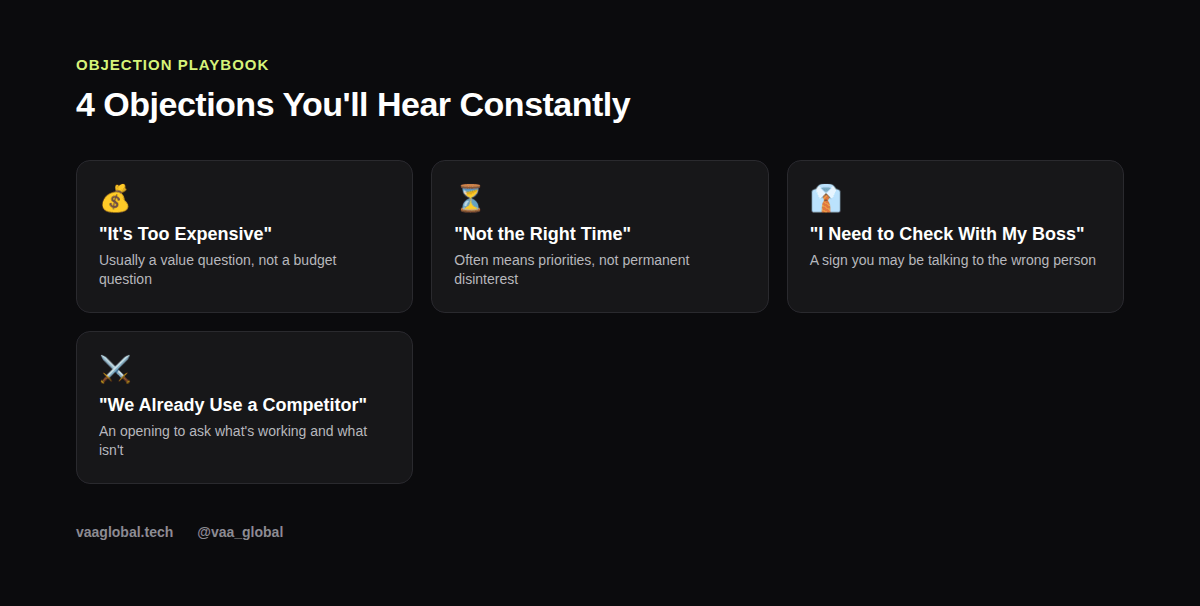
Learning the common objections in tech sales and how to handle them turns one of the most stressful parts of the job into something predictable, because the same handful of objections come up again and again: price, timing, authority, and competitors. Once you have a script for each, objections stop feeling like rejection and start feeling like a normal part of the conversation.
Why Objections Aren't Personal Rejection
New reps often treat an objection as a sign the deal is dead. However, that's rarely true. An objection is usually just the prospect thinking out loud. It often means they're engaged enough to raise a real concern. So treat objections as information, not rejection. That shift alone changes how you respond — calmly, instead of defensively.
Objection 1: "It's Too Expensive"
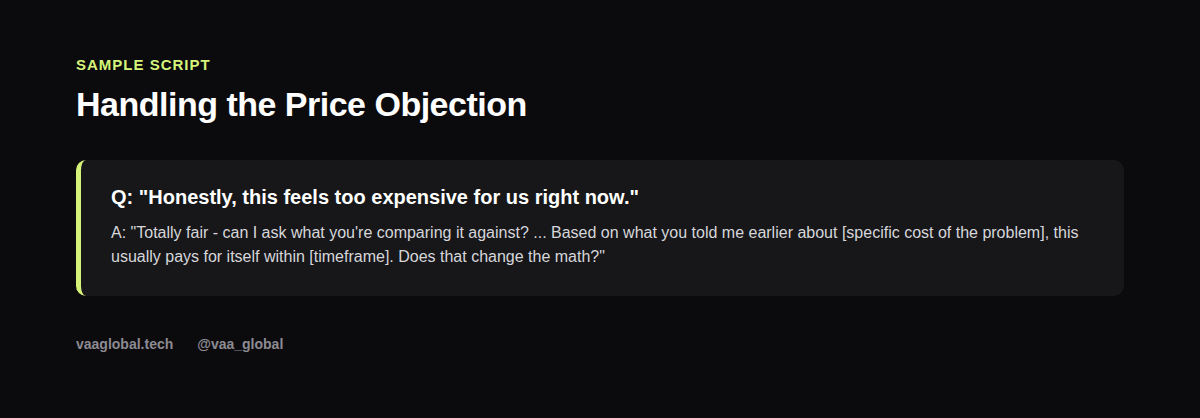
How do you respond to "it's too expensive"? First, ask what they're comparing the price against — sometimes it's a smaller, less capable tool, and sometimes it's simply "nothing," meaning they haven't internalized the cost of their current problem. Sample script: "Totally fair — can I ask what you're comparing it against? Based on what you told me earlier about [specific cost of the problem], this usually pays for itself within [timeframe]. Does that change the math?" Notice this reconnects to something specific from earlier in the call, rather than just offering a discount.
Objection 2: "Not the Right Time"
This objection is often genuine, not a brush-off. Ask a direct follow-up: "Totally understand — is it more that priorities shifted, or that the problem itself got less urgent?" The answer tells you whether to nurture this lead patiently or move on. Either way, avoid pushing harder in the moment, since that usually backfires with this particular objection.
Objection 3: "I Need to Check With My Boss"
This is often a sign you're talking to someone who isn't the actual decision maker, which is worth catching earlier in qualification next time. In the moment, respond with: "Makes sense — what questions do you think they'll have, so I can help you answer them?" This positions you as helpful rather than pushy, and sometimes surfaces the real objection hiding behind this one.
Objection 4: "We Already Use a Competitor"
Rather than attacking the competitor, ask: "That's helpful to know — what's working well with them, and what isn't?" This often uncovers a genuine gap your product fills, and it keeps the conversation collaborative instead of combative. Bashing a competitor directly almost always makes you look insecure, not confident.
A General Framework That Works for Any Objection
Beyond these four specific scripts, use a general structure: acknowledge the objection without agreeing or disagreeing yet, ask one clarifying question, then connect your answer back to something specific the prospect already told you earlier in the conversation. This framework works even for objections you haven't specifically prepared for, because it relies on listening, not memorized lines.
What Do You Say When a Prospect Goes Quiet?
Silence after a good call usually means priorities shifted somewhere internally, not that they're deliberately ignoring you. Send a short, specific check-in referencing something from the call — "Hey [Name], following up on the reporting delay you mentioned last week — still a priority?" — instead of a generic "just checking in," which almost never gets a reply.
How to Handle a "No" Without Getting Discouraged
How do you handle a no in sales? Separate it from yourself personally — a no is usually about timing, budget, or fit, not a judgment of you as a person. Ask a genuine, respectful question about the real reason, since the stated reason and the actual reason don't always match. This habit, more than any single script, is what separates reps who burn out from reps who build a real pipeline over time.
Practicing These Scripts Before You Need Them
Roleplay these four objections out loud with a friend, mentor, or even by yourself, until the responses feel natural rather than memorized. This kind of practice connects directly to interview preparation too — see tech sales interview questions and answers for how objection-handling comes up in real interview roleplays, and how to write a cold email that gets replies in tech sales for the outreach stage that leads to these conversations in the first place.
A Quick Reference Before Your Next Call
Before your next call, skim this list one more time. Price objection: ask what it's being compared to. Timing objection: ask if priorities shifted or the problem itself faded. Authority objection: offer to help them answer their boss's questions. Competitor objection: ask what's working and what isn't. Gong's research on sales objections is a useful free resource if you want more real call examples.
The Bottom Line
Mastering the common objections in tech sales and how to handle them comes down to four scripts plus one general framework: acknowledge, clarify, and reconnect to real value. Practice these until they feel natural, and objections stop being scary moments and start being normal parts of a healthy sales conversation. VAA Global's 10-week Tech Sales course covers objection handling as a dedicated module, alongside discovery, demos, proposals, and account management.