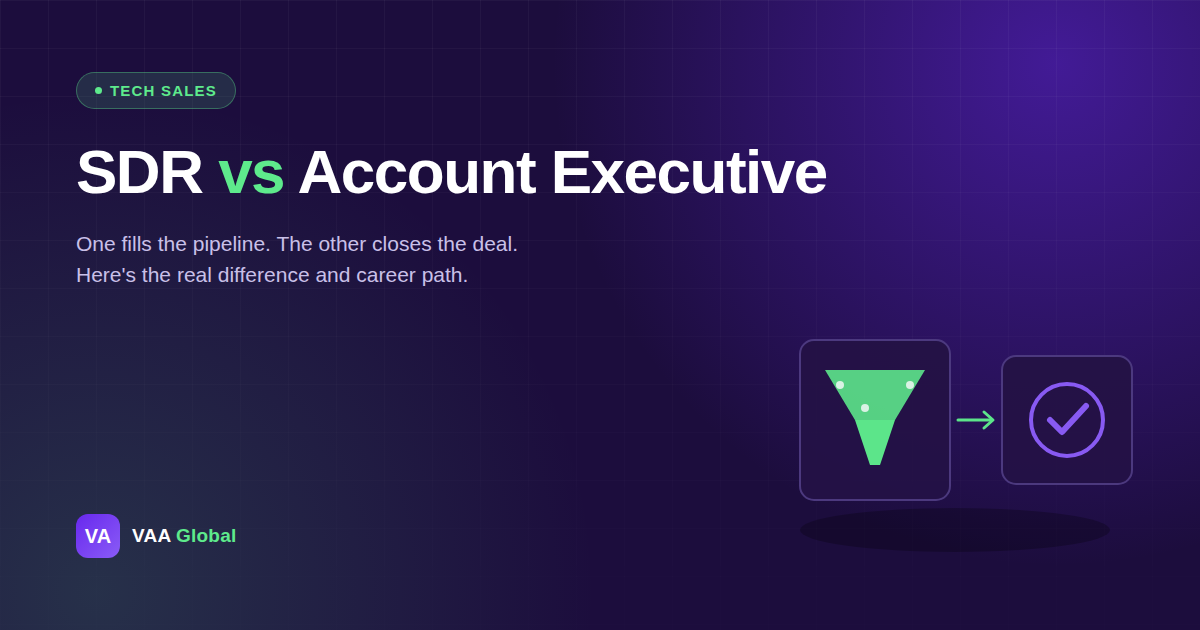
SDR vs account executive, or sales development representative vs account executive, is one of the first things to understand in tech sales. Both roles sit inside the same sales cycle. However, they own very different parts of it. This guide breaks down the real difference, then shows how the career path actually moves between them.
The Core Difference in One Sentence
An SDR finds and qualifies leads. An account executive closes them. One works the top of the funnel. The other works the bottom. That single line explains almost everything else below.
What an SDR Actually Does
SDRs directly handle cold outreach. They send emails. They also make phone calls. Their entire job is booking qualified meetings for someone else to close. Because of this, SDRs are measured on activity and meetings booked, not on closed revenue.
What an Account Executive Actually Does
Account executives take those qualified meetings and run with them. They run demos. They handle objections. They negotiate and close the deal. As a result, account executives are measured on closed revenue, quota attainment, and average deal size instead.
How to Become an SDR With No Experience
Most SDR roles are genuinely entry-level. Companies hire for coachability and communication skills more than a sales background. Because of this, SDR is the most common first step into tech sales for complete beginners, with no prior industry experience required.
How Long Does It Take to Become an Account Executive?
Typically, eighteen to twenty-four months of solid SDR performance leads to an AE promotion. Some genuinely strong performers move even faster than that. According to detailed breakdowns of both roles, SDRs and account executives differ mainly in revenue ownership, which is exactly why the promotion usually follows a track record of consistently booked meetings.
SDR vs Account Executive: Which Pays More?
Account executive roles typically pay meaningfully more than SDR roles, largely because compensation ties directly to closed revenue. That said, SDR pay is not bad either, and it usually improves quickly once quota-hitting becomes consistent. Either way, sales remains one of the more direct routes to fast income growth without a specific degree.
Are There Other Paths Besides Becoming an AE?
Yes. Some SDRs move into customer success once they enjoy relationship management over prospecting. Others move into revenue operations, since they enjoy the data side of the sales process. In fact, becoming an AE is common, but it is no longer the only realistic path forward from an SDR role.
How to Start Building a Career in Tech Sales
Both roles reward structured training over guesswork, since outreach, objection handling, and closing are all learnable skills. If you want a guided path, explore VAA Global's Tech Sales training program, built for beginners with no prior sales experience. You can also take VAA Global's free Career Compass quiz to confirm this path fits you, browse the full list of 33 VAA Global courses if you are still deciding between tracks, or read about VAA Global's story and approach to training.
What Skills Matter Most for Each Role?
SDRs lean on resilience, communication, and consistency, since outreach involves a lot of rejection before a single meeting gets booked. Account executives lean more on negotiation, storytelling, and reading a buyer's real objections. Because of this, the transition from SDR to AE usually involves picking up a noticeably different skill set, not just doing more of the same work.
Do You Need a Degree for Either Role?
Not necessarily. Many SDRs and account executives build their careers through demonstrated results rather than a specific degree. However, structured training still helps, since it teaches outreach scripts, objection handling, and pipeline management that would otherwise take months to learn on the job alone.
The Bottom Line
SDR vs account executive is really a career sequence, not a rivalry. Most people start as an SDR, build real sales skills over time, then move into an AE role once they have a consistent track record behind them. Either stage is a real, well-paid entry point into tech sales, with genuine room to keep growing from there.