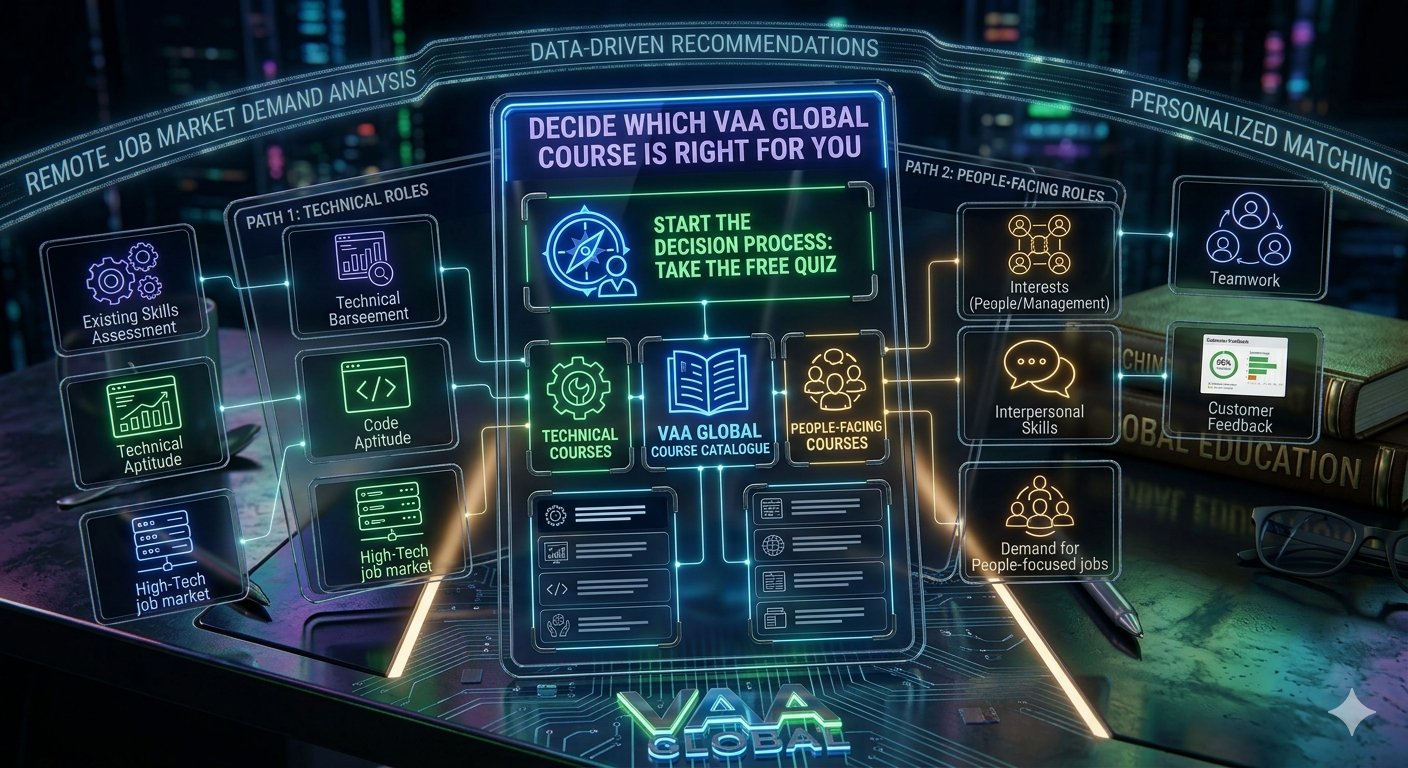
Picking a course shouldn't come down to a guess or whichever program a friend happens to mention. The clearer approach is to weigh three things: what skills or interests you already have, what remote employers are actually hiring for, and whether you're drawn to a technical role or a people-facing one. If you want a faster, more direct answer than working through all of that yourself, the free Career Compass quiz was built specifically to take your background and turn it into a course recommendation.
Start With What You Already Have
Before looking at what's popular or in demand, take stock of what you're already working with. Do you have any background in a technical area, even informally? Do you gravitate toward organizing things, communicating with people, or solving problems analytically? Existing skills and genuine interest matter because a live course requires sustained engagement, and it's much easier to stay consistent with material that connects to something you're already inclined toward.
This is worth doing honestly rather than picking a course because it sounds impressive. A course that lines up with a genuine strength or interest is easier to push through on the weeks when the material gets difficult, and that consistency matters more than the initial appeal of a course's title.
Factor In Remote Job Market Demand
Interest alone isn't enough if there's little remote demand for the resulting skill set. It's worth thinking practically about which types of roles remote employers are actively hiring for right now. This doesn't mean chasing trends blindly, but it does mean checking that a course leads somewhere with real, current opportunity rather than picking based on interest alone with no regard for where the jobs actually are.
A quick way to sanity check demand is to look at what kinds of remote roles keep showing up across job boards and hiring platforms. Courses that map directly to categories you see repeatedly are generally a safer bet than ones built around a niche with little visible remote hiring activity.
Technical vs People-Facing: A Useful Starting Split
One of the clearest ways to narrow down options is deciding whether you want a technical role or a people-facing one. Technical paths tend to involve specialized, hands-on work, think development, data, or other skill-specific tracks. People-facing paths center more on communication, coordination, and direct interaction with clients or customers, think virtual assistance, customer support, or project coordination-style roles.
Neither direction is inherently better, and plenty of people succeed in either. The point of the split is to give you a filter: if the idea of spending your day writing or building technical output excites you more than the idea of spending your day communicating with people, that's a real signal worth listening to, and vice versa.
Browse the Course Catalogue With These Filters in Mind
Once you've got a rough sense of your skills, the market, and your role preference, the course catalogue becomes much easier to navigate. Rather than scanning every course description from scratch, you're filtering: does this course build on something I already have, does it lead to a role type I actually want, and is there real demand for it among remote employers.
Use Career Compass Instead of Guessing
If working through all of that on your own still leaves you uncertain, the Career Compass quiz is built to solve exactly this problem. It's free, it takes your background and preferences, and it gives you a course recommendation instead of leaving you to guess. For anyone genuinely torn between two or three options, this is the fastest way to get a clear answer.
Once You've Decided, Commit Fully
Whichever path you land on, whether through your own reasoning or the Career Compass result, the next step is the same: apply and treat the course as the structured, live commitment it is. Indecision between courses is far more common, and far more costly, than picking a solid option and following through on it consistently.
It's also worth remembering that a course choice doesn't have to be permanent in the broader sense of your career. Skills gained in one remote-ready course often complement a second one later, so the goal at this stage is simply to pick a solid, well-matched starting point rather than the one perfect choice for the rest of your working life.
Take the free Career Compass quiz if you're still weighing your options, or head straight to the application form if you already know the course that's right for you, whether that's a technical path, a people-facing one, or something in between.