Weeks 1 Through 10: The Course Itself
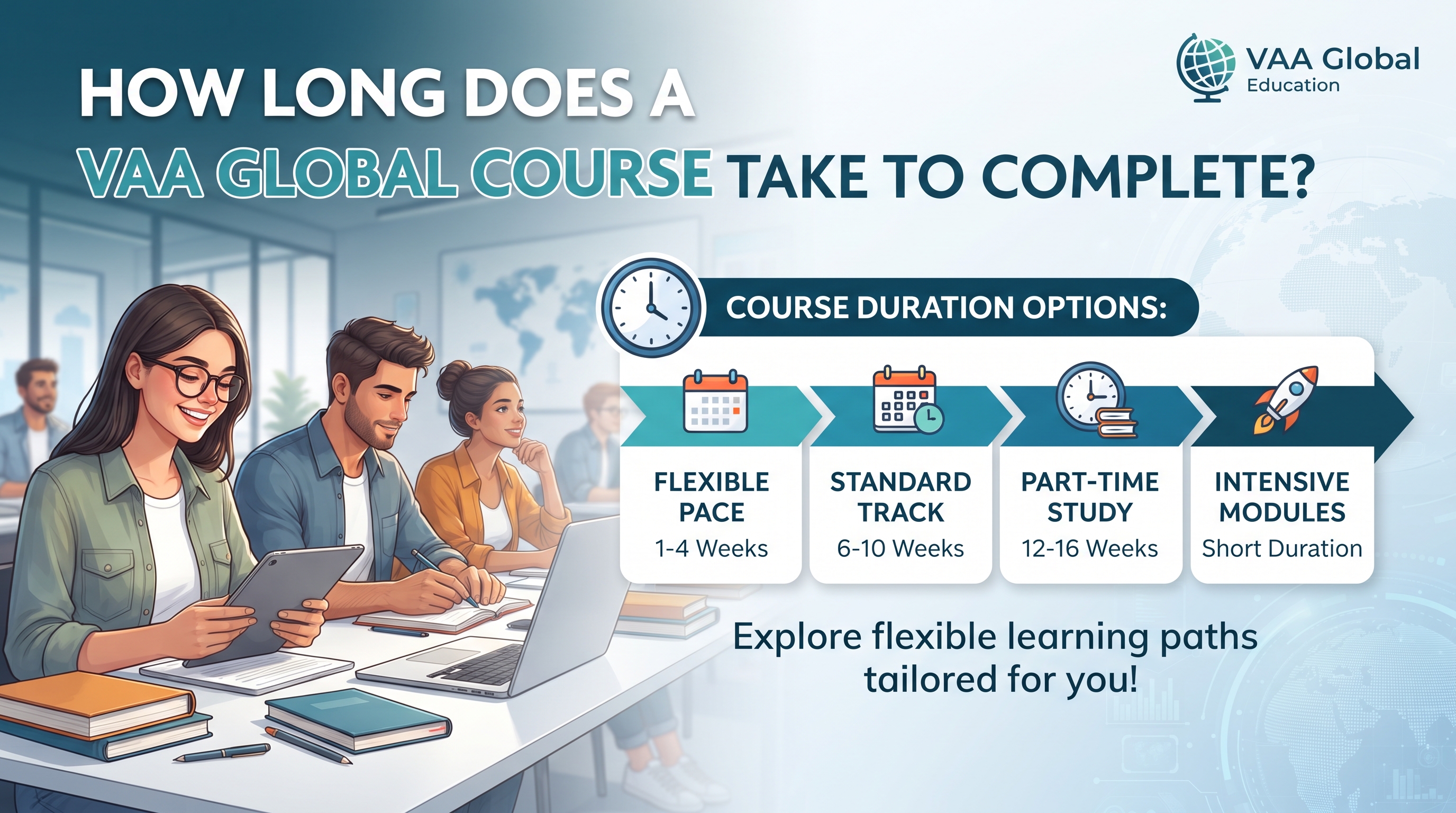
Every VAA Global course runs 10 weeks of live, instructor-led classes. Early weeks focus on fundamentals, building the foundation you need before anything more advanced makes sense. Middle weeks introduce more realistic, complex scenarios. The final weeks tie everything into a portfolio-ready project, so you leave the classroom portion with something concrete to show, not just notes.
Months 3 and 4: The Internship
Immediately after the 10 weeks, every course includes a 2-month internship. This is where the timeline earns its real value, you're not just learning a skill, you're applying it in a structured, supervised setting that gives you genuine experience to put on a CV.
The Full Picture: About Three Months to Job-Ready
Put together, most students go from their first live class to being job-ready, with 2 certificates and real internship experience, in roughly three months. That's a meaningfully shorter runway than most degree programmes, while still giving you documented, verifiable experience rather than just a certificate of completion.
What Happens Once You're Job-Ready
Once the internship wraps up, job placement assistance kicks in, and VAA Global Talent connects graduates directly with employers hiring for their specific skill set. The free CV and LinkedIn review tool can help you present the full three months of training and experience clearly when you start applying.
Planning Your Own Timeline
If you're weighing this against a specific goal, a target start date at a new job, a return-to-work plan, working backward from that date by roughly three months gives you a realistic sense of when to actually enrol, rather than assuming the process moves faster than it genuinely does.
Why the Internship Isn't Just Padding on the Timeline
It might be tempting to see the 2-month internship as simply adding time before you're technically done. In practice, it's doing real work: converting classroom learning into the specific kind of applied experience that employers actually screen for.
Skipping straight from ten weeks of classes to job applications, without that applied period, would leave graduates with knowledge but no evidence of having used it, a meaningfully weaker position when competing for a role.
What Can Extend the Timeline
The core structure stays consistent, but individual circumstances can shift things slightly, how quickly you complete internship deliverables, or how actively you engage with job placement support once you're ready. The three-month estimate is a reliable baseline, not a rigid guarantee independent of your own engagement with the process.
Knowing this timeline in advance also helps set realistic expectations with people around you, family, a current employer, since "about three months" is a far more useful answer than a vague "a few months" when you're actually planning around it.
Why Three Months Is a Genuinely Fast Timeline in Context
Compared to a typical university certificate programme, which often runs a full year or longer, or a self-directed learning path with no fixed end date at all, a structured three-month timeline with a guaranteed internship attached is considerably faster while still producing real, demonstrable experience rather than rushing past the fundamentals.
That combination, speed without cutting corners on the practical foundation, is precisely what the ten-weeks-plus-internship structure is designed to deliver.
That's a meaningful advantage for anyone trying to change direction without putting years of their life on hold to do it.
For most people weighing this decision, that trade-off, a few months of focused effort against a considerably longer traditional path, ends up being the deciding factor.
Planning realistically around that timeline, rather than an optimistic best case, tends to produce a far smoother experience overall.
Most students find that once the internship begins, the earlier ten weeks feel less like a separate phase and more like direct preparation for exactly what comes next.
It's a timeline worth writing down and planning around from day one, rather than treating as a loose estimate that might slip.
Building in a small buffer around that estimate, rather than planning to the exact day, tends to reduce unnecessary stress.
Ready to Start?
If a roughly three-month runway to job-ready fits your timeline, you can browse VAA Global's courses and apply to lock in a start date.