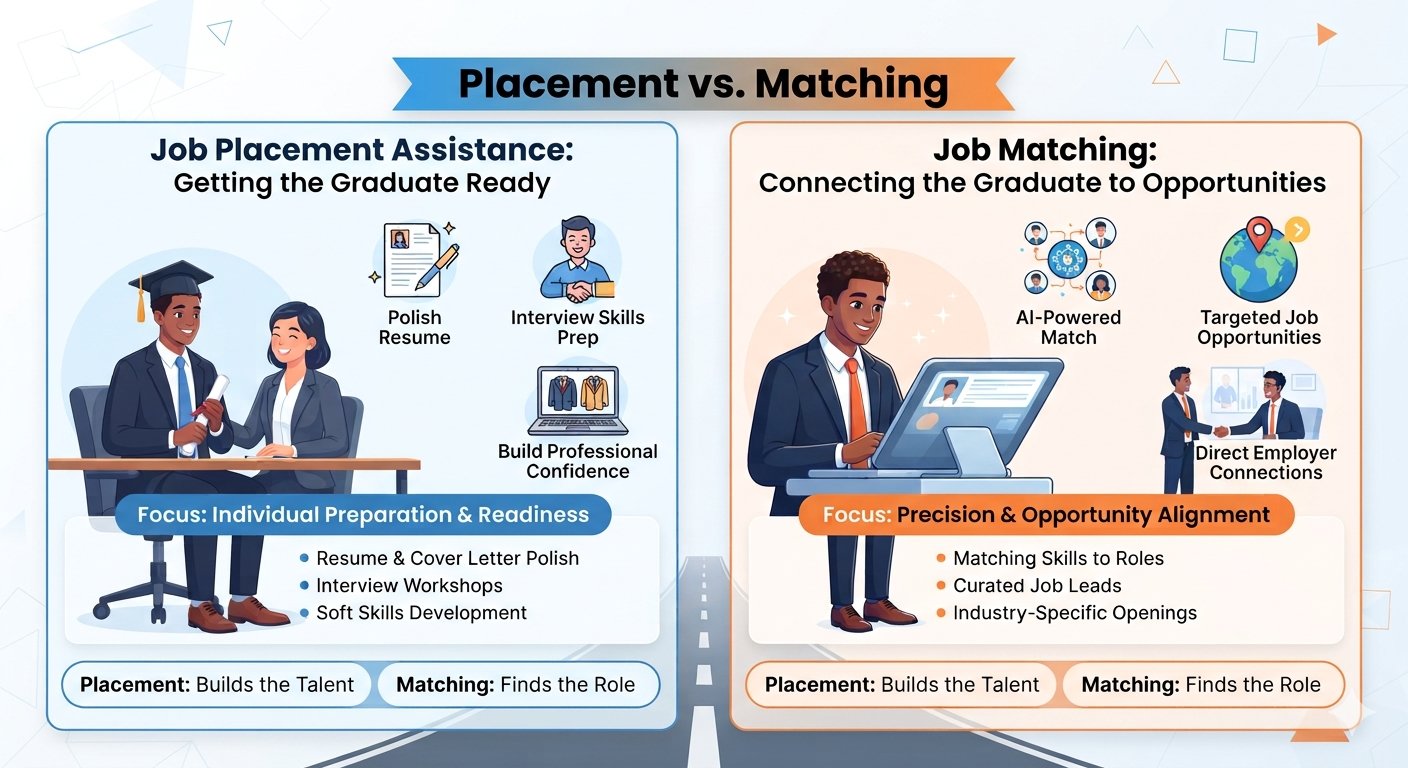
Job placement assistance and job matching sound like they mean the same thing, but at VAA Global they cover two different parts of the process. Job placement assistance is the preparation side: CV review, interview coaching, and portfolio support that gets a graduate ready to pursue roles. Job matching, which happens through VAA Global Talent, is the connection side: linking graduates to specific relevant openings based on their skills and the course they completed. Both are real, structured forms of support, and neither one is a guarantee of a job.
Job Placement Assistance: The Preparation Side
Job placement assistance covers everything that gets a graduate ready to go after a role. This includes reviewing and improving a CV and LinkedIn profile through the CV review tool, coaching on how to handle interviews, and support building out a portfolio through the portfolio builder. It's active, hands-on support aimed at making sure a graduate can present their skills and experience in the strongest possible way.
This side of the support exists because being skilled at a job and being able to convincingly present that skill in a CV or interview are two different things. Placement assistance closes that gap.
Job Matching Through VAA Global Talent: The Connection Side
Job matching is different. It's the process of connecting a graduate to actual, specific openings that fit their skills and the course they took. This happens through VAA Global Talent, which works to link graduates to relevant roles rather than leaving them to search job boards cold.
Where placement assistance is about getting a graduate ready, job matching is about putting them in front of actual opportunities that make sense for their background.
Because the matching is based on skills and course completed, a graduate is generally shown roles that fit what they actually studied rather than a broad, unfiltered list of unrelated openings, which saves time compared to searching general job boards without that filter.
Why the Distinction Matters
Understanding the difference matters because it sets realistic expectations. A graduate who thinks "job matching" means a job will simply appear might be disappointed when they still need to apply, interview, and compete for a role. A graduate who understands that job matching means being connected to relevant, appropriate openings, and that the rest of the process still requires effort, tends to engage with both forms of support more effectively.
Setting this expectation early tends to lead to a healthier, more consistent job search, since graduates who understand the actual mechanics of the support stay engaged through the process rather than losing motivation after the first match doesn't immediately turn into an offer.
How the Two Work Together in Practice
In practice, these two forms of support overlap. A graduate typically works on their CV and interview readiness through placement assistance around the same time they start receiving matches through VAA Global Talent. Being prepared and being connected to the right openings reinforce each other, since a strong CV performs better against a well-matched opening than a generic one applied to broadly.
Neither Is a Guarantee, and That's Worth Being Clear About
Neither job placement assistance nor job matching guarantees a specific job or income. Both are real, structured forms of support, but the final outcome still depends on the employer's hiring process, the graduate's own effort in applying and interviewing, and the state of the job market at the time. VAA Global's role is to make sure a graduate is well-prepared and connected to the right opportunities, not to promise an outcome no training program can actually control.
What This Means for a Graduate Actively Job Searching
For a graduate in the job search stage, the practical approach is to use both forms of support actively: revisit the CV review tool as experience grows, keep the portfolio current, respond promptly to matches from VAA Global Talent, and take interview coaching seriously rather than treating it as optional. Graduates who engage with both sides of this support tend to move through their job search more effectively than those who only use one.
It also helps to think of both forms of support as ongoing rather than one-time. A CV or portfolio that was strong at graduation can still fall behind if it's never revisited, and a graduate who checks in on both regularly is better positioned when a strong match does come through VAA Global Talent.
If you're aiming for a remote career and want both sides of this support, placement assistance and job matching, start by choosing a course from the course catalogue and submitting an application to begin the full process from the first class onward.