
CAPM vs PMP comes down to one question: how much real project experience do you actually have? Both are project management certifications from the Project Management Institute (PMI), but they sit at opposite ends of the experience spectrum, and picking the wrong one first wastes both time and money.
CAPM vs PMP at a Glance
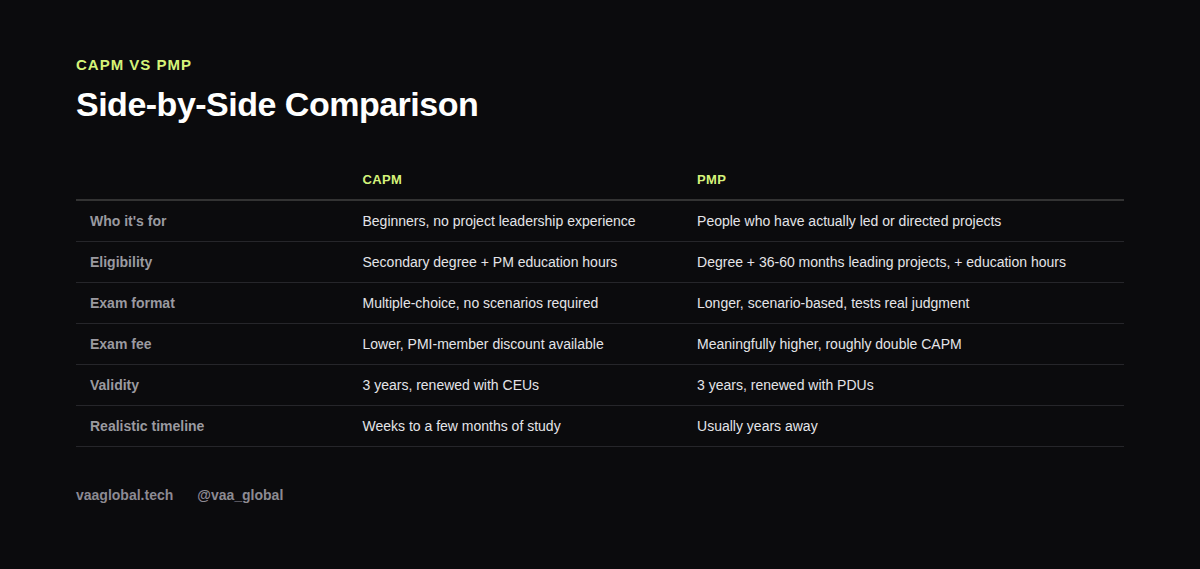
PMI updates its fee schedule and exact eligibility hours periodically, so treat the figures above as directional. PMI's own certifications page always has the current, authoritative numbers before you register or pay anything.
What Actually Counts as "Project Experience" for PMP
This is where most people get stuck, because "project experience" sounds like it only applies to people with a Project Manager job title. It doesn't. For a Nigerian remote worker building toward PMP eligibility, documented experience can come from work that was never formally labeled "project management" at all. A few concrete, realistic examples:
The key in all three cases is documentation: dates, the scope of what you owned, who you coordinated, and what you delivered. Keeping a simple running log of this kind of work, even informally, makes PMP eligibility a realistic goal rather than an abstract one down the line.
What CAPM Actually Requires
CAPM has deliberately lower entry requirements. It generally needs a secondary degree plus a defined number of project management education hours. It's specifically designed as an accessible starting point for people without years of hands-on project experience yet, which is exactly why it fits most beginners' actual situation.
What PMP Actually Requires
PMP requires significantly more: a documented number of hours leading and directing projects, which PMI details on its own site and verifies during the application process. This makes PMP genuinely out of reach for complete beginners. The requirement is about real, demonstrated project leadership, not test performance alone, regardless of how much exam-prep theory someone has studied.
Why the Experience Requirement Exists at All
These aren't arbitrary hurdles. Project management involves judgment calls, trade-off decisions, and stakeholder handling that are hard to test meaningfully without real experience behind them. Because of this, PMI's requirements split the two credentials by design. CAPM exists as a credential that doesn't assume that experience yet, while PMP exists specifically to verify it.
Should You Skip CAPM and Wait for PMP?
For most people early in their career, no. CAPM demonstrates real, verifiable knowledge now, while you build toward PMP eligibility through actual project work over the following years. Waiting with no credential at all often means missing out on exactly the kind of roles that would build toward PMP eligibility in the first place, since CAPM on a resume signals readiness that an untested theoretical interest doesn't.
Can You Sit CAPM and PMP in the Same Year?
Technically, if you already meet PMP's experience requirement independently, nothing stops you from sitting both in the same year. In practice, this is rare for beginners, since the entire reason to start with CAPM is that the PMP experience requirement typically takes years to accumulate. For most people, treating CAPM and PMP as sequential, not simultaneous, goals is the realistic path.
Is CAPM Worth It Without a Degree?
PMI's published eligibility criteria specify a secondary degree for CAPM. If you don't have one, check PMI's current eligibility page directly, since equivalency pathways and requirements are set by PMI and can change. Regardless of CAPM eligibility specifically, a structured project management education covering the same core skills, scheduling, stakeholder communication, risk management, builds real, usable capability even before any exam is in the picture.
Common Mistakes People Make Choosing Between Them
A few patterns show up repeatedly. First, treating CAPM as "the easy one" and rushing through prep without actually absorbing the material, which shows up later as weak foundational knowledge once real project work starts. Second, waiting years to start any certification because PMP feels like the "real" credential, when CAPM would have opened doors much sooner. Third, not keeping a record of project-style work as it happens, then struggling to reconstruct detailed experience documentation months or years later when applying for PMP.
Avoiding these three mistakes, studying CAPM properly rather than rushing it, starting with CAPM instead of waiting, and logging project experience as you go, makes the eventual move to PMP far smoother.
How Training Fits Into This Path
A structured project management course can build the foundational knowledge both certifications draw on, even before you sit for either exam. Our guide on what VAA Global's project management certification actually covers explains how that training maps onto CAPM and PMP preparation specifically. For a broader look at breaking into the field without prior experience, our guide on starting a project management career with no experience and our piece on becoming a project manager with no experience both cover the entry path these certifications support. If product-focused roles interest you more than traditional PM roles, where to learn product management in Nigeria is worth a look, and what a VAA Global certificate looks like is worth checking once you've completed the training itself.
The Bottom Line
CAPM vs PMP isn't really a competition, it's a sequence. Most people should target CAPM first, build real, documented project experience over the following years, and use that to reach PMP eligibility on a realistic timeline rather than an aspirational one. VAA Global's Project and Programme Management course includes PMP and CAPM exam preparation directly in its curriculum.