Applying for remote jobs in different time zones can feel confusing at first, especially when a posting says “US-based team” and you're sitting in Lagos wondering if you even stand a chance. The honest answer is that time zones matter, but they're rarely a hard dealbreaker on their own. What actually matters to most employers is whether you can offer enough working-hour overlap to collaborate, attend key meetings, and respond within a reasonable window — and that's something you can address directly in how you apply.
Why Time Zones Matter Less Than You Think (But Still Matter)
Many remote teams, especially distributed startups, have gotten comfortable working asynchronously — meaning not every task requires everyone online at once. However, most teams still need some live overlap for meetings, quick decisions, and onboarding support, particularly in the first few months. So the real question isn't “is my time zone compatible?” but “how many usable overlap hours can I offer, and is that enough for this specific role?”
How Much Overlap Hours Do Remote Employers Want
This varies by role and company, and tools like World Clock Meeting Planner can help you work out the exact overlap before you apply. As a rough rule of thumb: client-facing or collaborative roles (sales, customer support, project coordination) usually want at least 3-4 hours of daily overlap. More independent roles (writing, data entry, back-end development) can sometimes work with 1-2 hours or even asynchronous-only arrangements. If a posting doesn't specify, it's reasonable to ask during the application or interview process rather than guessing.
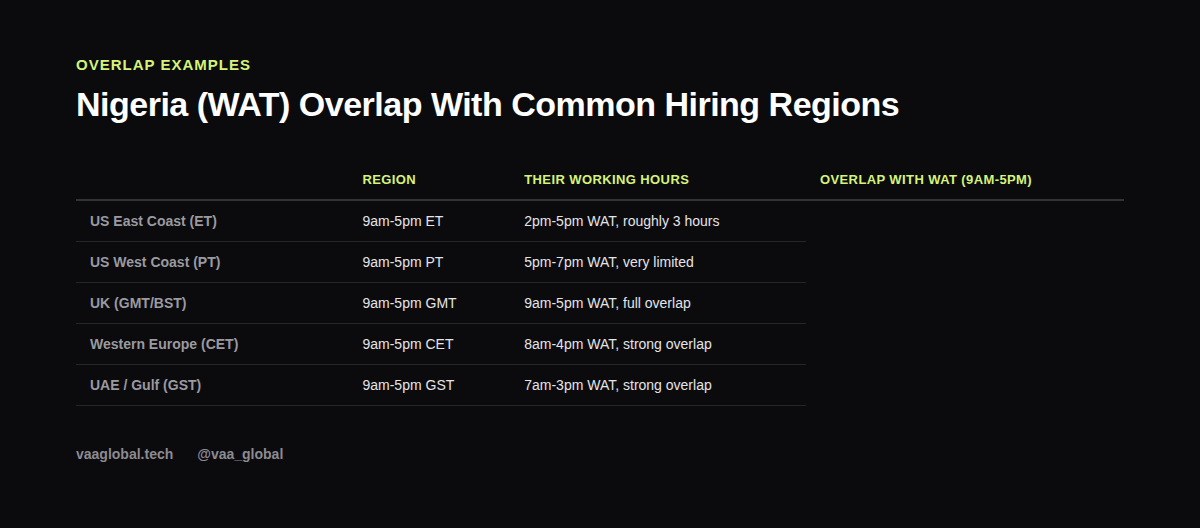
As the table shows, West Africa Time actually overlaps well with UK, Western European, and Gulf business hours — a full or near-full working day in some cases. The toughest fit is typically the US West Coast, where the gap narrows to just an hour or two in the late afternoon Nigerian time.
Can I Work a US Job From Nigeria?
Yes, plenty of Nigerians work for US-based companies remotely, but it depends on the specific role and team. East Coast roles (Eastern Time) tend to work reasonably well since there's a few hours of afternoon overlap with West Africa Time. West Coast roles are harder because the overlap shrinks to very early morning or late evening hours for you. Before applying, look at the job posting for any mention of required hours, and if it's unclear, address it directly in your application rather than assuming it will work out.
What Time Zone Should I Say I Work
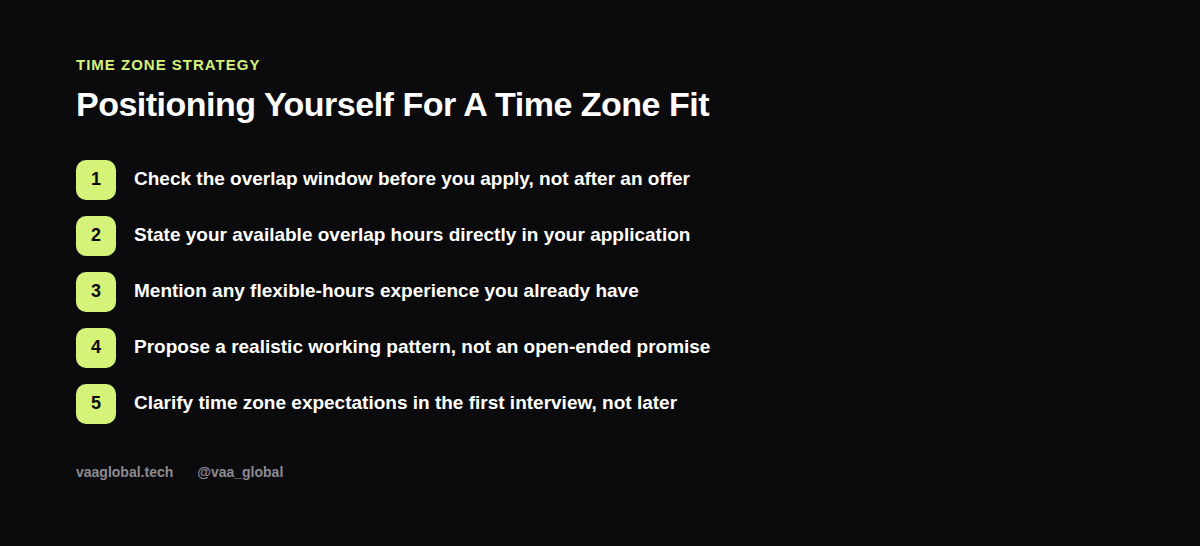
Always state your actual local time zone (West Africa Time, WAT, UTC+1) rather than trying to approximate it to the employer's zone. What you can and should do is translate that into overlap hours relative to their time zone — for example, “I'm based in Lagos (WAT) and can comfortably cover 9am-1pm Eastern Time daily, with flexibility for occasional early meetings.” This gives the employer exactly what they need to evaluate fit without them doing the math themselves.
How to Mention Your Schedule in a Cover Letter or Application
Don't bury your availability or hope it won't come up. A short, confident line works best: “I'm based in Nigeria (WAT) and can offer X hours of daily overlap with your core team hours, with full availability for scheduled calls.” This shows you've already thought it through, which signals reliability — a trait remote employers weigh heavily given they can't observe your work habits in person.
Demonstrating Async Work Experience
If you've worked with distributed teams, freelance clients in other countries, or collaborated across time zones before, mention it specifically. Employers want evidence you can manage deadlines without constant supervision, communicate clearly in writing, and follow up proactively rather than waiting to be chased. If you haven't had formal remote experience yet, you can still point to examples of self-directed work, like completing an online course on your own schedule or managing a personal project independently.
Handling the Time Zone Conversation in Interviews
Bring up schedule expectations early rather than waiting for the employer to ask, or worse, discovering a mismatch after accepting an offer. A simple question like “Can you tell me more about the core hours the team typically needs for meetings?” shows initiative and helps you both confirm fit before moving forward. This pairs well with broader remote job interview preparation so you walk in ready for every practical question, not just the technical ones.
Tools and Habits That Make Time Zone Gaps Manageable
Shared calendars with time zone conversion built in, async-friendly tools like Loom or written status updates, and simply being proactive about communicating your hours all go a long way. If you're managing international clients day to day, it also helps to study how others on a global team manage time zones with international clients so the daily friction stays low once you're hired.
When a Time Zone Gap Really Is Too Wide
Occasionally a role genuinely requires hours that simply don't work for your life — overnight shifts every day, for instance. It's fair to be honest about that upfront rather than accepting a role you can't sustainably do. Many remote postings, especially in remote jobs well suited to Nigerians, are structured with overlap-friendly regions in mind precisely because global hiring works better when both sides are realistic from the start.
The Bottom Line
Applying for remote jobs in different time zones isn't about pretending the time difference doesn't exist — it's about being upfront, doing the overlap math before you apply, and showing employers you've already thought through how the arrangement will work day to day. Handle it with confidence and specificity, and a time zone difference becomes a logistics detail rather than a reason to be passed over.