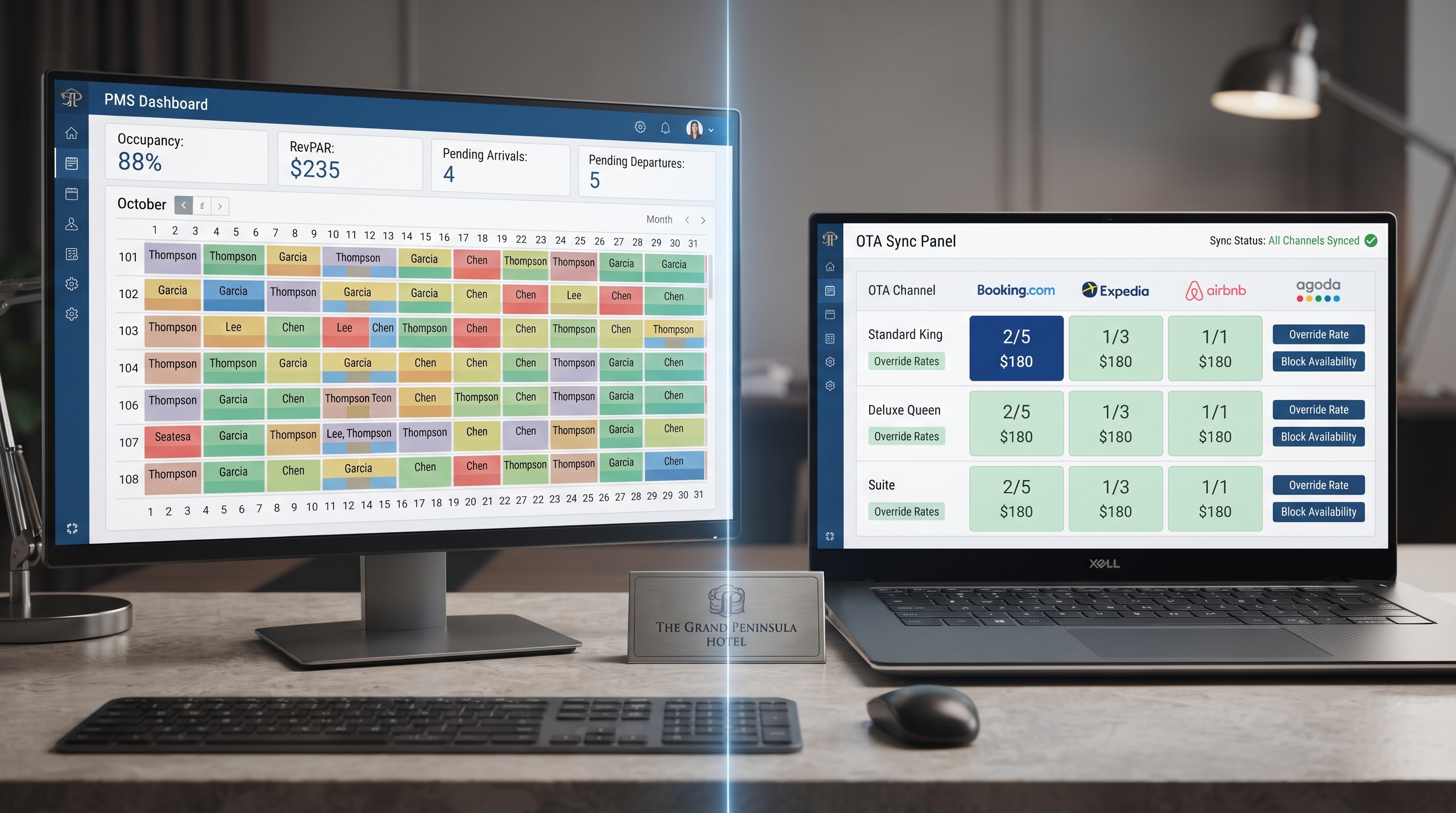

RevPAR helps you see how well a hotel turns the rooms it can sell into room sales. If you work in a hotel or study hospitality, this number links room price and demand. It gives you one clear view. This guide explains the math and what the result can and cannot tell you.
What is RevPAR?
RevPAR means revenue per available room. It compares room revenue with each room night the hotel could sell in the same period. It also counts empty rooms. So the number joins room price and filled rooms in one result. It does not show all hotel income or profit.
What is the RevPAR formula?
Use either method: RevPAR = total room revenue ÷ available room nights, or average daily rate × occupancy as a decimal. A RevPAR formula for hotels in Nigeria uses the same ratio; keep naira as the unit and apply the property's consistent reporting rules. As a result, both methods match when you use the same dates and room-sales rules. Cloudbeds' RevPAR calculator guide explains the formula, while India's National Council for Hotel Management and Catering Technology describes it in its revenue-management e-book.
For example, if a hotel earns ₦8,000,000 from rooms across 100 room nights, the result equals ₦80,000. This is a sample, not a claim about hotel prices or results in Nigeria.
How do you calculate RevPAR in a hotel?
If you search how to calculate RevPAR in a hotel, define one reporting period first. Next, use room revenue and available room nights from that same period. Follow these steps, then check that your source figures use consistent rules.
- Set the period. Choose one night, a week, or a month. Use the same dates for room sales and rooms for sale.
- Count available room nights. Next, count rooms the hotel could sell each night in the period. Use the same rule each time you take a room out of service.
- Total room revenue. Then use the hotel's approved room-sales rule. Treat taxes, packages, discounts, and fees the same in each report.
- Divide revenue by available room nights. Finally, the figure uses the same currency as your room sales.
Here is another sample. For instance, a 100-room hotel has 80 rooms filled for one night and earns ₦8,000,000 from rooms. Occupancy is 80%, while ADR is ₦100,000. Multiply ₦100,000 by 0.80, or divide ₦8,000,000 by 100. Both steps give the same figure: ₦80,000.
How do ADR and the hotel occupancy rate relate to RevPAR?
Average daily rate (ADR) shows the room price paid for each room sold. The hotel occupancy rate shows the share of rooms filled. As a result, the metric joins those two measures, so you can see why room sales changed. For instance, ADR can rise while occupancy falls. Therefore, the metric shows their combined effect.
Compare both parts before you change a rate. If RevPAR rises as more rooms fill but ADR falls, you may need a different response than when the rate rises. Meanwhile, check booking dates, day of week, and room mix before you draw a conclusion.
What does RevPAR leave out?
The metric counts room sales only. It leaves out restaurant, bar, spa, meeting, and other income. It does not subtract booking fees, wages, power, or other hotel costs. Therefore, a higher RevPAR alone does not prove that the hotel made more profit.
For a broader view, compare RevPAR with total revenue per available room (TRevPAR) and gross operating profit per available room (GOPPAR). The NCHMCT book separates room sales, total sales, and profit measures. In addition, note how your hotel counts free rooms, rooms out of order, tax, and packages. Use the same rules when you compare one period with another.
How should you use RevPAR for hotel decisions?
Use the metric to spot a pattern, not to make a choice on its own. Review it by date, room type, and booking channel if your system has those views. Then check demand, cancellations, and bookings still on the books.
- If occupancy falls while ADR holds steady, review demand by date and channel before discounting.
- Meanwhile, if ADR rises but occupancy falls sharply, compare the result with your forecast and booking pace.
- Finally, if the figure improves but profit does not, review fees, wages, and other costs with your finance team.
An online travel agency can help you reach guests, but it may charge a fee. The metric still divides room sales by room nights. It does not subtract that fee. Read VAA Global's guides to hotel revenue management and OTA management for more on rates and booking channels.
How can you compare results fairly?
First, match the dates and currency. Next, check that each report counts room nights and room sales the same way. Otherwise, the results may differ because of the rules, not hotel work. In turn, compare ADR and occupancy with the figure to see which part moved.
Meanwhile, a hotel PMS stores bookings and room data. Your revenue report then turns those records into measures. If you are learning these tools, see this guide to hotel PMS platforms and Cloudbeds. You can also review front-office operations to see how room status and guest service shape daily records.
How does RevPAR fit into hospitality training?
RevPAR sits within revenue management. You also need to know demand, forecasts, booking channels, guest types, and each KPI's limits. As a result, you can explain why a figure changed and what other data you need.
VAA Global's article on revenue management in hospitality introduces the broader discipline. For practice, keep a small sheet with room sales, rooms sold, room nights, ADR, occupancy, and RevPAR for set dates. Use sample figures as exercises, never as claims about a real hotel's results.
In short, RevPAR answers one clear question: how much did each room night earn? Use the same dates and room count each time. Then read the result with occupancy, ADR, total hotel sales, and costs. In short, this helps you explain the metric in class, in a report, or at work.