Almost everyone who learns how to overcome stage fright starts from the same place: a racing heart, a dry mouth, and a strong urge to cancel. However, stage fright is not a personality flaw, it is a physical response your body produces whether you are facing a lion or a boardroom, and it responds well to specific, practiced techniques. This guide breaks the process down into steps you can actually use before your next talk.
Is Stage Fright Normal for Beginners?
Yes, and it is worth saying clearly: is stage fright normal for beginners is one of the most common questions new speakers ask, and the answer is an unambiguous yes. Surveys of professional speakers consistently find that most still feel some nerves before going on stage, even after years of experience. The goal is not to eliminate the feeling entirely; it is to stop it from controlling your voice, pace, and posture.
Step 1: Name What You Are Actually Afraid Of
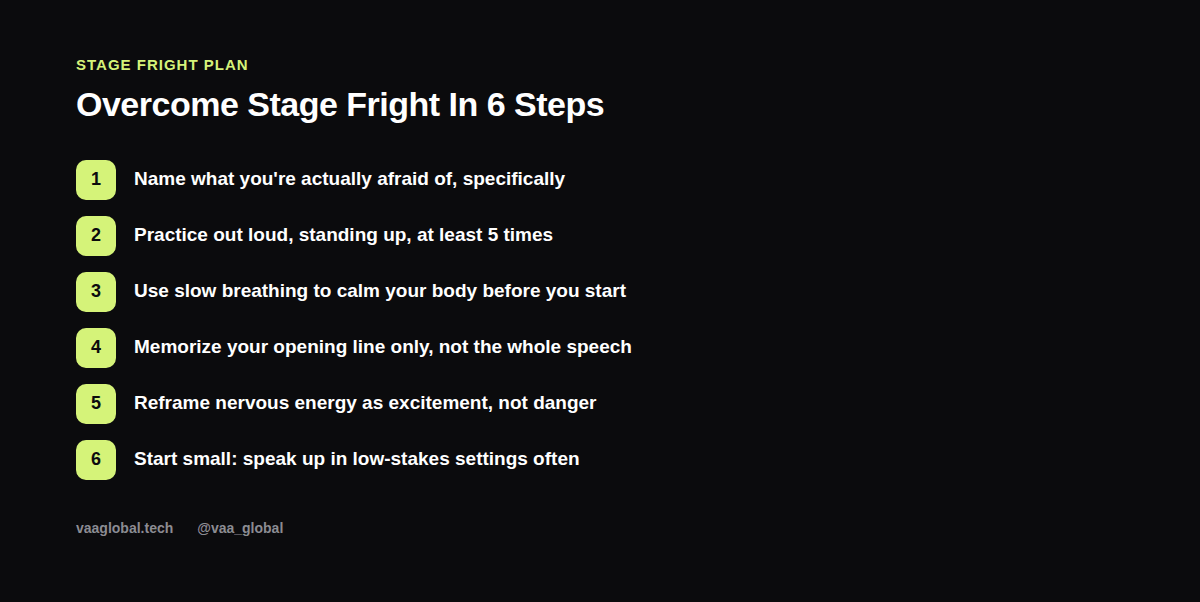
Vague anxiety is harder to manage than a specific fear. Ask yourself directly: are you afraid of forgetting your words, being judged, or a technical failure like your slides not working? Once you name the specific fear, you can prepare a concrete countermeasure, such as bringing printed notes as backup or testing your slides twice beforehand, instead of just hoping the feeling passes.
Step 2: Rehearse Out Loud, Standing Up
Reading your notes silently in your head is not the same skill as speaking them out loud while standing. Practice your presentation out loud, ideally in the same room or a similar setup, at least five times before the real thing. Because your mouth and breath need to physically practice the words, silent review alone leaves you underprepared, no matter how well you know the content.
Step 3: Use Breathing to Calm Your Body First
Public speaking anxiety triggers a physical adrenaline response, including a faster heartbeat and shallow breathing, before your mind even catches up. A simple technique is to breathe in for four counts, hold for four, and exhale for six, repeated several times right before you speak. This slows your heart rate measurably and signals to your nervous system that there is no real danger present.
Step 4: Memorize Only Your Opening Line
Trying to memorize an entire speech word for word often backfires, because one missed word can derail your confidence entirely. Instead, memorize just your first line cold, so you can start smoothly even if your nerves spike, and work from clear bullet points for the rest. Once you are a few sentences in, nerves typically settle and your natural voice takes over.
Step 5: Reframe Nervous Energy as Excitement
Research on anxiety reappraisal shows that telling yourself you are excited instead of nervous can genuinely shift how your body experiences the same physical sensations. Both emotions produce similar physical symptoms, so the label you attach to them changes how you interpret and perform under that feeling. This small mental reframe is one of the easiest techniques to use seconds before walking up to speak.
Step 6: Build Confidence With Low-Stakes Reps
Confidence in public speaking is built the same way any other skill is built: through repetition in situations with low consequences. Volunteer to speak up in small meetings, answer questions in group settings, or practice in front of a mirror or a trusted friend regularly. These small reps add up, and they pair well with broader guidance on structuring a presentation that keeps people engaged, since a well-structured talk is easier to stay calm through.
Why Do I Get So Nervous Before Public Speaking?
If you are still asking why do I get so nervous before public speaking specifically, it usually traces back to a fear of judgment or a past embarrassing experience, both of which your brain treats as a threat to avoid repeating. Understanding this root cause does not eliminate the nerves instantly, but it does make them feel less mysterious and more manageable with the techniques above.
How Do I Stop Shaking When I Present?
Shaking hands or a shaky voice usually comes from adrenaline with nowhere to go. Give that energy somewhere to release before you start, such as a brief walk, gentle stretching, or clenching and releasing your fists a few times backstage. Holding something steady, like a clipboard or a clicker, can also reduce visible hand tremors during the talk itself.
Do Not Forget Eye Contact and Posture
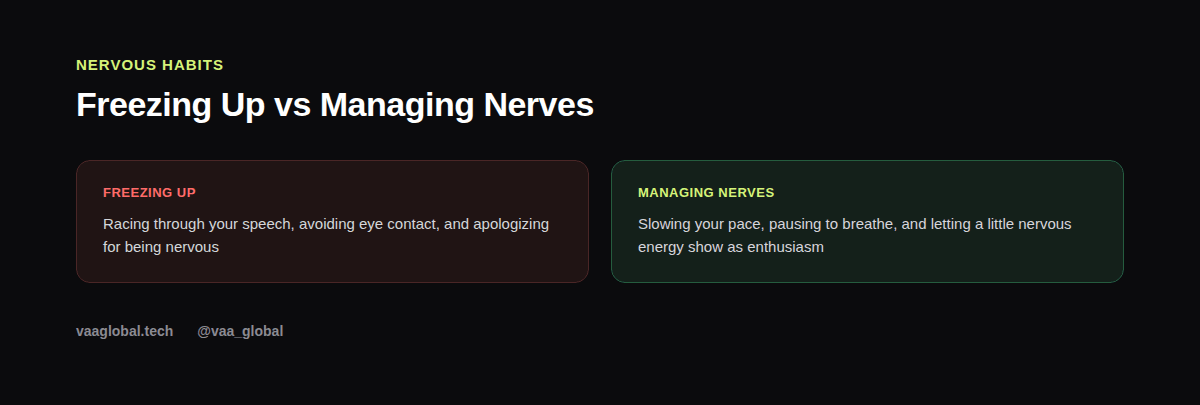
Nerves often show up first in your eyes and shoulders, not your voice. Making brief, genuine eye contact with a few friendly faces in the room, rather than scanning the crowd constantly, helps anchor you and can noticeably steady your breathing. Standing with open, relaxed posture rather than crossed arms or a hunched back also signals confidence to the audience, even on days when you do not fully feel it yet. The nonprofit Toastmasters International has built an entire community around practicing exactly these skills in a low-pressure, supportive setting, and it is worth exploring if you want regular, structured reps.
The Bottom Line
Learning how to overcome stage fright is less about becoming fearless and more about building specific, practiced responses: naming the fear, rehearsing out loud, breathing deliberately, and reframing the feeling itself. If you want structured, guided practice in a supportive setting, VAA Global's public speaking and media communication course covers speech structure, storytelling, and confidence-building over a 10-week, remote program, and pairs well with learning public speaking tips for virtual meetings if most of your talking happens on camera.