If you are new to project management, the Agile vs Scrum vs Waterfall debate can sound confusing because these terms get used loosely and interchangeably online. However, once you understand that Agile is a mindset, Scrum is one specific framework built on that mindset, and Waterfall is a completely different, linear approach, the confusion mostly disappears. This guide breaks down each one in plain language with real examples of when to use them.
What Is Agile, Really?
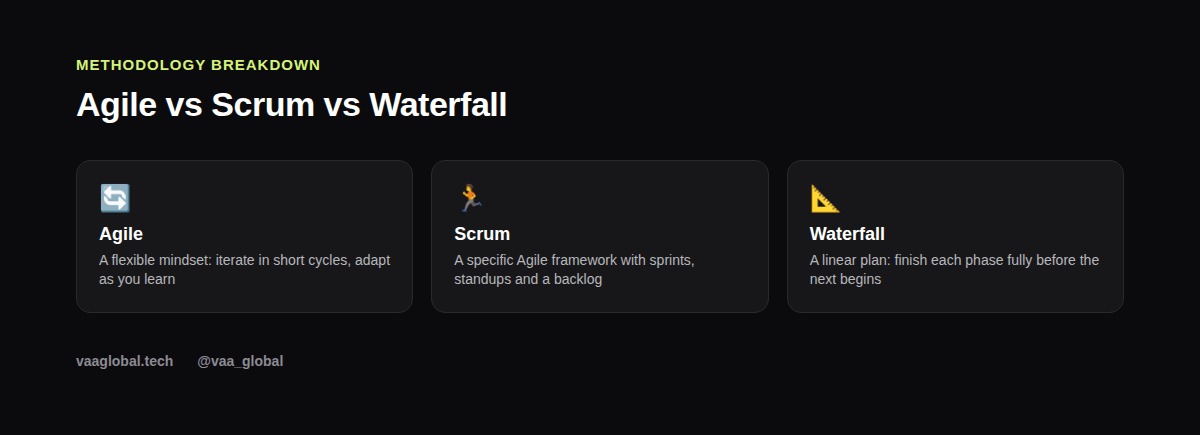
What is Agile at its core is a mindset, not a fixed set of steps: deliver work in small increments, gather feedback quickly, and adjust the plan as you learn more. Because requirements rarely stay perfectly fixed in real projects, Agile accepts change as normal instead of treating it as a failure of planning. Agile is best thought of as an umbrella; several specific frameworks, including Scrum and Kanban, sit underneath it.
What Is Scrum, Specifically?
What is Scrum is one popular way to put Agile ideas into practice. Scrum organizes work into fixed-length sprints, usually one to four weeks, with a backlog of prioritized tasks, short daily standup meetings, and a review and retrospective at the end of each sprint. Scrum assigns specific roles too, such as a Scrum Master who removes obstacles and a Product Owner who manages priorities. So, is Scrum a type of Agile? Yes; Scrum is one specific, structured implementation of the broader Agile philosophy.
What Is Waterfall Methodology?
Waterfall methodology moves in a strict, linear sequence: requirements, design, build, test, and deploy, with each phase completing fully before the next begins. This approach works well when requirements are well understood upfront and unlikely to change, such as in construction, manufacturing, or certain compliance-driven projects. The tradeoff is flexibility; discovering a problem late in a Waterfall project is far more expensive to fix than it would be in an Agile cycle.
Agile vs Scrum: The Key Difference
The simplest way to remember the Agile vs Scrum distinction is that Agile is the philosophy and Scrum is one method for applying it. You can be Agile without doing Scrum specifically, for example by using Kanban boards and continuous flow instead of fixed sprints. Many job postings use the words Agile and Scrum almost interchangeably, so during interviews it helps to clarify which specific framework a team actually follows day to day.
Agile vs Waterfall: The Key Difference
Agile vs Waterfall really comes down to how much uncertainty the project can tolerate. Agile embraces change throughout the project and delivers working pieces incrementally, while Waterfall commits to a fixed plan upfront and delivers the finished product at the very end. Neither approach is universally better; the right choice depends entirely on how stable the requirements are and how costly late changes would be.
Which Project Management Methodology Should You Learn First?
If you are asking which project management methodology should I learn first, start with the fundamentals of Waterfall, since its linear structure is easier to grasp conceptually, then move into Agile and Scrum, which are more widely used in modern software and marketing teams. Most project manager interview questions expect you to understand both well enough to explain when each one fits, and both PMP and CAPM exam prep also expect you to know these frameworks cold, as covered in our PMP vs CAPM comparison.
When Should You Use Waterfall Instead of Agile?
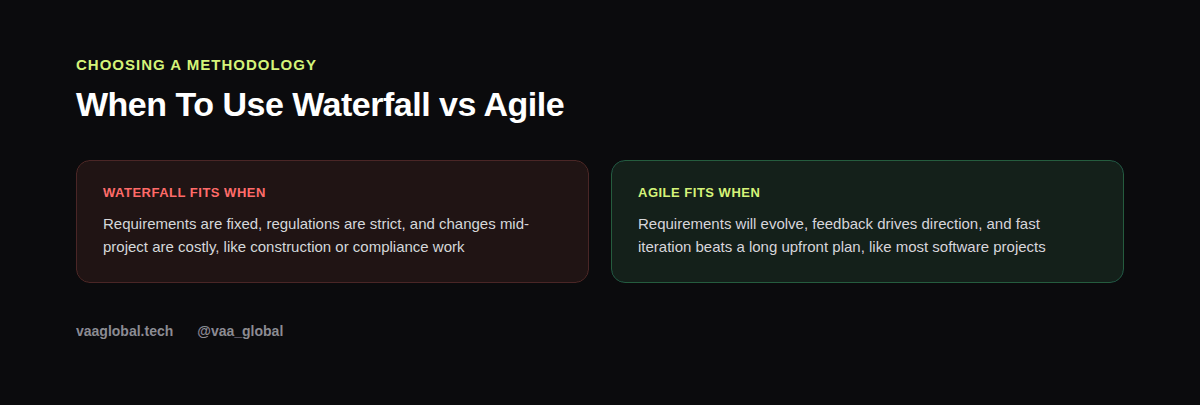
Use Waterfall when requirements are genuinely fixed, when regulatory or safety documentation requires a strict linear process, or when the client needs a complete, fixed-price proposal before work starts. Use Agile or Scrum when requirements are likely to evolve, when customer feedback should shape the product as it is built, or when speed to a usable version matters more than a complete upfront plan. The Project Management Institute offers further detail on both approaches if you want to go deeper.
Can You Mix Methodologies?
In practice, many teams blend elements of both, sometimes called a hybrid approach. For instance, a team might plan major milestones in a Waterfall-style sequence while running the actual development work in Agile sprints underneath. This is common in Nigerian organizations managing both client expectations and fast-moving delivery teams, and it is worth mentioning in interviews if you have real experience with it.
Why This Matters for Your Project Management Career
Understanding Agile vs Scrum vs Waterfall is not just interview trivia; it shapes how you actually plan, track, and communicate about real projects. If you are building toward a project management career with no prior experience, our guide on building a project management portfolio with no experience is a natural next step, and VAA Global's project and programme management training covers all three methodologies in depth over a 10-week, fully remote program.
The Bottom Line
Agile vs Scrum vs Waterfall is not really a competition between three rival systems; it is a toolkit, and the right choice depends on your project's requirements, risk tolerance, and how much change you expect along the way. Learn the fundamentals of all three, and you will be able to adapt to whichever methodology your next employer or client actually uses.