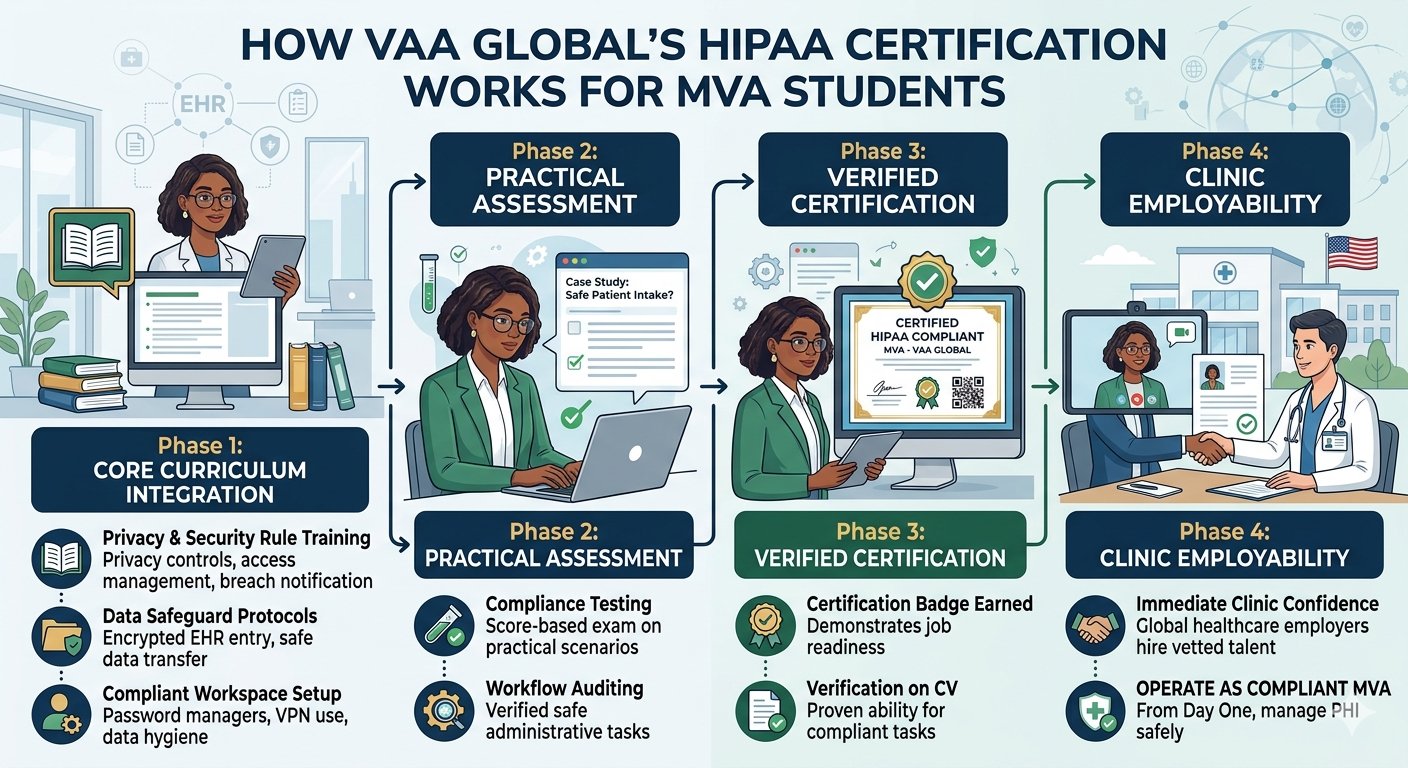
VAA Global's HIPAA Certification is a specific, high-value add-on available to Medical Virtual Assistance (MVA) students: a 300-question exam sitting inside the student portal, gated so that only students who already hold their MVA course certificate can access it. It requires a high pass mark and has a set time limit, and passing it triggers an automatic, separate HIPAA Certification certificate that shows up on your student dashboard. This isn't a generic add-on quiz. It's built specifically for students aiming at US-facing healthcare remote roles, where HIPAA knowledge is a real, practical requirement for the job.
Why HIPAA Knowledge Matters for MVA Graduates
The Health Insurance Portability and Accountability Act (HIPAA) governs how patient health information is handled in the United States. If you're pursuing remote work with US healthcare providers, clinics, or medical billing companies as a Medical Virtual Assistant, understanding HIPAA isn't optional background knowledge, it's often a hard requirement for the role itself.
Many US employers hiring remote medical virtual assistants specifically look for candidates who can demonstrate HIPAA awareness before they're trusted with patient data. This is exactly the gap VAA Global's HIPAA Certification is built to close.
You can learn more about how HIPAA itself is structured directly from the U.S. Department of Health and Human Services, which publishes the official rules and guidance that the certification content is grounded in, available at hhs.gov/hipaa.
How the Gating System Works
The exam isn't open to everyone. It's specifically restricted to students who have already earned their Medical Virtual Assistance course completion certificate. This means you complete your MVA training first, through the course catalogue, and only then does the HIPAA exam become accessible in your student portal.
This gating exists for good reason: the exam assumes you already have the foundational MVA knowledge in place, and it builds specifically HIPAA-focused content on top of that base rather than teaching medical virtual assistance from scratch.
What the Exam Itself Involves
The HIPAA Certification exam consists of 300 questions, a substantial exam by most standards, reflecting the depth of the material it's testing. It requires a high pass mark, meaning you need solid, thorough understanding of HIPAA principles to clear it, not a surface-level familiarity.
The exam also runs under a time limit, so you're working against the clock as well as the material itself. This combination, volume, a high bar to pass, and a time constraint, is what makes the resulting certification genuinely mean something rather than being a rubber-stamp add-on.
What Happens When You Pass
Passing triggers an automatic outcome: a separate HIPAA Certification certificate is issued and appears on your student dashboard immediately. You don't need to request it manually or wait for someone to process it. It's a distinct credential, separate from your MVA course completion certificate and separate from your internship certificate.
That means an MVA graduate who completes the full path can end up holding three separate, specific credentials: the course completion certificate, the internship certificate, and the HIPAA Certification certificate, each proving something different to a potential employer.
Why This Matters for US-Facing Job Applications
When you're applying for remote medical virtual assistant roles with US-based healthcare employers through VAA Global Talent or independently, being able to point to a specific, named HIPAA Certification certificate is a concrete differentiator. It answers a question employers are often specifically screening for, directly and verifiably, rather than leaving them to assume you picked up HIPAA basics somewhere along the way.
This is worth highlighting explicitly on your CV and LinkedIn profile. Use the CV review tool to make sure the HIPAA Certification is presented clearly, not buried as a minor detail under your general MVA training.
It's also a credential that can set you apart even among other MVA graduates, since it demonstrates initiative: you didn't stop at the minimum required to finish the course, you went further to prepare specifically for the compliance side of US healthcare work.
Preparing to Sit the Exam
Because the exam is substantial, 300 questions with a high pass mark and a time limit, treat it with the same seriousness you'd give a professional certification exam outside of VAA Global. Review your MVA course material on HIPAA-related content thoroughly before attempting it, and make sure you have a distraction-free block of time set aside that matches the exam's time limit.
Given that it's gated behind your MVA certificate, you'll already have the foundational context by the time you're eligible. Treat the exam as the natural next step in your MVA path rather than a separate, disconnected challenge.
If you're pursuing Medical Virtual Assistance with US healthcare employers in mind, apply to VAA Global's MVA course and work toward the HIPAA Certification once your course certificate is in hand.