
Yes, learning French can open up real remote job opportunities, and for Nigerians specifically it is one of the more underused skills in the remote work market. Nigeria sits right next to a cluster of French-speaking countries, Benin, Niger, Chad, and Cameroon, and companies that want to serve those markets, or Francophone Europe and Canada, need English-French bilingual staff for customer support, virtual assistance, and content work. Most Nigerians only think of Spanish or German when they think of language skills for remote jobs, which means French speakers face noticeably less competition.
Why French Specifically Matters for a Nigerian Remote Worker
West Africa is one of the most linguistically split regions in the world, with English-speaking countries sitting right next to French-speaking ones. That split creates a real business problem: companies operating across the region need staff who can serve both English and French-speaking customers without hiring two separate teams. A Nigerian who speaks both languages is a natural fit for that gap in a way that most competitors in other countries simply are not.
This is not a theoretical advantage. Pan-African fintechs, e-commerce platforms, telecoms, and logistics companies increasingly serve customers in Cote d'Ivoire, Senegal, and the DRC alongside Nigeria, and they need support agents and virtual assistants who can move between English and French conversations in the same shift.
The Remote Roles Where French Actually Pays Off
Bilingual customer support is the clearest and most immediate opportunity. Companies with Francophone customer bases hire remote agents to handle calls, emails, and live chat, and a French speaker who can also work comfortably in English is more valuable than a monolingual candidate in either language.
Virtual assistance is the second major lane. French-speaking entrepreneurs and small business owners in France, Quebec, Belgium, and Francophone Africa hire remote VAs for scheduling, email management, and admin support, and finding a VA who can also handle English-language tasks is a real selling point for them.
Content localization and transcription work is a third, less obvious opportunity. Businesses that produce English content but want to reach French-speaking audiences need people who can adapt, translate, or subtitle that content accurately, and this kind of freelance work pays per project rather than requiring a full-time contract.
What Employers Are Actually Looking For
Most remote employers hiring for bilingual roles are not looking for academic French. They want someone who can hold a natural conversation, write a clear email, and handle customer-facing situations without constant hesitation. That is a very different skill from grammar-heavy classroom French, and it is why a course built around practical, work-relevant scenarios tends to get people job-ready faster than general language classes.
Employers also look at how you present the skill. Listing 'French: intermediate' on a CV without any evidence behind it is weak. Listing it alongside a certificate, a portfolio sample, or a demonstrated project carries far more weight.
How VAA Global's French Language Course Is Structured Around Work
VAA Global's French Language course is built for people who want to use the language for remote work, not for a classroom exam. The focus is on practical conversation, workplace vocabulary, and the kind of communication that shows up in customer support tickets, VA tasks, and client calls, so that what you learn maps directly onto what employers actually ask for.
You can see the full course listing, along with VAA Global's other language and remote-skills courses, on the course catalogue.
Pairing French With a Core Remote Skill
French on its own is a language skill. Paired with virtual assistance, customer service, or another core remote skill, it becomes a hiring advantage. A bilingual VA or a bilingual customer support agent is a much narrower, more valuable search result for a recruiter than a monolingual one, and narrower searches usually mean less competition for the same roles.
If you are not sure whether to start with a language course or a core skills course first, the Career Compass is a free quiz built to help you figure out which combination actually fits your goals and background before you commit to anything.
What Happens After the Course
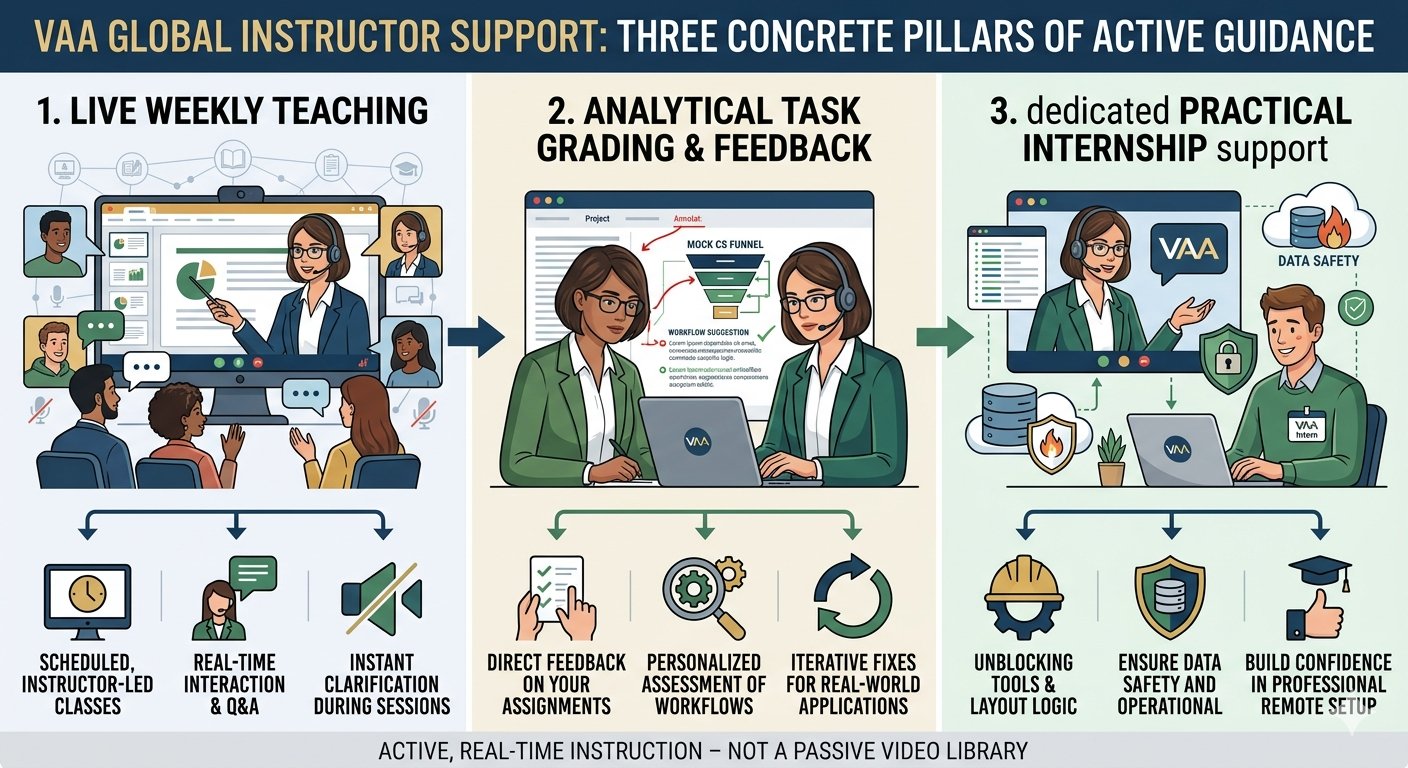
Completing a French Language course at VAA Global comes with the same support structure as the rest of VAA Global's programmes: a certificate, job assistance and interview coaching, access to remote job opportunities, job matching through VAA Global Talent, a 2-month internship, mentorship from industry experts, portfolio building, and LinkedIn and personal branding support. That means the language skill is not left to sit on a CV unused. It gets built into a job search strategy from day one.
Being Realistic About the Timeline
French will not turn into a job offer overnight, and no course can promise that. What it does is widen the pool of roles you qualify for and reduce the number of people competing for the same postings. Combined with an active job search and a strong CV, that widened pool is what actually moves the needle.
If you are weighing whether a French Language course is worth your time, the honest answer is that it depends on pairing the language with a real remote skill and an active job search, which is exactly what VAA Global's structure is built to do. You can start by exploring the course catalogue or go straight to the application form to begin.