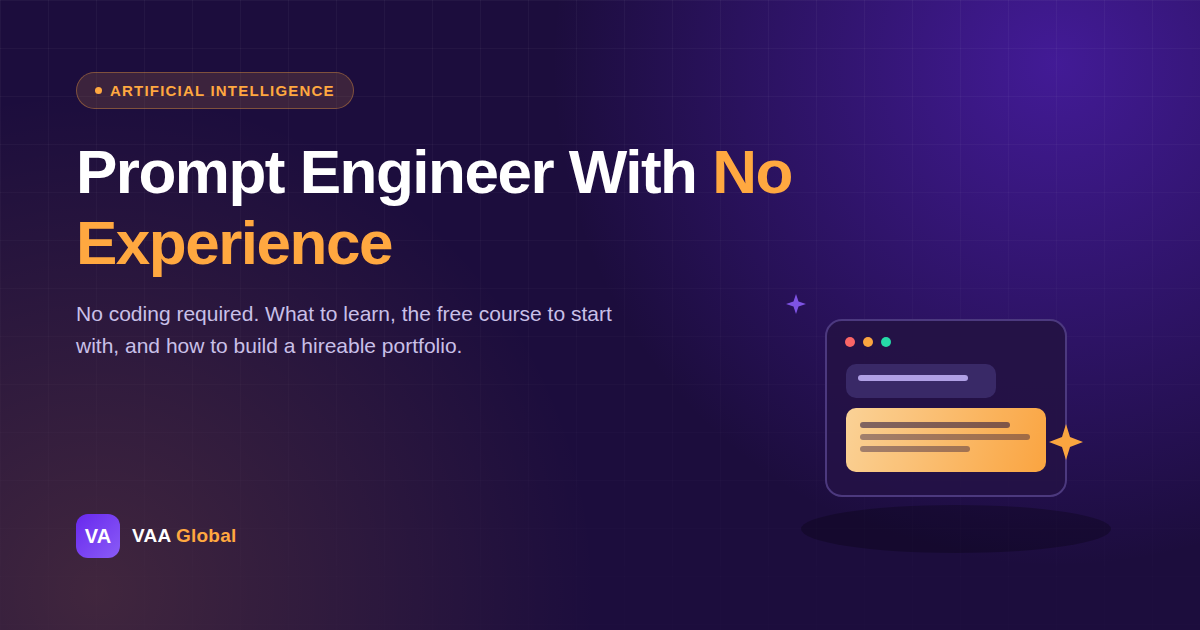
Yes, you can become a prompt engineer with no experience. You do not need a computer science degree. You do not even need to write code. Instead, what you need is structured thinking, curiosity, and a willingness to test and refine your prompts until they work. This guide covers how to become a prompt engineer with no experience, step by step, including which free course to start with.
What Does a Prompt Engineer Actually Do?
A prompt engineer writes clear, structured instructions that get useful, consistent output from an AI model. Generic prompts produce generic results. So the job is to close that gap: define the task clearly, shape the output format, and give the model everything it needs without overwhelming it. For example, a vague prompt like "write about marketing" produces a generic essay, while a structured prompt with context, audience, and format produces something a business could actually use.
Why This Role Does Not Require Coding
Most prompt engineering roles focus on language and logic, not programming. You are essentially writing very precise instructions in plain English. Because of this, people from writing, teaching, and customer support backgrounds often adapt faster than expected. That said, basic comfort with common AI tools will still help, even without any coding background.
Step 1: Learn How Large Language Models Actually Work
Start with the fundamentals. Understand what a large language model can and cannot do, why it sometimes gives wrong answers, and how context affects its output. You do not need deep technical knowledge here. You just need enough to reason about why a prompt succeeds or fails.
Step 2: Take a Short, Free Course First
You do not need months of study before you start. Several free prompt engineering courses exist online. One of the best places to start is DeepLearning.AI's free prompt engineering course, which gives you the vocabulary and techniques in a matter of hours. Use it as a foundation, then build real practice on top of it. Later, once you want a more formal credential, you can look into paid AI certifications too. None of this requires a technical background to begin, and it works well even for complete beginners in Nigeria who are switching careers.
Step 3: Practice on Real, Messy Tasks
Pick a real task, for example summarizing customer emails or drafting product descriptions. Then write and rewrite the prompt until the output is consistently useful. This kind of hands-on prompt engineering practice matters more than any certificate. A portfolio of working prompts proves skill far better than a resume line ever could.
Step 4: Build a Small Portfolio You Can Show
However, you do not need dozens of examples. Document three or four prompt projects. For each one, show the task, the prompt you wrote, and the before-and-after output. This gives a hiring manager something concrete to judge. It also shows you understand structure, not just trial and error.
Step 5: Find Entry-Level AI Jobs Without Coding
Several entry level AI jobs for beginners do not require coding at all. Data annotation, chatbot training, and AI content editing are common starting points. Many of these remote AI jobs hire globally, which makes them realistic even from Nigeria. Prompt engineering work often overlaps directly with these jobs, since all of them depend on giving AI systems clear, well-structured instructions.
How to Learn Prompt Engineering Skills in a Structured Way
Self-study works, but it takes longer because you have to figure out the right order on your own. Structured training removes that guesswork. If you want a guided path, explore VAA Global's Artificial Intelligence training program, built for beginners with no technical background. You can also take VAA Global's free Career Compass quiz to confirm this path fits you, or browse the full list of 33 VAA Global courses if you are still deciding. For more on how the training works day to day, read about VAA Global's story and approach.
The Bottom Line
Becoming a prompt engineer with no experience is realistic in 2026. First, learn how language models work. Then, take one short, free course. After that, practice on real tasks until your prompts consistently work. Finally, that combination, plus a small portfolio, is enough to start applying for entry-level AI roles today.